Showing posts with label Nuclear. Show all posts

Wednesday, May 22, 2013

Getting To Mars Depicted (Part 2)

In Part 1, we went through how much a trip to Mars costs in terms of fuel and hardware.  It takes 8 large rocket launches just for one manned mission.  That is about 75% the launches of the Apollo program to the moon.  Back then, the US Congress was willing to spend the money, but today they are holding back wanting to cut NASA's budget.  That's nothing new.  Congress has been cutting NASA's budget for at least the past 20 years.  A manned mission to Mars is quite a huge undertaking.  I know I did not talk about the radiation concerns or other crew health issues.  NASA likes to mention those.  They don't like to mention how much it would cost, and I think that is an issue that Congress and the public need to address.  The more the public knows about this issue the better.  How could we possibly reduce the cost?  Well, I've got 2 ideas.  Both of them are along the lines of mass transportation and reusable assets.  Reusable transportation assets and multiple manifests could provide more effective financing than one mission going alone by any one government space program.

Many Launchers for 1 Mission
Reusable Assets

When talking about reusable assets, a tug to take payloads from Earth orbit to Mars orbit and a reusable Mars lander/launcher come to mind.    For Mars, these assets have to be very sophisticated to include transferring of fuel and other consumables.  They would have to be able to be controlled remotely with some automation and manually by any crew.

I've talked about a reusable tug before.  For Mars, having a large tug that can travel many times between the planets could provide the means to take multiple missions on each trip.  Distributing the cost of the trip among several customers could make the trip financially possible.  I like to imagine such a tug as being based on the concept of the Saturn S-IVB.  It would have to be much larger.  I could have duo-propulsion: traditional chemical booster; electric propulsion such as ion drive or plasma drive.  Space.com has a great article on electric propulsion called How Electric Spacecraft Could Fly NASA To Mars.  A robitic arm such as the Canadarm 2 could provide a means of capturing and docking many different types of space modules.  Also it should be able to carry many modules to include unmanned and manned modules simultaneously.  Our module technology has become quite sophisticated so I don't think that would be a problem.  One of the biggest issues of such a craft would be electric power.  Solar panels are nice, but large ones would be needed to power the electric propulsion.  They also should be able to retract and deploy on command and often.  I expect that aerobraking maneuver would help reduce the amount of fuel needed for each mission.  Solar panels would need to retract for that maneuver lest they are damaged.  These panels would have to last a long time.  Another option, though less popular, would be giving the craft its own nuclear power reactor.  Of course, responsible handling of the nuclear material is a must; including a disposal plan for the depleted nuclear material.

A reusable lander/launcher is necessary. The idea of landing on an atmospheric planet is enticing and yet hard.  If you going to reuse the lander, it has to launch from the planet as well.  We've never created a craft like that before.  It would need a heat shield that can pop off and be replaced easily (by robotic means), a reliable engine, and large tanks for fuel.  After every launch back into orbit, it would need to be serviced and refueled for the next landing.  This craft is important because for one manned mission, NASA would use 3 landers and 1 launcher.  That's 4 vehicles.  Consolidating hardware complexity and weight into one vehicle should save on cost.  Using this vehicle for many missions should be a savings multiplier.

What do we really want to do on Mars?  Do we want to just plant a flag and walk around a go home?  No, many folks want to do many things.  From geology to colonization to terraforming, Mars has inspired many possible missions.  If we go with throw away assets, we won't be able to afford getting there but once in a generation if at all.  Mars should also only be the first step to exploring and exploiting the inner solar system.  Therefore, reusable assets are a must.  We must build an infrastructure.

Multiple Manifests

Mars Plane
 To spread the cost of trips to Mars and back, it would seem a no brainer to get as many different missions and customers to sign on.  It's like filling up the cargo hold and passenger cabins of a larch ocean fairing ship to make trips between continents across a large ocean.

Imagine multiple unmanned mission accompanied by one manned mission packed on the reusable tug that is about to depart Earth orbit.  These mission could be from all types: orbital, landers, rovers and sample returns.  The landers, rovers, and sample return missions can get loaded up on the reusable lander/launcher to get down to the surface along with the assests of the manned mission.  It seems they would all land in one spot.  Well, that could create the opportunity to have some planetary transportation services such as fast rovers and aircraft.  You can quickly imagine a multitude of missions and activity around and on Mars.

Spreading the cost for each trip and back from Mars among many customers seems reasonable.  Using reusable assets such as a reusable transportation tug and a reusable lander/launcher goes hand in hand with multiple manifests.  Such an effort could easily be a commercial venture.  Such an infrastructure could have the effect of researching the red planet in a much faster fashion than what we do now.  If regular trips to Mars every 3 years is sustainable then we would have established a permanent link worthy of colonization.

Sunday, January 20, 2013

Space Exploration Plans From Boeing

I read in a NASA Spaceflight.com article that Boeing came out with a moon exploration plan.  The plan entails a small space station put at Earth Moon Lagrange Point 2 (EML2).  That's a region of space past the dark side of the moon.  From there you can have a variety of missions ranging from moon missions to asteroid missions to mars missions.  We're told to think of it as a staging area.  It's supposed to be easy to get to and not that much fuel is needed.  They call it Earth Moon Lagrange point Platform (EMLP).  Then Boeing came out with a Mars exploration plan as stated in this NASA Spaceflight.com article.  They use the EML2 as a staging are to launch to Mars with a combination of chemical and ion propulsion system craft.  Are these a good ideas?  I tend to think that it is, but I'm also a little skeptic.

Sure it seems you can do it all with these plans, but at what cost?  SLS doesn't promise to be economical.  It will take several launches of SLS to make the Moon plan work.  It will also take several (at least 2) launches of the same rocket to make the Mars plan work even after the EMLP has been established.  The only reusable part of the SLS are its solid rocket boosters.  At least in the moon plan a reusable moon lander is called for, and the EMLP is designed to be a multi-mission asset.  These plans call for many in-space and landing assets to be built.  This is not cheap.  I am also skeptic about this Mars lander that is supposed to land and launch astronauts on to and from the Martian surface.  How big does that thing need to be?  How much fuel does it need?  Mars is about one third of the gravity of Earth.  Sp they seem to need one third of the energy of a Earth based rocket to get to orbit.  Like a third of a Falcon 9.  I'm just guessing here, the details I'm sure are different due in part Mars' gravitational field's profile (gravity is not linear with altitude).  Yet, it gives you an idea of the problem.  Think of all that hardware and fuel launching from Earth, in parts, and sending off to Mars.  Its huge!  The Mars plan seems to imply that the large transfer vehicle is for only one use, and one mission.  So if we want to make another go at it, we need to spend a lot of money to do so.

Apollo used all throw away assets to do its 7 moon landings.  It was canceled due to cost.  I hold the philosophy that space assets should and ought to be reusable, that is used for more than one mission.  The trans-lunar injection was performed by Saturn V's third stage.    That function can be made by a reusable space tug.  A reusable space tug would be equipped with propulsion (chemical, ion, and/or plasma), communication, and power (solar or nuclear).  They would dock with a manned capsule or cargo capsule/canister and take them to their destination.  I don't see why NASA does not pursue this route rather than majoring on throw away assets.  A reusable space tug can take crew, cargo, and/or modules from Earth orbit to Lunar or Martian orbits and return to Earth orbit.  Then they could be refueled and loaded up with a payload and do the next mission.  The only thing that has not been mastered in this sequence is an unmanned tug returning to Earth orbit.  Yet, space programs do have experience getting into Mar's orbit and using aerobraking to do it.  Similar techniques could be used with the tug.  Of course, when its taking a capsule back to Earth, the capsule would disengage the tug before the tug maneuvers to Earth orbit because it could take weeks for the tug to get to low orbit.  NASA could make its own, or a company can make its own and sell the services to NASA.  I wonder if some company out there is doing just that?  I don't know.  I did think up this reusable tug idea back in 2004 when SpaceShipOne was making its historical flights.  I posted this idea on Space.com forums at the time.  It seems that NASA thought of the Space Tug concept too in 1969.  These tugs could be of variable sizes for a variety of missions for many customers.  They could go to Moon, Mars, Venus, Mercury, the Asteroid Belt, and even the gas giants.  They could form an effective fleet for space exploration and commercial exploitation such as mining.  I imagine that reusable in-space assets, such as the space tug, could bring down the cost of traveling to the Moon and Mars significantly since the commercial launch companies can also leverage their launch capabilities.

Yes, the Boeing plans are cool.  I believe they will be too costly for Congress to flip the bill.  Making good use of the new commercial space approach with reusable assets could make the missions cheaper and help keep them going for a long time.


Saturday, November 10, 2012

Replacing The Rocket Engine?

Have you read Dr. Zubrin's article on VASIMR?  WOW!  Dr. Zubrin knows his stuff.  Many scientists and engineers know their stuff.  There is just a lot of controversy and opinions about how to get to Mars.  Thank goodness that they are not trying to decide on a recipe for pumkin pie.  They'd have to put on my tomb stone, 'Died waiting for pumking pie.'  Yeah, Dr. Zubrin has some misgivings about VASIMR, but what is VASIMR and what are the other propulsion systems he's talking about?

Deep Space 1 - first spacecraft to use Ion Drive
VASIMR (Variable Specific Impulse Magnetoplasma Rocket) is taunted as a plasma propulsion system.  It uses radio waves to turn matter into plasma then uses magnetic fields to accelerate the plasma out of the exhaust.  If the energy is doing two things, you can see that the efficiency of the system is probably not good, just as Dr. Zubrin said.  Sometimes projects need longer time than others to come to a good solution.  If you look at the history of the internal combustion engine, you will see that it has a long list of epochs and people working on one thing or another that eventually became the internal combustion engine we so adore by revving our engines while standing still at a red light looking at one another as if we were a formula 1 race car driver while living things choke on the fumes.  Despite Dr. Zubrin's desire to excuse VASIMR and politician's desire to promote it, it still may be key to a future and better propulsion system than we have today.  Yes, we should've told old Robert Goddard to stop playing with those toy liquid fuel rockets, nothing would come of them.  No, nothing; just taking men to the moon.  That's all.

Ion drive is a propusion system that emits ions.  It uses an inert gas and voltage differentials to accelerate the gas.  The result is that it takes a long time to get to the destination, but its cheaper than large conventional chemical rockets to get up to speed.  Deep Space 1 got to fly around the southern pole of the Sun and Smart-1 got to go from Earth orbit to Lunar orbit on ion thrusters.  Dawn got to Vesta and then to Ceres.  It could only accomplish visiting two space bodies with an on board main thruster such as the ion drive to escape the orbit of one and insert into the orbit of another.  It's like scampering around the asteroid belt.  I hope it finds its cheese.

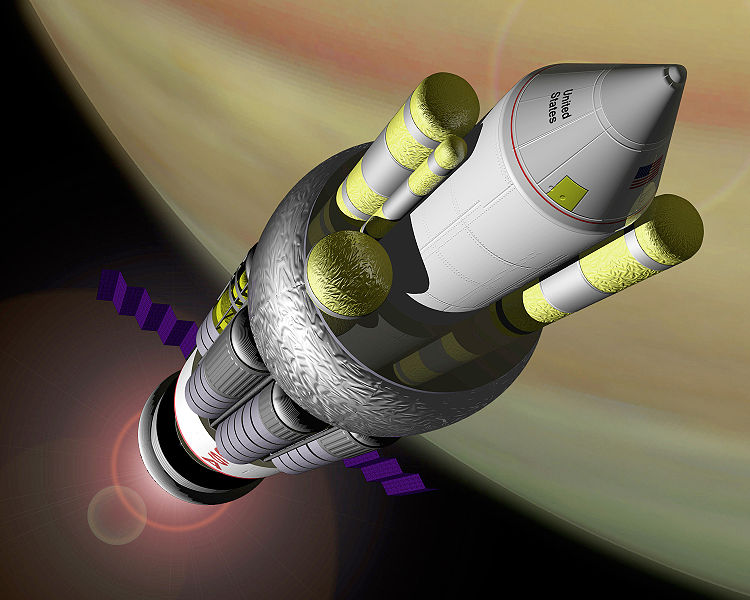
Thermal nuclear propulsion system is one that emits matter heated by a thermal nuclear reactor.  We're talking a rocket here.  Well, the idea is that energy in the form of heat from a nuclear reactor can heat up a gas and produce really fast speeds for a spacecraft.  That could be a potentially good propulsion system.  OK, let's see.  In the wiki it mentions thermal nuclear reactor and hydrogen in the first sentence.  It also mentions that a core was made in 1955.  I don't know what they were smoking in 1955, but it must have been good stuff.  What do you tell the first guy that's going to fly this thing?

"Here you go buddy, just plant your seat right there and strap in.  Concerns?  Nah, we don't expect anything to go wrong.  It will be a fun ride.  Here, just sign on the dotted line right here.  Small print?  Don't let it concern you, it's just some legal mumbo jumbo and all.  Have a safe trip."

Who in their right mind would fly this?  I don't think the human psyche can dismiss images of a big explosion when talking about nuclear reactor and hydrogen together.  Dr. Zubrin wants NASA to research this.  I hope a working model would be indeed safe.

Let's talk about the big one, nuclear pulse propulsion studied under the name of Project Orion.  Essentially, its thermal nuclear explosions detonated just behind a very thick pusher plate.  Do this several times and the craft accelerates in pulse intervals.  It's funny that the scientists were talking about making a farm on a spacecraft that uses this propulsion.  The energy this thing can harness is enormous.  It's the largest energy per weight that we know of.  The scientists involved do agree that there were some issues with the system to be worked out.  The basic idea works, and was tested on small scale with conventional explosives.  Now, it's pulse propulsion.  That means one minute your all fine and dandy and the next your splattered against the back bulkhead until the acceleration stops.  Then it starts all over again.  How uncomfortable does this seem?  Can you imagine a cow handling this?  You'll probably end up with sour milk.  In spite of the challenges of this system, the scientists were optimistic about making a viable system.

Light Pulse propulsion is a modern idea that has some relation with nuclear pulse propulsion.  The idea is that while in atmosphere, a laser can give a reflector with a particular shape power to heat up air and make it expand thus propelling the craft.  The laser is shot form the ground.  This is to propel a craft from the ground to orbit as a first stage.  It's a compelling idea, because you have your power source on the ground and not as dead weight on the craft.  If you use a dedicated nuclear power facility with a very large laser, then you can lift a lot of stuff and many craft to orbit reducing the cost of launch over time.  I like this idea.  I wonder if it can roast some marshmallows in flight.  The in-flight meal should have s'mores in it.


Well, that's what Dr. Zubrin was talking about, and more.  We get weird ideas about how to travel from point A to point B.  Most don't work.  We keep trying until we get it right.  You can get your idea a try if you study Math and Science.  Your going to have to learn to write and argue as well, because your going to get criticized. Are you up for the challenge?

[NOTE FROM THE AUTHOR: The humor in this post is and experiment. In no way was the intention to criticize.  I'm sorry if it comes off that way.  I'm keeping the post as is as a reminder of how poorly chosen humor can hurt.]