Growing up making model aircraft and learning about all kinds of craft, I bought a book on helicopters. It documented all the helicopters up to that time, 1980's. The designs were interesting and varied. I did notice a brand of helicopter that seemed pretty fancy and yet I hadn't heard of. It was the Augusta helicopters. They seem to rival high end VIP helicopters of Bell. Recently I was saddened to hear that AugustaWestland had some serious allegations against them in their deal with selling some helicopters to India. Westland was a British aircraft firm. Augusta and Westland were merged in 2000. Both companies have a good history in making high quality helicopters. Let's check out a couple of these beauties.
Westland Lynx
The Lynx was originally developed by Westland for the British military. Westland shared its production with the french company Aerospatiale, now a part of Eurocopter. This helicopter has had long history with British, French, and many other countries' military. Whether with wheels or skids it has had a lot of different configurations for multiple roles. It's popularity is not surprising, since it set the speed record for helicopters in 1986. I've seen footage where this very capable craft has even done the unimaginable for rotary wing, barrel roles. It's a great air platform. The updated version of the Lynx is called the AugustaWestland AW159 Wildcat. It made an appearance in the movie Skyfall. The Wildcat has a max speed of 296 kph (183.9 mph), and a range of 787.3 km (489.2 mi). It can take 2 crew and 6 passengers.
AW101
The AW101 was originally a joint effort by Westland and Augusta under the name of EH101. They call it Merlin. It's a medium lift craft that replaces the S-61's role with many modern features. Troop carrier, sub hunter, search and rescue, this craft can do it all and in all weather conditions. Looking at the specs, it can hold 2 crew members and 30 passengers. It has a range of 1058 km (657.4 mi). It has a cruising speed of 278 kph (172.7 mph).
AW 609
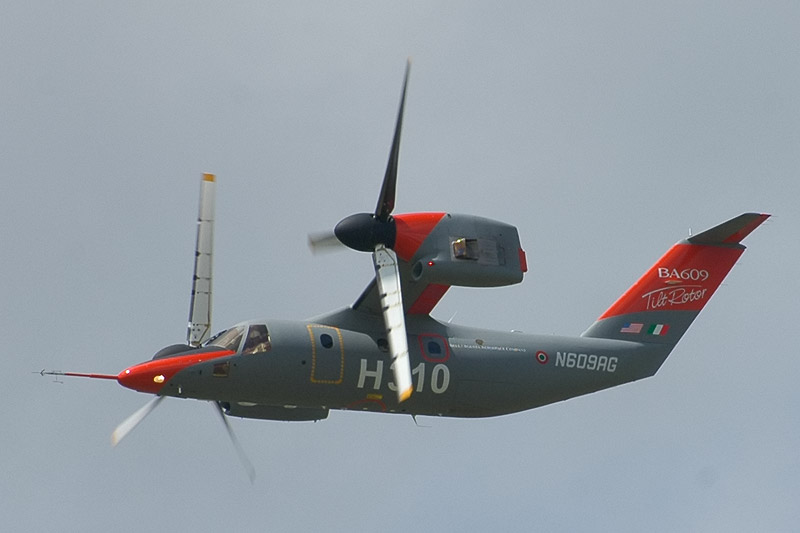
The AW609 was developed by Augusta and Bell and it's being produced by AugustaWestland. The tiltrotor technology was developed by Bell in a project called XV-15. Out of it came V-22 Osprey. You can say that the AW609 is the civilian version of the tiltrotor tech. It has a cruise speed of 465 kph (299 mph). It has a range of 1390 km (852 mi). It up to 9 passengers with a crew of 2. This exceeds the speed and range of the AW101 and the Wildcat. This is the purpose of the tiltrotor, to have a VTOL aircraft that can fly longer and faster than a helicopter. Sikorsky's X-2 and Carter Copter's Slowed Rotor techs are competing for similar markets as the tiltrotor tech.
If you haven't heard of AugustaWestland before, now you have. It happens to be a mainstay company in the rotary wing craft business just like Boeing, Sikorsky, and others. They have an impressive presence in Europe but do business world-wide. They are bold enough to try to market the tiltrotor in the commercial markets when no other company will. I'd keep an eye on these guys see what they will do next.
Ever had a dream where you flew without a craft? You felt free and liberated. You could go anywhere. Well, that's been the dream of humans since history began. What if you could capture that feeling? Well, today there are several who are trying with some technology you wear.
There's an ex-airline pilot by the name of Yves Rossy. He calls himself 'Jetman' and his technology comprises of a set of wings and mini-turbofan engines. With that he flies like a bird. When he puts on the wings and engines, his body become part of the whole flying craft. Leaning his body up down left right, is part of how he controls the flight. He is like a bird.
Yves Rossy on TED
Martin Jetpack
Remember the Jetpack? It's technically called the Rocket Belt. It's used in various public events such as the Los Angeles Olympics in 1984. It inspires the mind and causes us to think how wonderful such a flight could be. You just strap it on and you fly up and around buildings above the tree tops. WOW! Unfortunately it only lasts for less than a minute. It is indeed rocket technology. Now, there's a company out there taking the idea of the Rocket Belt and redesigning it for longer flights. It's called the Martin Jetack. It seems to work like the Rocket Belt, but its bigger and does not use rockets. Instead, it uses an engine that powers two ducted fans. The design is impressive. I particularly like the control fins way down low in the path of the ducked fans' thrust. It's absolutely amazing. You should really check out their website here and see their progress. Especially check out the videos. I really get inspired and a tingle up my spine when I see this thing fly. How could you not? Ok, yes, jetpacking is a dream that many have dreamed for a long, long time. Watch the Rocketeer and it has reference to the time period people dreamed of this. It has some really good actors in there, especially Jennifer Connelly. But I digressed. Yeah, this flying free is really cool. Now an off shoot of this is a water jetpack called the Jetlev-Flyer. It makes jetpacking a water sport. It's quite an ingenious and fun application of the jetpack tech. I takes the same configuration as the Rocket Belt. I've also seen a video of an adaptation of it that takes the configuration similar to that of Iron Man. It has main thruster on the feet and stabilizing thrusters on the arms. Really Cool!
ITN News
Now let's go high, really high. In fact, let's go out of this world high, literally. The EVA Suit (extra vehicular activity suit) is now commonly used outside of the ISS (international space station). The NASA EVA suits come with a jetpack just incase astronauts and cosmonauts get unattached to the ISS. This gives them the ability to cruise around in orbit. Astronauts have often described EVA suits as your own personal space craft. You have water, heating, cooling, oxygen, air pressure, and toilet capabilities. Hey, those guys are in those things for 8 hours at a time you got to put the stuff somewhere. These things are truly amazing. They allow you to experience space as much as possible without dying. But when did they first test these things? If you think it was during Apollo, your wrong. If you think it was during Gemini, your wrong. If you think it was during Mercury, your wrong. Nope, it was before all of them that these things were tested. One of the most extreme tests was done at the edges of space in Project Excelsior. No, it was not a transwarp drive test run, like trekkies would like to believe. Instead it was a test of the EVA suits by means of a balloon to the height of almost 103,000 feet. The individual had to jump off the balloon at that altitude and parachute down. GULP! That's a huge height. Scardicats need not apply. The man of the hour was Col. Joe Kittenger. WOW! Pilots often say, 'Why jump out of a perfectly good craft?' For years Kittenger remained the highest parachute jump by a man. Now, that record is being challenged, and Kittenger is helping with the project. The Project is called Red Bull Stratos.
Look Out Below
Red Bull Stratos is an ambitious project to not only break records but to test a new EVA suit. I think it might be a suit for commercial astronauts though I have not read anything to that effect, I just have a hunch. Just think, you get up in the morning, got to work, put on a suit and a helmet and gloves, climb into this godola that's attached to a balloon that takes you over 100,000 feet from tierra firma. You get up, unhook and JUMP! Oh man! I can feel it, but what kind of crazy person you have to be to do that? If your such a crazy person, more power to ya. Ok, so they found someone to do this jump and his name is Felix Baumgartner. This is an impressive guy in his own right without this feat. I think the big jump will take him to new heights. I can only imagine that more people would want to experience such a jump and perhaps a new space tourism market will be born. This is really mind boggling. You see Earth far below. You see the curvature of the planet, above you is the black sky of space, and there is barely any air around you at all. Your space suit is what is keeping you alive with oxygen. Good thing it had some facilities built in it, cause you going to use those when you see the view. Amazing. Absolutely, amazing.
Well, how to you like that? From fun to extremely dangerous, we've looked at some of today's or tomorrow's wearable aviation. What would you give to try one right now? I would do it in a heartbeat. The I'll be reminded that I'm scared of heights. The notion of putting on something that makes you superhuman like a super hero is amazing. To experience freedom of movement from a extremely personal view is awe inspiring. To make dreams into reality is what this tech is all about. You can do it, but you have to know science and math to do it as well as having big dreams. Cheers.
In 2005 the Bell Boeing Osprey went into service with the United States Marine Corps. It was the first operational tiltrotor aircraft. No, it was not the first attempt at taking VTOL beyond the helicopter, but it is enjoying more success than some other concepts. Now, some new concepts are in research that are made to give tiltrotor competition. The ideas behind all these concepts are longer range and faster speeds while still allowing for vertical takeoffs and landings. Let's look at a couple of older concepts and then look at the newer ones.
Tiltwing aircraft was tried in the late 1950's. It was an interesting concept and it wettened the US, Canada, and Unite Kingdom's militaries on the idea of a VTOL transport that had longer range than helicopters. The idea was that the main wing tilted from a horizontal position to a vertical position, thus also tilting the engines and propellers. You could say that it was the predecessor of the tiltrotor. I always liked this concept and thought that it had potential. Apparently so did a lot of other folk.
The slowed rotor concept was also an interesting concept. The idea was that a aircraft with a helicopter like rotors and wings and engines of a plane could take off vertically slow the rotor to reduce drag and increase range and speed for cruising and then land vertically. Actually the concept employed techniques of the autogyro for going from lift from the rotor to lift from the main wing. Before and after the second world war, aircraft companies ventured in this concept. The Fairey Rotodyne enjoyed some success, such as creating a world record in speed for the convertiplane (converting form helicoptery type to airplane type) category. It even had buyers before it was cancelled. McDonnell XV-1 was also an attempt at this concept.
Since the 80's Boeing has been trying its stopped rotor aircraft concept. They now call it the Canard Rotor/Wing. Like the slow rotor concept, the craft has wings, forward propulsion, and a main rotor. In this case they stop the main rotor and use it as a wing for cruise flight. The rotor is also used for vertical take offs and landings. I remember that they had trials in the 80's using a unique aircraft. The idea is tantalizing You can imagine a military fighter aircraft taking off vertically and landing vertically but flying with great precision and acrobatics. This concept promises to be less fuel intensive than the Harrier jump jet. Right now Boeing is marketing it as an unmanned aerial vehicle, but it was fully intended to have a pilot form the beginning.
Now, let's look at some conventional concepts.
Jay Carter has a small company called Carter Aviation Technologies. It's a aerospace research company that gives out licenses to production companies. Remember how the slowed rotor aircraft concept had some issues? Well it had a barrier. You can think of it akin to the sound barrier. This barrier is a little harder to grasp. You see in theory if you slowed down the main rotor, it produces less drag. It also produces less lift. So you have the main wings to provide that lift provided your going fast enough. The problem is that in that transition the rotor blades become unstable and can cause the craft to loose control. Jay Carter broke that barrier, and has a great document on this achievement in his website. It's called Mu-1. The result is that Carter Aviation Technologies has a slowed rotor aircraft design that is stable and works well. This is an important breakthrough in aviation. To think a small company solved a problem that big companies abandoned decades ago is a mighty feat. Carter Aviation Technologies has made a prototype aircraft they are calling the PAV that seats 4 people.
Sikorsky developed what we know as the helicopter concept. In this new effort for range and speed, they don't want to be outdone. They developed a concept that is very different than tiltrotor or slowed rotor. They call it Sikorsky X2. It's interesting because it's a real helicopter. It has counter rotating main rotor and a pusher propeller. The idea is that the counter rotating main rotor will provide stability where a normal single rotor would not at high speeds. They seem to have put in many technologies to create this concept. I've read where they want to sell it to the Military to provide support for the MV-22 Osprey during operations. You see conventional attack helicopters can't keep up with the Osprey in flight. Generals seem to still be learning how to employ the tiltrotor in combat. I fear that the X2 may use a lot of fuel, after all it's just using muscle to overcome obstacles.
There you have it. A variation of technologies to make VTOL (vertical take off and landing) aircraft faster and with longer range than the helicopter. We will see what happens in the future. Chances are that more than one concept will prevail. Incidently, if you think that tiltrotor is only for the military, think again. The Agustawestland AW609 is marketed for the business class aircraft.


_Barrasford_-_geograph.org.uk_-_1587659.jpg)