Showing posts with label orbit. Show all posts

Tuesday, June 18, 2013

Mass Logistics To Space Idea

ISS partners keep a flow of small pressurized cargo craft coming to the station for just 6 crew and experiments. Progress, ATV, HTV, Dragon, and soon Cynus make up such a fleet. The ATV is the biggest carrying a max of 16,900 lbs or 7,667 kg. On land, we stack huge metal boxes carrying all kinds of cargo on ships, trains, and trucks.  These are shipped around the land supplying communities with effectively whatever they need. Commonly these are 40ft long cargo containers and can carry a max of 68,008 lbs or 30,848 kg. Imagine if commercial space takes off, and many space stations orbit around Earth, the moon, and deep space are made and manned. Having around 24 people in each station who need food, clothes, equipment sent to them and waste taken from them. How would you supply that amount of cargo? SpaceX's Falcon Heavy can lift to orbit almost the gross weight/mass of two 40 ft cargo boxes. So, I figure it could carry the cargo of one of these cargo boxes in a purpose made reusable stretch cargo capsule.  It would be a vehicle of mass logistics transportation.   What would such a craft look like and what would its operation be like?

Stretch Capsule concept made from Apollo CM pic
Why stretch anything?  The airline industry have stretched the bodies of its planes for many years to expand their payload capacity.  I remember first learning about stretched aircraft  with the DC-9.  It would seem reasonable to assume that commercial space companies sought out a solution for an increased capacity without reinventing the wheel all the way.  SpaceX's Dragon is touted as a reusable capsule.  They also want to make it to be capable of propulsive landings on the ground from orbit.  Thinking about those capabilities, you could stretch the capsule lengthwise (see pic above) to increase cargo capacity per trip.

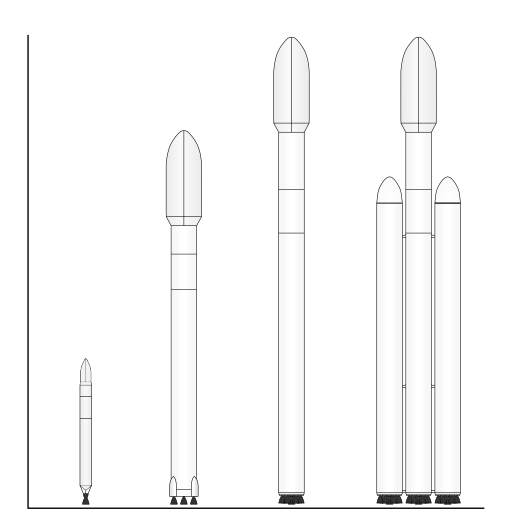
Falcon Heavy (right) with Falcon family
A stretched capsule could launch from a heavy lifting rocket like the Falcon Heavy housed in a fairing.  Upon arrival, it could dock or be captured and berthed to a station.  The hatch on one end of the capsule would minimize space issues while attached to a station.  I don't imagine that it would be used for crew but only for pressurized cargo.  The station's Astronauts (Cosmonauts, or Taikonauts - if you like) would unload it and load it back up with whatever needs to be taken back down to Earth.  That could include experiments and even waste.  I've been considering the environmental impact of expending waste by burning it in the atmosphere.  Dealing with the waste on the ground might be more beneficial.  The capsule would detach from the station and de-orbit on its own merit.  The long heat sheild and the integrity of the cross sectional shape of the capsule would allow for a similar atmospheric re-entry as the Dragon.  Stretching the capsule longways also allows room for extra parachutes.  Dragon stores its parachutes on the side of the craft in a compartment.  The stretched capsule could have two or more compartments for parachutes.  Then comes the propulsive landing which would have a number of thrusters along the sides of the craft.  Several landing legs would also support this operation.

 The stretch capsule could be an intriguing idea for future engineers and space operations.  I think the alternative is to build newer and bigger capsules mostly from scratch.  It's not just the capsule that has to be designed but the manufacturing process as well.  I think a stretched solution would use the existing manufacturing process with some added parts.  In the end, this is just one idea out of many.

Sunday, January 20, 2013

Space Exploration Plans From Boeing

I read in a NASA Spaceflight.com article that Boeing came out with a moon exploration plan.  The plan entails a small space station put at Earth Moon Lagrange Point 2 (EML2).  That's a region of space past the dark side of the moon.  From there you can have a variety of missions ranging from moon missions to asteroid missions to mars missions.  We're told to think of it as a staging area.  It's supposed to be easy to get to and not that much fuel is needed.  They call it Earth Moon Lagrange point Platform (EMLP).  Then Boeing came out with a Mars exploration plan as stated in this NASA Spaceflight.com article.  They use the EML2 as a staging are to launch to Mars with a combination of chemical and ion propulsion system craft.  Are these a good ideas?  I tend to think that it is, but I'm also a little skeptic.

Sure it seems you can do it all with these plans, but at what cost?  SLS doesn't promise to be economical.  It will take several launches of SLS to make the Moon plan work.  It will also take several (at least 2) launches of the same rocket to make the Mars plan work even after the EMLP has been established.  The only reusable part of the SLS are its solid rocket boosters.  At least in the moon plan a reusable moon lander is called for, and the EMLP is designed to be a multi-mission asset.  These plans call for many in-space and landing assets to be built.  This is not cheap.  I am also skeptic about this Mars lander that is supposed to land and launch astronauts on to and from the Martian surface.  How big does that thing need to be?  How much fuel does it need?  Mars is about one third of the gravity of Earth.  Sp they seem to need one third of the energy of a Earth based rocket to get to orbit.  Like a third of a Falcon 9.  I'm just guessing here, the details I'm sure are different due in part Mars' gravitational field's profile (gravity is not linear with altitude).  Yet, it gives you an idea of the problem.  Think of all that hardware and fuel launching from Earth, in parts, and sending off to Mars.  Its huge!  The Mars plan seems to imply that the large transfer vehicle is for only one use, and one mission.  So if we want to make another go at it, we need to spend a lot of money to do so.

Apollo used all throw away assets to do its 7 moon landings.  It was canceled due to cost.  I hold the philosophy that space assets should and ought to be reusable, that is used for more than one mission.  The trans-lunar injection was performed by Saturn V's third stage.    That function can be made by a reusable space tug.  A reusable space tug would be equipped with propulsion (chemical, ion, and/or plasma), communication, and power (solar or nuclear).  They would dock with a manned capsule or cargo capsule/canister and take them to their destination.  I don't see why NASA does not pursue this route rather than majoring on throw away assets.  A reusable space tug can take crew, cargo, and/or modules from Earth orbit to Lunar or Martian orbits and return to Earth orbit.  Then they could be refueled and loaded up with a payload and do the next mission.  The only thing that has not been mastered in this sequence is an unmanned tug returning to Earth orbit.  Yet, space programs do have experience getting into Mar's orbit and using aerobraking to do it.  Similar techniques could be used with the tug.  Of course, when its taking a capsule back to Earth, the capsule would disengage the tug before the tug maneuvers to Earth orbit because it could take weeks for the tug to get to low orbit.  NASA could make its own, or a company can make its own and sell the services to NASA.  I wonder if some company out there is doing just that?  I don't know.  I did think up this reusable tug idea back in 2004 when SpaceShipOne was making its historical flights.  I posted this idea on Space.com forums at the time.  It seems that NASA thought of the Space Tug concept too in 1969.  These tugs could be of variable sizes for a variety of missions for many customers.  They could go to Moon, Mars, Venus, Mercury, the Asteroid Belt, and even the gas giants.  They could form an effective fleet for space exploration and commercial exploitation such as mining.  I imagine that reusable in-space assets, such as the space tug, could bring down the cost of traveling to the Moon and Mars significantly since the commercial launch companies can also leverage their launch capabilities.

Yes, the Boeing plans are cool.  I believe they will be too costly for Congress to flip the bill.  Making good use of the new commercial space approach with reusable assets could make the missions cheaper and help keep them going for a long time.


Friday, September 28, 2012

NASA's Exploration In Funding

NASA has a dilemma.  It wants to take the next step in human space exploration.  That step invloves leaving Low Earth Orbit and going to the Moon, Asteroids, and eventually Mars.  The problem is that since the mid 1990's Congress has not been providing money to NASA to meet their ambitions.  NASA has one of, if not 'the', premier manned space programs.  With the economic situation in the world I don't see that changing.  Let's look at what NASA is asking the Federal government to do and what an alternate solution can be.

Space Launch System
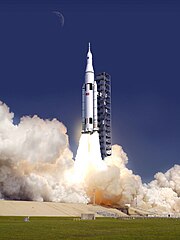
NASA is making a new rocket.  It's 'going to be' the biggest rocket ever built and flown, if it's appropriately funded.  It's called the Space Launch System (SLS).  It is to launch large cargo or spacecraft to orbit.  I stop short there and some people would say, "No, it's supposed to launch spacecraft beyond low earth orbit".  Well, reality is that to get beyond low orbit, you need to get to low orbit and then have a booster with enough fuel to get you where you want to go.  That is what I call a spacecraft.  For example in the Apollo Program, when the Saturn V rocket got the command module/service module, the lunar lander, and the S-VIB booster made up the space craft that launched from low orbit to the moon.  In the LRO/LCROSS launch, the Centaur booster was part of the spacecraft that launched from low orbit to the moon, even though the Centaur was also the second stage of the Atlas V rocket used to take the stack to low orbit.  The maneuver from low orbit to the moon is called the translunar injection (TLI).  The SLS is projected to cost $18 billion to include the manned spacecraft called the Multi-Purpose Crew Vehicle.  Now NASA is looking for more money but this time to build a small space station around the Moon called Gateway.  In 2006 an estimate cost of the International Space Station was at $35 billion, and that was low balling it.  A small space station around the moon or at a lagrange point could cost just as much or close to it.  The reason is that although smaller, it takes a lot of energy to get it out there.  Will Congress support NASA with full funding in these efforts?  Judging from the last decade, I say no.  The effort will probably be a waste of time and money, just like other defunct NASA programs such as Constellation.

Falcon 9
There is an alternate route that NASA can pursue.  Leveraging commercial companies services to space and in space refueling, NASA can get in the business of human space exploration again.  The Augustine Commission Final Report found that cost of space exploration could be reduced by the use of commercial cargo launches to fuel manned spacecraft to go explore from low orbit and use mid lift rockets such as the EELV and Falcon 9.  This would be an alternative to a large rocket operation such as the SLS which could launch both spacecraft and fuel at the same time.  NASA has pursued a different way of operations with the ISS cargo and new crew with its Commercial Crew and Cargo Office (C3PO) which lead to the Commercial Space Transportation Program.  It operated differently than usual at NASA.  In it, NASA pays for transportation services rather than ownership.  The commercial company owns and operates the launcher and spacecraft.  This saves money for NASA because price is set and doesn't slip like in developing and operating rockets such as Apollo, Shuttle, and Constellation.  This in turn allows the commercial company to make money from NASA and other customers allowing for creativity.  An example of such creativity is SpaceX's DragonLab in which SpaceX gets multiple science customers for one Dragon capsule flight.  In a sense, SpaceX is continuing what Shuttle did for the science community.  So the alternate process for a large launcher would require several launches from Earth to build a TLI spacecraft and fuel it in low orbit.  This would then launch from low orbit and go off and do it's mission on Moon, Asteroid, or Mars.  They could even build a small space station and send it to the moon using ion thrusters without people, only to be manned when its in its position in a Lagrange point or around the Moon itself.  The launchers needed exist today.  SpaceX is in the process of building a bigger launcher called Falcon Heavy which could bring down the cost per launch of such efforts.  I think the real key to success is to operate like NASA'a C3PO suggests and pay for services rather than own launchers.


NASA should get out of the business of making rockets, and get into the business of exploration, science, and aerospace research alone.  It's time commercial companies take over launches.  The United States won't financially support NASA's ambitions with business as usual. 

Monday, September 10, 2012

Liquid Fuel Rockets

I understand it, but I don't think it's justified.  Some people give too much credit to the Third Reich for developing rockets.  Rockets were around since at least Marco Polo's time.  The Chinese had gunpowder and made rockets with it as well as other weapons.  Thus they created the solid fuel rocket.  The the V-2 was developed under the Third Reich, and it was not a solid fuel rocket.  Let's look at who first developed the liquid fuel rocket and then let's look at rockets after the V-2.
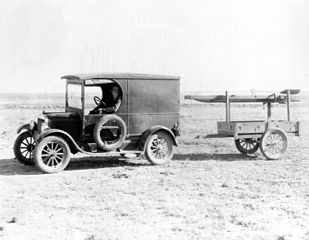
R.H. Goddard towing a rocket
 In 1923 a man who had been a sickly child and a book-worm, tested a gasoline and liquid oxygen rocket engine.  For years before, he had experimented with solid fuel rockets.  He had made guidance systems, and mathematical formulas to predict trajectories.  In 1926 this man made the first liquid fuel rocket launch from a farm in Auburn, Massachusetts, USA.  It went to a height of 184 feet in 2.5 seconds (Wiki).  That man was Robert H. Goddard.  Yes, the liquid fuel rocket was invented in the United States, not Germany.  Regardless, even Goddard thought of space travel with rockets and made experiments to that end (Wiki).

V-2 replica
Since Goddard there were several rocket enthusiasts around the world working where Goddard left off.  They followed Goddard's writings.  One group in Germany included Wernher Von Braun, who had a really long name.  He made rockets for the Third Reich, namely the V-2 rocket.  What the Third Reich provided was resources and enthusiasm for the rockets.  They were used as an instrument of war, but even Von Braun dreamed of space.
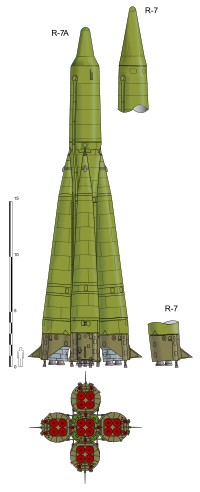
R-7
At the end of World War II, the Soviet Union (USSR) and the United States (US) grabbed as much as Germany as they could including rocket scientists and V-2 rockets.  The USSR made the R-7 as the first ballistic missile that could launch and atomic bomb.  While Von Braun was the mastermind behind the Saturn rockets, Sergei Korolev was the mastermind behind the R-7, the Vostok, the Voskhod, and N-1 rockets.  Following the same pattern, Korolev was part of a rocket society before World War II and was a rocket engineer.  He was imprisoned for 10 years in the USSR.  He was released to work on the rockets.  He was also instrumental in convincing Khrushchev to launch a radio transmitting satellite instead of making a weapon demonstration with the rocket.  Thus Sputnik-1 was launched and the world would never be the same again.  You see, Sputnik-1 was the first satellite as we understand man-made satellites today.  It transmitted a 'beep' that could be picked up by any ham radio enthusiast.  People in the US feared USSR from then on.

Of course we know that the US gave USSR chase in the space race which resulted in the race to the Moon.  Von Braun and his team made the Saturn IB and Saturn V rockets under NASA.  Saturn V still remains the most powerful rocket ever flown.  It's the epitomical rocket of the space race and the race to the Moon.  It could take 260,000 pounds to orbit.  Impressive by any measure.  The N-1 was also impressive but not quite as the Saturn V.  It could take 200,000 pounds to orbit.

SkyLab riding on a Saturn V
When the space race was done, the big rockets were not as much needed anymore.  One Saturn V launch was done to put the first US space station called SkyLab into orbit.  USSR also followed the space station approach to space research.  The cold war ruled.  Rocketry became subordinate to Inter-Continental Ballistic Missile (ICBM) build up.  Which took the whole of society to the brink of annihilation.  The flip side of rocketry was the satellite industry, both military and commercial.  Today the Russia and the US uses a variety of rockets and a variety of sizes to launch all kinds of satellites.

Long March 3B
Today we have dedicated rockets for satellites and unmanned spacecraft.  Boeing Delta IV, Delta IV Heavy, Atlas V, and Falcon 9 are among the biggest rockets in the US.  Russia has the Soyuz and Proton rockets as their biggest.  Europe has the Ariane V, Japan has the H-IIA and China has the Long March 3B.  India also has a rocket called the GSLV which can lift 11,020 lbs to orbit.  Interesting to note that India is developing a heavier vehicle called the GSLV-III that will rival Falcon 9 as far as lifting capability to orbit.  It's maiden flight should be soon.  These rockets can lift from around 15,000 lbs to 50,000 lbs to orbit.  If you consider that today's shipping containers can weigh up to 68,000 lbs, you see that these rockets fall short of commercial shipping standards as far as capability.  Almost all these countries are developing bigger rockets.  If humans are to expand their living quarters to space, the moon, and mars, they have to have bigger rockets and fly them cheaper than they do now.  This is the big drive.  There is a future in rocketry.


We looked at Goddard and his rockets, then looked at the cold war rockets of the US and USSR, and finally we looked at the modern rockets.  It's really amazing that most of the technology that was essential to rocketry was developed by one man, Robert Goddard.  To get from Goddard to today's rockets, there were myriads of men and women developing technologies to go bigger, faster, and farther.  These people were of all kinds of backgrounds including different political backgrounds.  The rocket is a tool for man.  Let's hope we can use it wisely.