SpaceX has accomplished what many have said was impossible. They—a commercial company—have launched two humans successfully to orbit on the Crew Dragon (Dragon 2). Not only to orbit, but they have sent them to the International Space Station on May 30th, 2020. Some have said how important this accomplishment is for the United States to get back launching Americans from American soil. I agree; that's true. Nationalism aside, there is a much much deeper and more important milestone this accomplishment marks that few are saying, and it has to do with our future from here on out. It marks the beginning of commercial human operations. What does that mean? It means we are no longer dependant on government money to get humans to space. SpaceX will open the market to allow citizens and anyone to go to space.
An actor has a contract to go to the ISS on SpaceX Dragon to shoot a movie. Tom Cruise is reportedly going to ride on Crew Dragon to the space station in the near future (Verge article). This was announced almost a month before the launch. This is how Earth-shattering this launch is. It's already sparking space tourism.
A billionaire wants to go to space and take artists around the moon. He has a contract with SpaceX. The Dear Moon project by entrepreneur Yusaku Maezawa hired SpaceX to take him and artists on a journey around the moon on Starship. It's the most ambitious space tourism feat yet. The Crew Dragon launch validates SpaceX's ability to launch humans into space and thus to launch them on the yet to be developed Starship as well.
I heard on the webcast of the launch that SpaceX plans on sending making available twice a year on Crew Dragon a year to the ISS. This article from the Verge states that SpaceX made an agreement with Space Adventures to have four private citizens in the next year or so.
Now, the future can open up. Commercial Space Stations project entrepreneurs can make real plans because they have a way to get people to their stations. Axiom Space, Bigelow Aerospace, and the Gateway Foundation have been surely watching eagerly the Crew Dragon launch.
Low Earth orbit, the Moon, Mars, the Asteroid Belt, and deep space are all potential destinations for commercial human missions and colonies. The successful launch of Crew Dragon is amazing and is also the key to an open and profitable space future. Ad Astra.
Elon Musk is considering pulling back on Mars for now. Check out this interview:
He needs to get the astronauts to space and to the ISS. He also needs to make it happen by next year. No pressure. Except, no more landing legs for Dragon (see minute 35:45). So no power landing for it either, so no Red Dragon, either, and Dragon won’t land on the moon either. Come to think about it, that’s a lot of things. And there goes much of Musk's Mars plans for Mars out the window. And why? Well, real practical practice takes priority over dreams.
Notice that Musk said, “If you want to get people fired up, you make a base on the Moon. And then going beyond that, getting people to Mars.” He said this in minute 24:46.
Robert Bigelow was also at the same conference Musk was at. Check out this video.
Bigelow proposes going back to the moon before Mars because the Chinese are heading to the moon and we need to beat them to it. The prize is resources.
So what do we make of all this talk in the summer of 2017? To me, I can only conclude that for now Mars is out and the Moon is in on everyone’s agenda, including NASA’s. In my opinion this represents a change of plans that is steered by finances and resources. It’s sad that the dreamers dreams are put on hold for Mars. If you want to see a Mars landing, I suggest you keep healthy and plan to live a long life.
“The best-laid plans of mice and men often go awry,” Robert Burns.
IF we want to be a space faring people, we HAVE to adopt new launch vehicle standards. This has become painfully obvious to me this fall with that failure of the Antares rocket and the political fallout of the RD-180 rocket engine which makes the Atlas V as useless as if it had a catastrophic in-flight failure. You can say this sentiment has been building since SpaceX arrived on the scene and Elon Musk talked about improving the rocket. I see it now. I see how deficient our rockets have been. The rocket is basically in a state that the automobile was in the pre-Model T period. They are costly and unreliable. They are toys for the rich. Small efforts have been attempted to bring the launch price down. The only company that is bringing prices significantly down is SpaceX. Those prices still need to come down MORE. SpaceX can't do it alone either. There needs to be more companies in the effort. Well, I came up with some standards to start with that should get us in the right direction. Of course this is just my own opinion. They cover items from payload to the first stage.
1. The payload needs to be recoverable in all phases of flight. Capsules with crews have had abort systems which were high speed rockets that separated the payload (capsule and crew) form the failing rocket and allowing the parachutes to activate and bring the payload safely to the ground. Why don't we have this on unmanned payloads? Unmanned payloads today just blowup with the rest of the rocket in case of an abort. Thus making vapors out of hopes and investments. Then the insurance companies have to pony up cash. I have no doubt this drives up cost of launch to some degree. If some degree of recovery of the payload could be guaranteed I bet cost would come down.
2. The upper stage needs to be able to orbit the Earth and make a reentry and landing back to it launch site to be able to reuse. This is a plan for SpaceX. They want to make the second stage of the Falcon 9 rocket reusable. They want it to land after a launch back to base, preferably. Today, all second stages are discarded after launch. This means all that hardware has to be created from scratch and tested for ever launch. That's a lot of man hours. That's a lot of material. That's a lot of money. It's just a bad way to operate. We've just been operating like that since the beginning of the space age. The one exception would be the Space Transportation System which, arguably, had an orbiter that was held the payload and was also the second stage. It was totally reusable. It's drawback was that there was a lot of maintenance to it to get ready for the next flight. Yet, overall reuseability should bring down the price of each launch. Beneficial reuseability was demonstrated in the suborbital world with SpaceShipOne in 2004.
3. The first stage needs to be able to lift the upper stage and the payload to a certain altitude guaranteed even in the event of an engine failure. One rocket today meets this standard. That rocket is the Falcon 9. It demonstrated it in Oct 2012 where one Merlin engine shut down. The rocket kept on flying and thanks to its design got it main payload to the International Space Station. If that happened to any other rocket, the mission would have been a total failure. The Falcon 9 can do this feat because it has 9 rockets which allows it to loose one or two engines before mission failure. This needs to be a standard in all future rockets. The area from the launchpad to the altitude where the second stage can ignite is a critical one. The Earth is the most dangerous object to a flying rocket. The more distance it can get away from the planet the safer it is. That's why this standard is so important. It give a high degree of guarantee to get to that second stage at a reasonable cost.
4. The fist stage needs to be recoverable in one piece and reusable. No one has ever accomplished this. Oh, now your thinking about the SRBs in the STS. Well, those were not reused in one piece. They were broken down and rebuilt. I'm not talking about breaking down and rebuilding. I'm talking about launch, land, recover, refuel, and launch again. SpaceX is trying to learn how to do this. They are currently trying to land their first stage on a large barge in the ocean. Nobody else is even trying. Well, Blue Origin was proported as wanting to accomplish this but they are not releasing where they are at or how far they got. With them it has been so long that I can only conclude they were unable to finish the project. First stage reuseablility is essential to bring down prices. It represents the biggest hardware in the rocket stack. It is only a suborbital vehicle by itself.
5. Intensive and comprehensive checks on first stage, and upper stage systems need to be done at the launch time where the computer has the ability to abort at the sign of any failed test. Most, if not all, mainstream rockets have implemented this standard to some degree or another. The more successful the rocket, the more comprehensive their computerized checks are. This stands to reason. This is why there are delays at launch time. Though they may be a little frustrating, I take the delays as a sign that the checks and tests are working and working hard. It is a good thing. Could Antares have used more comprehensive checks and tests to avoid its catastrophic failure? Possibly. Time will tell. As far as I can tell, these tests and checks have become more and more computerized over the years. Where many of them were just people staring at numbers on a screen to see if they see any anomalies. This is thanks to miniaturization of the computer circuits on silicon chips and more sophisticated software. Progress in this area should continue. We need to get smarter software and more powerful computers as time goes on. I have no doubt this trend will continue. So this standard is the one standard that is being implemented by all successful launchers. Great! 1 out of 5 ain't bad?!
Elon Musk, in an interview with Walt Mossberg and Kara Swisher, mentioned that reusable rockets were needed to make space more accessible. So he's working on the reusable rocket. In my estimation, reusable stages just cover 2 of 5 standards that ought to be implemented by all launchers if we are going to be a people that live and work in space. I don't mean low Earth orbit. I mean the Inner Solar System, to include: the Moon, Mars, Venus, Mercury, Asteroid belt, and Near Earth Objects. It's time we look at the big picture and make plans to inhabit this playground. To do it we not only need to be scientifically smart but also economically smart in all things.
These standards are mostly from other people through the decades. Many have realized we needed reusable vehicles to access space to include many science fiction writers. Computerized tests came out of necessity from real life launch companies and government entities. Von Braun and his team implemented the multi-engine first stage to where if one goes out it could still get to orbit. Maxime Faget came up with the idea of a rocket as a launch escape system for crews. I just expanded the possible idea to non-human payloads.
I'd like to see other launch companies make new rockets that take on these standards. I know a couple of start ups that are targeting the small satellite launch market that design their rockets with multiple engines on the first stage. One of them is called Firefly. We need to wait and see what happens. For now, we have to make due with the clunker rockets as we see Falcon 9 develop and incorporate 4 out of the 5 standards I've stated. Watch the other companies tremble in fear.
Could solid fuel be the cure to SpaceX competitors? ATK seems to think so. Look what they are touting.
A Nasaspaceflight.com article titled 'ATK expand on its domestic alternative to Atlas V’s RD-180' said that ATK is bidding for a solid state first stage for the Atlas V. Has the much hailed hero rocket by ULA plummeted this far from the heavens? According to the article, plans to make the politically maligned RD-180 engine in the US fell through. Now, they are hoping for the BE-4 from Blue Origin to save the rocket. But wait! Here comes ATK with an alternative solution, solid fuel first stage for the Atlas V. What?!
Yes, solid fuel first stages. Ahhhh! Those where the days. Oh the thrust, the power, the long slender look. Doesn't just give you goosebumps? I'm referring to the 'Stick.' No, not some sleazy battery operated toy, but the rocket that was supposed to put astronauts back into space after the Shuttle was decommissioned as part of the ill fated Constellation Program.
Ares I was to be powered by a large solid rocket booster based on the Shuttle SRB. It was aptly and despisingly nicknamed 'the Stick.' The only launch, or proto-launch of such a configuration was in 2008 with the Ares 1-X.
Also according to the article, ATK is also petitioning Orbital Sciences and offering a solid rocket booster as a first stage to Antares. This would make Antares an all solid fuel rocket, perhaps the biggest in operation. It's not the best of options that could exist for them, but I suspect it would be a quick fix for the troubled rocket.
Now, this is all fine and dandy for ATK. They are making smart moves for their business. I don't blame them for offering solid rocket boosters as first stages for troubled Atlas V and Antares. However, if ULA or Orbital Sciences have any delusions of competing with SpaceX on the basis on solid fuel, they better think again. SpaceX prices are already so low the launch market members are tossing up their lobster dinners and scrambling for ideas to compete. SpaceX is still on the move. They are learning how to catch a flying Falcon 9 in the ocean, and then fly it again. This is sure to bring their prices down even further, causing more tossing of lobsters. Hmmm...maybe SpaceX will get an award for saving lobster populations on the planet.
"If everyone is thinking alike, then somebody isn't thinking." - George S. Patton.
For years after the Saturn V rocket was retired, rockets in the United States were reduced to a set of parameters. This reflected a way of thinking in the industry. If a rocket failed on liftoff, it was to be blown up. It was an easy solution to minimize collateral damage. Of course, computers then had a tiny fraction the power of today's computers. By the way, that smartphone you just dropped? Yeah, it has more computing power than they could dream of back then. Manufacturing was largely done by hand, or by hand operated mechanical/electrical machines. Flaws were checked by only human hands and eyes for hours on end. Now, we have robotic arms equipped with X-rays, infrared, ...etc, sensors. The flaw checking is done in a fraction of the time it used to.
Saturn V was the so big that it took five of the biggest rocket engines on its first stage. It was said that it could loose one engine and still complete the mission, or at least it could get its payload to orbit. That capability went away with the Saturn V. Elon Musk brought it back with the advent of Falcon 9.
So now, we have a contrast of operations. One is a legacy operation founded on old technology and a robust track record. The other is based on new technology capabilities and the need to take launch operations in a whole new direction. I say 'new' though it's been in operation for four years now, it's still relatively new compared to the many decades of launch history we've had.
On October 7th 2008, Falcon 9 rocket lifted off carrying the Dragon capsule bound for the International Space Station. There was an engine anomaly and one engine shut down. The rocket kept on going. The primary payload got to complete its mission. The secondary payload did not. The rocket was not blown up. If any other rocket had a main engine anomaly and was shut off, the rocket would have to been blown up because there would be no way it could get its payload to any orbit. Atlas V and Delta IV would have to be blown up if such a thing happened to them.
In contrast, on October 28th 2014, Orbital Sciences rocket, Antares, lifted off and had allegedly a main engine anomaly within seconds. It was blown up by mission control as soon as they detected the anomaly. I gathered that from the briefing after the mishap and some articles. The exact reason and conditions of he anomaly is still being investigated. Antares was built on the old mindset on how you design a rocket. Orbital is good at getting parts together and making a rocket. They leverage the market.
You can see the difference here between the mishaps between Falcon 9 and Antares. Falcon 9 was purposely designed to succeed with redundancy and Antares was not. You can say the designers of Antares didn't know or didn't realize. I say that is total BS. Everyone knows! Everyone in rocket design knows the Saturn V. They know about all the mishaps in the past. They are just making the same mistake as everyone else is doing by not thinking, or they are rationalizing the problem away. This problem still exists in Atlas V and Delta IV. The designers of those rockets did not account for this problem.
I was going to go into other points, but this point is so big and poignant. It just makes me mad. It makes me mad that for years big companies have been ripping off NASA and the US taxpayers with high cost for launches on rockets that are sub quality. In contrast, this entrepreneur is offering high quality rockets at low cost launch service. How can anyone pass that up? The reality is they can't. The Atlas V days are numbered because it's too costly and its engines are politically risky. So they are trying to give it different engines. Europe is trying to make a new rocket in an attempt to compete with SpaceX. Through all of this money is scarce. Recession is coming back to Europe and things are slowing down in China. So reducing cost to launch satellites is too tempting. The old ways have to go. Elon has the floor.
In my opinion, there is a fundamental flaw in our efforts to commercialize launch operations to space. We had scientists show us how to do it under NASA and then had companies do it for a profit. OK. That sounds all nice and good. Except we end up with an enormous launch cost per payload weight measure. Now, scientists take into account to most efficient way to do things. They did a good job of this in getting to space. They developed a very efficient way, scientifically. Sometimes scientific efficiency opposes financial realities. I was shocked when my physics teacher, back in high school, said that to travel from point A to point B in a vehicle and to have that vehicle at point B at the end of the trip was not very efficient. Of course in my mind, I thought I still needed that vehicle to go other places, and that's where economics came in. So why do we throw away rockets? We do it for efficiency, not economy. Maybe we should alter the way we go to space to make it more economical. SpaceX has an idea, DARPA has and idea, and I have an idea of how to make change this efficient operation into and economical one.
SpaceX, as most people know, wants to make throw away rockets into reusable rockets. That's tall order. So tall, that they are the only ones actively pursuing this avenue. They have succeeded in reentering their first stage Falcon 9 v1.1 and flown it all the way down to the ocean. Now there is talk of them wanting to land their first stages on a floating platform. Kudos to them for getting this far. They are ahead of everyone else.
DARPA came up with an idea that uses wings. It's called the XS-1. The idea is to have an unmanned space plane act as the first stage of a rocket to launch small satellites. Supposedly, these would fly back to base. That would be good. You want your first stage to come back to base to reuse it and not haul it back to base.
Here's my idea, as crazy as it sounds. Scientists, scream if you must. In a 2 stage rocket, make the first stage suborbital. Yes, you heard me. Let it only go up and down, like an elevator. Let the second stage be responsible for the lateral velocity. Mull that over a bit. Sure, how high should that first stage go? Pretty high, I can imagine. Perhaps even beyond the atmosphere (greater than 100 km in altitude). How mush fuel should that second stage have to get from 0 to 17,000 mph before falling back to Earth or sustaining altitude while accelerating laterally? How much fuel would the first stage need for all the fuel the second stage would need and to land as well? A lot. OK. What are the benefits? How about having a first stage that can land on the same landing pad as it launched from. Conceivably, it could be prepped with another second stage, payload, and fuel and fly in short order again. Now we're talking rapid turn around for a first stage rocket. What is that worth?
So there they are. SpaceX has it's plan to alter the launch operations to make it more economical and is working it. DARPA has a competition with an idea using wings. I just throw science to the wind and take an idea that leverages most fuel possible to get the most out of the hardware. What is sure is that launch as we have seen it in the past is not how it's going to be in the future because we just can't afford it anymore.
Boeing and SpaceX have won NASA's Commercial Crew Transportation Capability competition in the last month. Good job to both teams. Now, I've written a lot about SpaceX because there has been a lot to write about. Here, I'm gong to change my focus on the Boeing team. It may come to a surprise to some of my readers that, in fact, I like Boeing as a company. I've been a customer, both for pleasure and business, for many years of their jetliners and never had a complaint. Boeing is mostly a mainstay company. They have their jets for many decades. Sure, they change them to meet market demands, but for the most part, they keep them up and running for as long as possible to keep costs down both for themselves and for their customers. On the rocket side, they have the Delta family. It has been operating well for many years. There has been a couple of mishaps, but overall everything is OK. They do make the currently largest rocket in the world, the Delta IV Heavy. Then they have business with the military and NASA in miscellaneous projects - at least for this post. CST-100 is a different project for Boeing. For a company that is a safe company as Boeing, CST-100 is really out there.
The first thing about CST-100 is that it is not business as usual. It is not a 'cost plus' contract. It is a contract where risk is taken on by Boeing. That, I sense, is a big deal to the company. Sure, they do take on that sort of risk when they sell a jetliner to an airline company, or do they? Well there is no airliner to go between the end user and the company. So far, the contract will be just between NASA and Boeing. In the unforeseen event Boeing decides to put in a third party, like ULA, then the dynamic would change a little. Let's assume that it won't. Boeing will take responsibility for the craft and all the technicalities. That means that they retain ownership. For a disposable craft, ownership is a short lived thing. Risk is the important item here. Any technical malfunction leading to human injury or fatality could lead to money lost by the company. Amount will vary on a case by case basis. Of course, since this is rocket industry, the sky is the limit. (These are generalized statements. I have no clue what agreements NASA and Boeing will have including anything pertaining to risk.)
Credit EC Holm
Now, in face of the higher risk, I can see why the CST-100 was designed the way it was; it has little innovation. About the only two major innovations it does have are that it can land on land using airbags and has autonomous docking. Otherwise, it is shaped like the old Apollo capsule, most of its supporting systems are in the service module like in Apollo, thrusters are in the service module like Apollo. So the craft has a strong design basis in legacy systems. I believe this was to reduce risk.
There seems to be a belief out there on the net that this craft's electrical system is only powered by batteries alone. If that is the case, it is unprecedented and could possibly be a significant innovation. Batteries are traditionally heavy and don't last long. They are usually replenished with power form solar cells or fuel cells as is for all modern maned or cargo carrying craft.
The CST-100 team was in a tough situation. On one side, they had a company that was adverse to a lot of risk, and on the other side, they had a project that demanded to take on a lot of risk. So the design reflected lower risk. I applaud the team for their excellent work in such a tough situation. Is CST-100 really what we need to advance commercial space? Maybe. Time will tell. It is not the best. It was design for five people but can fit seven. On the other hand SapceX Dragon 2 was designed for seven people. Dragon 2 is a riskier program to build. CST-100 has a better chance at success. I think both will make it. I can't stress enough how extraordinary it was for Boeing to take on this project in the first place. There was never a manned capsule made in Boeing's name. Instead Boeing bought McDonnell Douglas who had made both the Mercury and the Gemini capsules (late 1950's to early 1960;s). These are on display at the St Louis Science Center. I took pictures of them - seen above. They are strikingly small. So small that they look like some mesh between modern art and engineering built around humans. This is a really risky project for Boeing. I applaud them in taking this leap.
NASA has made its choices. SpaceX and Boeing are in and Sierra Nevada Corporation (SNC) is out. In their comments, NASA said that it was a hard choice. I believe them. The Dream Chaser was based on the HL-20, a NASA project. This gives Dream Chaser good credibility. So, what possible future could there be for a spaceship that needs someone to fly it?
It's an unprecedented situation in the world where a company has an almost ready made space ship but needs someone to fly it. SNC has vowed to keep on with the project with possibly using it to compete for NASA's next round of cargo hauling to the ISS (see Denver Business Journal article). In a Denver Post article, SNC said it will offer flight to anyone or even sell a space ship to anyone. You can see they are trying their best to keep the project afloat.
Now, bear with me in some speculation. I can think of two customer/buyers that would be in their interest to buy services or a craft.
European Space Agency (ESA) has for a very long time toyed with the idea of having their own manned access to space without relying on Russia or the United States. They considered making a space plane they called Hermes a long time ago. They are considering leveraging the ATV technology and making a capsule to launch on an Ariane 5 launcher. They are currently about to launch a technology tester to test reentry systems known as IXV. Why not just forgo development and buy a Dream Chaser? They could take their astronauts to ISS and bring home experiments landing on a european runway. Sounds like an opportunity Europe would be crazy to pass up.
Virgin Galactic (VG) is about to fly people to space. Six people at a time get to fly to suborbital space in the new SpaceShipTwo space plane. They get to experience weightlessness for 5 minutes and then come home. A chance of a lifetime, nay, a chance never before offered, What would be the next step? Why orbit of course. With a Dream Chaser, Virgin Galactic could take passengers to orbital space for a day or a week and then come home. Up to six passengers can fit on board. Then they can land on a runway just like SpaceShipTwo, Heck, it can be the same runway. Dream Chaser shares some technologies with SpaceShipTwo. They have the same non-caustic hybrid engines, and they have the similar type of landing gear configuration. They are both made out of carbon fibers and resin.
So here we are. In an unprecedented situation in the history of commerce, a orbital space ship is offered to the world. Isn't it exciting? Will ESA and VG make an offer? We have to wait and see how the market responds. Is it too early for a commercial orbital space craft? Does anyone really have the money to purchase? It the answers are 'no' then SNC will probably store Dream Chaser for a future venture, hopefully.
NASA wants to build a rocket bigger than Saturn V, the Space Launch System 130 metric ton launcher. This is to get the hardware they need to go to Moon, Astroids, and Mars. It's basically a cargo hauler. Now the Ares V, from the cancelled Constellation Program, was going to be a 188 metric ton rocket. I had done some of my own calculations to realize that it could potentially haul the equivalent of 4 shipping containers to low Earth orbit. Now, Saturn V was a 118 metric ton rocket. Take a moment and thing about these numbers. Think, also, about how much stuff people use every day. Most of the stuff we use come in shipping containers. Now consider a city in space. The content of the many shipping containers that come by train and sea ships has to be launch off the Earth. Has it dawned on you how much stuff such a city will need? Has it dawned on you how big the rockets need to be to launch such stuff? I came to realize that we are just at the very beginning of space colonization. We have cargo carriers that supply the International Space Station (ISS) now that are both from government and commercial entities. How much will the rocket launchers of the future have to grow to meet the demand?
ESA ATV
I looked at data shipped to the ISS in 2012. I then reduced the number to tons per person per year. I got 3.8 tons. This is a pretty rough number. I then did the same with the United States in 2012 and got 6.2 tons per person per year. It would seem that the astronauts and cosmonauts are living on a shoelace compared the people on the ground.
If that is the case, our current launchers are, for all practical purposes, the smallest they can be to support 6 people permanently in orbit. Falcon 9 (13.2 metric tons), Antares (6.1 metric tons), Ariane 5 (16 metric tons), Soyuz (6.5 metric tons), and H-II (10.1 metric tons) are the launchers for cargo to ISS. This is our baseline. On average, our launchers are 10.4 metric tons to low earth orbit.
If the astronauts lived like we do on earth, by how much will our launchers grow? I calculate that our launchers would have to be 19 metric tons on average for 6 people with 6 launches per year. You can see how that number already dwarfs our current launchers.
Now what if we had more than one space station or one big one, in orbit and a total of 100 people living in space full time? If they live like astronauts do now, they would need 380 tons launched from the ground annually. They will need launchers of 1,040 metric tons to launch 6 times a year.
Now if those 100 people lived like we do on Earth, then they would need 620 metric tons in a year. The launchers would need to be 1,900 metric tons for 6 launches.
Can you imagine a 2000 metric ton rocket launcher? That's about 17 times the size of a Saturn V. That is huge.
You might say what if we increase the number of launches a year? Won't that decrease the size on the average launcher? Sure it will. Let's see.... I calculate that for 100 people that need 620 metric tons a year and 20 launches, they would need average launcher size of 510 metric tons. That's still about 4 times the size of a Saturn V. Now 20 launches a year is quite a hefty schedule. I suppose if they spread out the load over 4 companies and/or countries it's not so bad. Though a 510 metric ton rocket is quite large, I believe it is within the realm of possibility to accomplish.
You can see how the number expand with the increase of people.
This is only to LEO. What about the Moon and Mars? Well the numbers get exponentially larger. So the rockets get exponentially larger. The ones we have now are puny by comparison. That is why people have suggested learning to 'live off the land' and reduce the need for new cargo from Earth. Even in deep space living off of asteroids and comets will be necessary. It's just too much for us to lift that much stuff out of the Earth's gravity well. The other thing we can learn to do is recycle, and recycle everything. Air, water, waste (yes No 1 and No 2), soil, plant matter, and parts are things we need to learn to recycle if we are to live in space, or on the Moon, or on Mars. New technologies are bound to be needed to this end. Are we up for the challenge?
The current Space Launch System (SLS) rocket that is in development is a 70 metric tonne vehicle. By comparison, SpaceX's Falcon Heavy is a 53 metric tonne rocket. The Falcon Heavy is slated to make its maiden flight towards the end of 2014. SLS is slated for a 2017 maiden flight, but that time seems to be slipping. These dates often slip, even for commercial companies like SpaceX. The SLS program is also slated to create a 130 metric tonne rocket to explore the solar system. Consider that commercial space services have already been successful and saved NASA money. Consider also that a new space services market has been created and is growing. I do not think that SLS will survive long in a commercial space services dominant environment. I think a competition for a 130 metric tonne rocket is in order for NASA.
In 2006 NASA's Commercial Cargo & Crew Program Office (C3PO) created the Commercial Orbital Transportation Services (COTS) which was a competition for companies to create rockets and spacecraft to provide the International Space Station (ISS) with cargo. COTS also lead to Commercial Resupply Services (CRS) which was the operational missions to supply the cargo. While there were many entrants into COTS, including Boeing and Lockheed Martin, SpaceX and Orbital Sciences won, and are supplying cargo today. The CRS contracts were fixed price versus the traditional Cost Plus contracts which is how SLS is being developed. Under CRS the companies retain ownership of their rockets and spacecraft, and also the risk associated with development and operation. Risk is one of the potentially most costly aspect of any project or program. By giving companies the risk, NASA has also given the companies freedom for innovation. Essentially NASA has helped create new competition in the space launch world and has saved money at the same time. SpaceX's Dragon first berthed with ISS in 2012. Orbital Sciences' Cygnus first berthed with ISS in 2013. The success of COTS is historic for the planet. For the first time, orbital commercial services became a reality.
Think of the future where commercial space companies dominate launch and operation services. What place does a costly SLS have in this environment? Already Falcon Heavy encroaches on the lifting capability of the 70 metric tonne SLS. SpaceX has plans to launch cargo and people to Mars. They will make a very large rocket that competes with 130 metric tonne SLS. What future does SLS have? Even is SLS functions perfectly, its cost will make it obsolete. With a constraint budget, NASA would be tempted to launch the Orion Multipurpose Crew Vehicle (MPCV) on a commercial launch service. They might even be tempted to use a commercial capsule for missions like a new version of SpaceX's Dragon. To me, the mighty dollar is going to doom SLS the scrap heap.
In the aerospace industry, competitions is what spur innovation and development. Charles Lindbergh won the Ortieg prize in 1927 by crossing the Atlantic Ocean in a non-stop flight with his plane the Spirit Of St Louis. This resulted in our current transatlantic flight market. This also resulted in round the world air commercial air travel. Burt Rutan's Scaled Composites won the X-Prize in 2004 by flying their space craft SpaceShipOne to suborbital space twice in a two week period. This has spurred the new commercial space market. Now Virgin Galactic, Xcor, and others are competing for customers for their first suborbital passenger space flights. These competitions work. Let us go a step further and make a competition that will result in more than one commercial launch system of 130 metric tonnes or greater.
Why would we need such monster rockets you may ask. Commercially, the bigger the rocket, the less money per kilogram is needed to launch anything. Who would use these? Besides NASA, there are current companies and organizations with big plans and ideas. Bigelow Aerospace makes inflatable habitat modules for future commercial space stations/space ships/moon bases. The Mars Society members long to get to Mars. Google Lunar Xprize participants have big plans for the Moon. B612 is an organization with a mission to help protect Earth from asteroids. Our current rocket only can start these big ideas. These represent many people from many countries. They want to go to space. They need very large rockets to get to their endgame.
As wonderful an idea SLS is, it is just not cut out for the future that is just around the corner. If NASA is not relieved of the burden of a 130 metric tonne SLS, the agency will be bypassed by commercial companies in the field of exploration. NASA should take the lead in exploration, not lag behind. They should not make any more rockets. They should hold a competition to develop 130+ metric tonne rockets. Then they could use those commercial rockets and services to get their spacecraft out in the solar system. Then they can make more of the wonderful discoveries they have been doing since the 1970s. These discoveries have helped people on Earth through the decades. New discoveries can only help those on Earth and those out in the solar system.
SpaceX and ULA are fighting. It started when Elon Musk went before the Senate Appropriations Committee to testify how unethical it was for the Air Force to grant ULA a large contract for EELV missions while SpaceX is in the middle of the registering with the EELV program.
In the process, Musk not only made clear the successes of SpaceX but the fact that all Falcon rockets parts are made in the US while the Atlas engines are made in Russia and are subject to Putin. Then they hyperbole started. ULA claimed sixty some odd successful launches in a row. Well, as a company, ULA is not that old. In fact ULA (6 years old) is younger than SpaceX (12 years old). But it's the two companies behind ULA that have the successful launches, Boeing and Lockheed Martin. In my mind, ULA is just a front man. ULA is really a ploy to compete with the new space companies. I question that ULA should even be in the EELV program. Instead it should be Boeing and Lockheed Martin competing still. The government should have never allowed a sole company to compete for EELV launches. That's a monopoly.
Now the fight is still ongoing. It's becoming a 'he said' and 'she said' thing. It's really pathetic and sad. What it should boil down to are the price tag. SpaceX claims it can launch satellites at at fraction of what ULA charges. In the end that is what matters. The government has to save money. It has to keep national security assets and at the same time lower the cost. That's for all our sakes.
On commercial principles, Congress has a dilemma. Clearly the Air Force has disregarded competition and fair trade principles in favor of keeping assets flying to orbit. Should Congress punish the Air Force? Or, should the EELV program be overhauled? Some might say that the word 'evolved' could be taken out if all they are going to launch are old Atlas Vs and old Delta IVs. Maybe the 'expendable' word could be taken out since SpaceX is about to make the rocket reusable. In any case the program seems broken and/or mismanaged.
In the meantime, let's sit back and watch the drama unfold. Maybe the fireworks will come before the 4th. Perhaps some popcorn and a lounge chair is in order. At any rate, in the end SpaceX seems to be holding all the cards. It's just a matter of time. Really, I guess time is what this feud is all about. After all, time is money.
ISS partners keep a flow of small pressurized cargo craft coming to the station for just 6 crew and experiments. Progress, ATV, HTV, Dragon, and soon Cynus make up such a fleet. The ATV is the biggest carrying a max of 16,900 lbs or 7,667 kg. On land, we stack huge metal boxes carrying all kinds of cargo on ships, trains, and trucks. These are shipped around the land supplying communities with effectively whatever they need. Commonly these are 40ft long cargo containers and can carry a max of 68,008 lbs or 30,848 kg.
Imagine if commercial space takes off, and many space stations orbit around Earth, the moon, and deep space are made and manned. Having around 24 people in each station who need food, clothes, equipment sent to them and waste taken from them. How would you supply that amount of cargo?
SpaceX's Falcon Heavy can lift to orbit almost the gross weight/mass of two 40 ft cargo boxes. So, I figure it could carry the cargo of one of these cargo boxes in a purpose made reusable stretch cargo capsule. It would be a vehicle of mass logistics transportation. What would such a craft look like and what would its operation be like?
Stretch Capsule concept made from Apollo CM pic
Why stretch anything? The airline industry have stretched the bodies of its planes for many years to expand their payload capacity. I remember first learning about stretched aircraft with the DC-9. It would seem reasonable to assume that commercial space companies sought out a solution for an increased capacity without reinventing the wheel all the way. SpaceX's Dragon is touted as a reusable capsule. They also want to make it to be capable of propulsive landings on the ground from orbit. Thinking about those capabilities, you could stretch the capsule lengthwise (see pic above) to increase cargo capacity per trip.
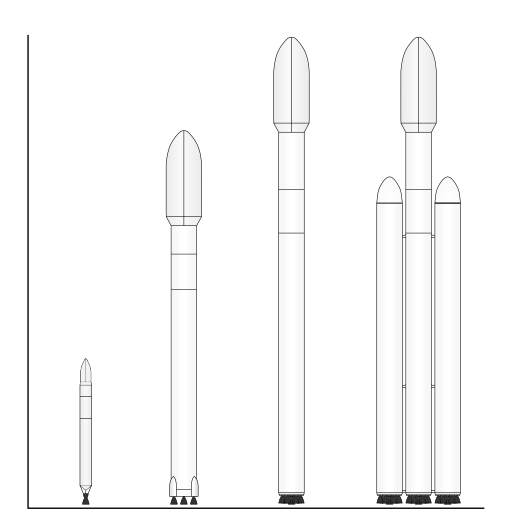
Falcon Heavy (right) with Falcon family
A stretched capsule could launch from a heavy lifting rocket like the Falcon Heavy housed in a fairing. Upon arrival, it could dock or be captured and berthed to a station. The hatch on one end of the capsule would minimize space issues while attached to a station. I don't imagine that it would be used for crew but only for pressurized cargo. The station's Astronauts (Cosmonauts, or Taikonauts - if you like) would unload it and load it back up with whatever needs to be taken back down to Earth. That could include experiments and even waste. I've been considering the environmental impact of expending waste by burning it in the atmosphere. Dealing with the waste on the ground might be more beneficial. The capsule would detach from the station and de-orbit on its own merit. The long heat sheild and the integrity of the cross sectional shape of the capsule would allow for a similar atmospheric re-entry as the Dragon. Stretching the capsule longways also allows room for extra parachutes. Dragon stores its parachutes on the side of the craft in a compartment. The stretched capsule could have two or more compartments for parachutes. Then comes the propulsive landing which would have a number of thrusters along the sides of the craft. Several landing legs would also support this operation.
The stretch capsule could be an intriguing idea for future engineers and space operations. I think the alternative is to build newer and bigger capsules mostly from scratch. It's not just the capsule that has to be designed but the manufacturing process as well. I think a stretched solution would use the existing manufacturing process with some added parts. In the end, this is just one idea out of many.
NASA is currently working on making the Space Launch System (SLS). It's the latest rocket system that the government is working on to create. The last one, was the Constellation program which failed. Before that, the Space Transport System (Shuttle) was made in the 1970's by NASA. Sure many companies were involved in these programs across the country, just like with the Apollo rockets. This gives NASA full control and responsibility of success and failure with these systems. Is this really the best thing that NASA could do? Is NASA wasting their time? I think NASA should get out of the rocket development business altogether. Case in point, I found this article in Al.com (Alabama) by Lee Roop. In it, some members of Congress state that SLS is too expensive. Here we go again. It's financial crunch just like in Constellation. I'm starting to have doubts that SLS will ever fly. NASA's strength is research for aerospace companies, and provide opportunity for scientific experiments off the planet. They also do good in space exploration, manned and unmanned. Why not have NASA major on these strengths rather than developing rockets while Congress refuses to fund NASA appropriately? Much scientific experimentation is refused because of lack of money available. Commercial Space can take over the development and responsibility for launches as they are demonstrating today. They already are taking pressurized cargo to the ISS. They are slated to take astronauts to ISS as well. Let's see what we got as far as rockets and what a rocketless NASA would look like where it comes to space exploration.
So far, the major commercial players to launch NASA assets into orbit are ULA, Orbital Sciences, and SpaceX. These guys represent the current launch might of the United States. The rockets are:
Atlas V is being upgraded to be human rated to compete with Falcon 9. Antares is also competing with Falcon 9 but in the pressurized cargo area. ULA is a cooperation between Boeing and Lockheed Martin. Before SpaceX, only Atlas V, the Delta family and Oribtal's rockets (not Antares) were the launchers plus NASA had Shuttle (STS). Shuttle is gone. You see that the commercial companies are responding to NASA's need and challenge to assist in the manned exploration effort already.
If NASA never gets SLS, how could it explore asteroids and Mars? SLS represents an approach that was used for Apollo. That approach was to put all your assets on one BIG ROCKET and go for your target. Man has never been manlier (that's a joke). There is another theoretical approach but it's never been tried. That approach requires the use of medium size rockets (Atlas V, Delta IV, Falcon 9). The idea is to use more than one launch to Earth orbit and put together your stack that goes to your target in orbit. That stack would have a rocket big enough to leave Earth orbit, carry all the assets needed for the mission including a capsule to return the crew back to earth. This would give commercial companies contracts and responsibility for launches. Plus the old axiom is put to use that says "don't put all your eggs in one basket". Launch from Earth represents the most risk to hardware and crew on any mission apart from landing. Does this seem inefficient? Perhaps to a rocket scientist, but it just may very well be more economically feasible than the alternative.
What about Orion? The Orion capsule is the only asset to come out of the Constellation program to survive, albeit modified. It is slated to launch on a Delta IV Heavy for its first space test run and return at high speed through the atmosphere. That tells me it doesn't need SLS to get to orbit. Delta IV or Falcon Heavy are capable of handling the job.
What could this stack look like? If you look at SLS, the stack could be the upper stage that uses the J-2X engine, whatever space module needed form the mission, and the Orion Command Module. 2 or 3 launches should do the trick. Later, they could make the J-2X booster into a reusable booster that comes back to Earth orbit ready to be refueled for another mission.
SLS is based on old idea of space operations. This is a new century. NASA has bigger plans for exploration than is SLS can economically provide. SLS is really putting money in a rocket that is seldom going to be used. That makes no economic sense. NASA should stop reinventing the rocket.
NASA without its own rocket could open up the architecture of a mission to become more economically feasible, more reliable, and more evolvable. I say let commercial companies lift NASA to orbit. Then NASA can take care of exploration from there.
If there is anything that Aerospace was made for, its go save the planet and life on it. B612 Foundation is doing just that and its non government. The are counting on your donation.
They want to build and fly an observatory in solar orbit to find the unknown asteroids. This observatory will be launched by SpaceX. Check this video out.
Today a rock from space hit Russia in the Ural Mountains. Many people were injured due to glass breaking because of the shock wave from the rock breaking up and exploding. Here is an LA times article.
NASA also informed us that Asteroid 2012 DA14 is making a very close flyby the earth. IT seems these asteroids are getting closer and closer to the Earth.
These incidents puts it into perceptive. We need to take action and try to secure the safety of Earth from asteroids. The B612 Foundation needs your donation. It will take years, so your donation over time should help. I'm planning on donating myself.
The following video is PBS NOVA episode on the analysis of the meteor in the Urals:
While I don't claim to have the whole story behind the new commercial space effort, I did start to follow it in spring 2004. I think some of the 'old guard' of spaceflight are trying to discredit the new companies. Some of the attacks leverage peoples' ignorance on how these companies got their start. So, here's a layout of the history of new commercial space.
Mike Melvill and SpaceShipOne
Now its 'new' commercial space because NASA and the US Military have contracted with commercial companies to launch satellites into orbit since the beginning of the space race. Those were cost plus contacts. Boeing, Lockheed, and McDonnell Douglas were among these companies, and they made up the establishment. In 1996 the X Prize put set up a competition for the first company to send 3 humans to suborbital heights twice in two weeks with the same craft. I have to say that back then the X-Prize foundation set up shop at the St Louis Science Center. Such a feat was not done by anyone including NASA and Roscosmos. That may sound strange, but orbital flight and flights to the moon were more important than suborbital flight in the 1960's space race. We're talking manned missions here. This would be a coup for reusable spacecraft. In 2004 Scaled Composites won. Its SpaceShipOne did 3 space flights that year. Mike Melvill was one of the pilots and was the first commercial astronaut pilot. The first was a test flight while the other two were for the prize. Instead of sending up 3 people, they had the pilot and the equivalent weight of two other bodies. SpaceShipOne and its mother ship WhiteKnight became the first totally reusable launch system since the X-15 and its B52 mother ship. After the win, Richard Branson contracted with Scaled Composites to make SpaceShipTwo and WhiteKnightTwo thus forming Virgin Galactic.
Of course, Space Adventures was the company that started the space tourism with Dennis Tito the International Space Station in 2001.
Masten Space Systems competed with Armadillo Aerospace in the Lunar Lander Challenge. They managed to win the level 2 prize. Now they are pursuing reusable suborbital launch rockets demonstrating VTVL technology. NASA has long used sounding rockets for research since the V-2 rocket. Those were single use rockets. NASA has been experimenting with these reusable rockets from both Armadillo and Masten in the last couple of years to present. The benefits of such vehicles are obvious. They supply multiple missions. I think of Masten and Armadillo as a type of rocket company that is contracted by other rocket and/or space companies rather than catering to the public. These guys seem small, but they are not to be underestimated. Once they mature the technology, space will never be the same.
SpaceX Dragon
Other companies sprung up with the X-Prize momentum. Space Exploration Technologies started in 2004 and had a preliminary design of their Dragon capsule and a family of rockets known as Falcon. They were going after the cost plus launch companies and a cheaper way to launch to orbit. At this time they received no government moneys. It wasn't until the X-Prize was won that NASA seriously looked at the new companies. XCOR came up with a space plane called Xerus around 2002. Now, they are touting a smaller suborbital space plane called Lynx. If and when the Lynx flies, it will be the first fully reusable commercial suborbital space plane in a single stage. Now XCOR has plans to use the old Space Shuttle landing strip in Cape Canaveral for the Lynx.
Of all these space companies, one really is in a league of their own. Bigelow Aerospace makes inflatable space stations. They started in 1999. Their design was based on some inflatable space modules ideas from NASA. In 2006 and 2007, they launched two test modules that were successful, Genesis 1 and Genesis 2. Now NASA has bought a small inflatable module to attach to the ISS and taken up there by SpaceX's Dragon spacecraft.
What's next for space competition? There a current competition, the Google Lunar X-Prize. This started in 2007. Watch these competitors. The idea is to put a rover or probe on the surface of the moon. Yes, commercial space is looking at the moon even if NASA is not. If all goes according to pattern, one or two teams will spearhead through and land taking the prize. Then contracts will emerge from NASA and other space companies.
NASA Administrator Bolden congratulating Musk after COTS demo
When NASA got interested in this New Commercial Space, they started with a program that was designed to check out then new companies capabilities. This program was called Commercial Orbiting Transportation Services (COTS). It started in 2006 with SpaceX and Rocketplane Kistler. SpaceX proved their worthiness but Rocketplane Kistler was another story. It failed and put a black mark on commercial space. In its place, NASA elected Orbital Sciences. This company started in 1982 with the advent of the Pegasus air launched rocket. It seemed to be a bold attempt at making access to space cheaper at the time. Orbital still operates and sells launches with Pegasus and with other more traditional rockets. Orbital has had some setbacks. Now its fixing to launch its new Cygnus spacecraft and Antares rocket to satisfy COTS. Now NASA has Commercial Resupply Services (CRS) contracts with SpaceX and Orbital. They also are hosting a competition for development of hardware for commercial companies to transport Astronauts to orbit in their Commercial Crew Development (CCDev) program. COTS, CRS, and CCDev are the programs that give money to the competing companies so far.
Now for two humble space companies. In 1998, UP Aerospace was founded. Their launch vehicle is a small suborbital rocket. They have scored some NASA and DOD contracts. They have been launching from Spaceport America in New Mexico since 2006. In 1977 the concept of an all volunteer lighter than air company was imagined. Out of that meeting came JP Aerospace. It may be the oldest commercial space company that was not part of the establishment. They have launched many balloon missions to the edge of space. They have even launched some rockets from their balloons. Their ultimate goal is to create a ground to orbit system using airships and a lither than air station. It sounds wacky, but to me it seems more plausible than the space elevator concept. To their credit, JP Aerospace made and flew the highest dirigible ever to fly called the Tandem in 2011.
Well, that's the start of the New Commercial Space. It started with just dreams and private money and now NASA is helping out here and there. New companies are still being made and the market is likely to grow. Deep Space Industries wants to mine asteroids; Golden Spike wants to sell you a ticket to the moon; and Stratolaunch wants to air launch medium sized rockets. These were formed in 2011 and 2012. This is history in the making. This is rocket science and rocket business. I don't know which is more daunting.


.jpg/240px-CST-100_(crop).jpg)


.jpg/287px-Ares-V_(Feb_2008).jpg)