Showing posts with label future. Show all posts

Thursday, August 3, 2017

Mad Dash to Plan B

NASA needs a bigger budget from Congress to get to Mars. Check out Dan Vergano’s article, NASA's Mars Program Is As Sad As It’s Ever Been

Elon Musk is considering pulling back on Mars for now. Check out this interview:


He needs to get the astronauts to space and to the ISS. He also needs to make it happen by next year. No  pressure. Except, no more landing legs for Dragon (see minute 35:45). So no power landing for it either, so no Red Dragon, either, and Dragon won’t land on the moon either. Come to think about it, that’s a lot of things. And there goes much of Musk's Mars plans for Mars out the window. And why? Well, real practical practice takes priority over dreams.


Notice that Musk said, “If you want to get people fired up, you make a base on the Moon. And then going beyond that, getting people to Mars.” He said this in minute 24:46.

Robert Bigelow was also at the same conference Musk was at. Check out this video.


Bigelow proposes going back to the moon before Mars because the Chinese are heading to the moon and we need to beat them to it. The prize is resources.

ESA wants to make an international base on the moon. They have been in talks with China about it, (article: http://www.independent.co.uk/news/science/moon-base-outpost-china-europe-chinese-space-agency-collaboration-together-a7702936.html) That’s very interesting. Let’s wait and see how things pan out.

It seems that Russia also has an interest in a mission to the moon (article: https://www.engadget.com/2017/03/15/roscosmos-first-manned-moon-landing/) We also need to wait on this as well. Maybe they will hook up with another country for this.

So what do we make of all this talk in the summer of 2017? To me, I can only conclude that for now Mars is out and the Moon is in on everyone’s agenda, including NASA’s. In my opinion this represents a change of plans that is steered by finances and resources. It’s sad that the dreamers dreams are put on hold for Mars. If you want to see a Mars landing, I suggest you keep healthy and plan to live a long life.

“The best-laid plans of mice and men often go awry,” Robert Burns.

Friday, December 26, 2014

Space Faring Standards

IF we want to be a space faring people, we HAVE to adopt new launch vehicle standards.  This has become painfully obvious to me this fall with that failure of the Antares rocket and the political fallout of the RD-180 rocket engine which makes the Atlas V as useless as if it had a catastrophic in-flight failure.  You can say this sentiment has been building since SpaceX arrived on the scene and Elon Musk talked about improving the rocket.  I see it now.  I see how deficient our rockets have been.  The rocket is basically in a state that the automobile was in the pre-Model T period.  They are costly and unreliable.  They are toys for the rich.  Small efforts have been attempted to bring the launch price down.  The only company that is bringing prices significantly down is SpaceX.  Those prices still need to come down MORE.  SpaceX can't do it alone either.  There needs to be more companies in the effort.  Well, I came up with some standards to start with that should get us in the right direction.  Of course this is just my own opinion.  They cover items from payload to the first stage.

1.  The payload needs to be recoverable in all phases of flight.  Capsules with crews have had abort systems which were high speed rockets that separated the payload (capsule and crew) form the failing rocket and allowing the parachutes to activate and bring the payload safely to the ground.  Why don't we have this on unmanned payloads?  Unmanned payloads today just blowup with the rest of the rocket in case of an abort.  Thus making vapors out of hopes and investments.  Then the insurance companies have to pony up cash.  I have no doubt this drives up cost of launch to some degree.  If some degree of recovery of the payload could be guaranteed I bet cost would come down.

2.  The upper stage needs to be able to orbit the Earth and make a reentry and landing back to it launch site to be able to reuse.  This is a plan for SpaceX.  They want to make the second stage of the Falcon 9 rocket reusable.  They want it to land after a launch back to base, preferably.  Today, all second stages are discarded after launch.  This means all that hardware has to be created from scratch and tested for ever launch.  That's a lot of man hours.  That's a lot of material.  That's a lot of money.  It's just a bad way to operate.  We've just been operating like that since the beginning of the space age.  The one exception would be the Space Transportation System which, arguably, had an orbiter that was held the payload and was also the second stage.  It was totally reusable.  It's drawback was that there was a lot of maintenance to it to get ready for the next flight.  Yet, overall reuseability should bring down the price of each launch.  Beneficial reuseability was demonstrated in the suborbital world with SpaceShipOne in 2004.

3.  The first stage needs to be able to lift the upper stage and the payload to a certain altitude guaranteed even in the event of an engine failure.  One rocket today meets this standard.  That rocket is the Falcon 9.  It demonstrated it in Oct 2012 where one Merlin engine shut down.  The rocket kept on flying and thanks to its design got it main payload to the International Space Station.  If that happened to any other rocket, the mission would have been a total failure.  The Falcon 9 can do this feat because it has 9 rockets which allows it to loose one or two engines before mission failure.  This needs to be a standard in all future rockets.  The area from the launchpad to the altitude where the second stage can ignite is a critical one.  The Earth is the most dangerous object to a flying rocket.  The more distance it can get away from the planet the safer it is.  That's why this standard is so important.  It give a high degree of guarantee to get to that second stage at a reasonable cost.

4.  The fist stage needs to be recoverable in one piece and reusable.  No one has ever accomplished this.  Oh, now your thinking about the SRBs in the STS.  Well, those were not reused in one piece. They were broken down and rebuilt.  I'm not talking about breaking down and rebuilding.  I'm talking about launch, land, recover, refuel, and launch again.  SpaceX is trying to learn how to do this.  They are currently trying to land their first stage on a large barge in the ocean.  Nobody else is even trying.  Well, Blue Origin was proported as wanting to accomplish this but they are not releasing where they are at or how far they got.  With them it has been so long that I can only conclude they were unable to finish the project.  First stage reuseablility is essential to bring down prices.  It represents the biggest hardware in the rocket stack.  It is only a suborbital vehicle by itself.

5.  Intensive and comprehensive checks on first stage, and upper stage systems need to be done at the launch time where the computer has the ability to abort at the sign of any failed test.  Most, if not all, mainstream rockets have implemented this standard to some degree or another.  The more successful the rocket, the more comprehensive their computerized checks are.  This stands to reason.  This is why there are delays at launch time.  Though they may be a little frustrating, I take the delays as a sign that the checks and tests are working and working hard.  It is a good thing.  Could Antares have used more comprehensive checks and tests to avoid its catastrophic failure?  Possibly.  Time will tell.  As far as I can tell, these tests and checks have become more and more computerized over the years.  Where many of them were just people staring at numbers on a screen to see if they see any anomalies.  This is thanks to miniaturization of the computer circuits on silicon chips and more sophisticated software.  Progress in this area should continue.  We need to get smarter software and more powerful computers as time goes on.  I have no doubt this trend will continue.  So this standard is the one standard that is being implemented by all successful launchers.  Great!  1 out of 5 ain't bad?!

Elon Musk, in an interview with Walt Mossberg and Kara Swisher, mentioned that reusable rockets were needed to make space more accessible.  So he's working on the reusable rocket.  In my estimation, reusable stages just cover 2 of 5 standards that ought to be implemented by all launchers if we are going to be a people that live and work in space.  I don't mean low Earth orbit.  I mean the Inner Solar System, to include: the Moon, Mars, Venus, Mercury, Asteroid belt, and Near Earth Objects.  It's time we look at the big picture and make plans to inhabit this playground.  To do it we not only need to be scientifically smart but also economically smart in all things.

These standards are mostly from other people through the decades.  Many have realized we needed reusable vehicles to access space to include many science fiction writers.  Computerized tests came out of necessity from real life launch companies and government entities. Von Braun and his team implemented the multi-engine first stage to where if one goes out it could still get to orbit.  Maxime Faget came up with the idea of a rocket as a launch escape system for crews.  I just expanded the possible idea to non-human payloads.

I'd like to see other launch companies make new rockets that take on these standards.  I know a couple of start ups that are targeting the small satellite launch market that design their rockets with multiple engines on the first stage.  One of them is called Firefly.  We need to wait and see what happens.  For now, we have to make due with the clunker rockets as we see Falcon 9 develop and incorporate 4 out of the 5 standards I've stated.  Watch the other companies tremble in fear.

Sunday, October 26, 2014

Launch Reimagined

In my opinion, there is a fundamental flaw in our efforts to commercialize launch operations to space.  We had scientists show us how to do it under NASA and then had companies do it for a profit.  OK.  That sounds all nice and good.  Except we end up with an enormous launch cost per payload weight measure.  Now, scientists take into account to most efficient way to do things.  They did a good job of this in getting to space.  They developed a very efficient way, scientifically.  Sometimes scientific efficiency opposes financial realities.  I was shocked when my physics teacher, back in high school, said that to travel from point A to point B in a vehicle and to have that vehicle at point B at the end of the trip was not very efficient.  Of course in my mind, I thought I still needed that vehicle to go other places, and that's where economics came in.  So why do we throw away rockets?  We do it for efficiency, not economy.  Maybe we should alter the way we go to space to make it more economical.  SpaceX has an idea, DARPA has and idea, and I have an idea of how to make change this efficient operation into and economical one.

SpaceX, as most people know, wants to make throw away rockets into reusable rockets.  That's tall order.  So tall, that they are the only ones actively pursuing this avenue.  They have succeeded in reentering their first stage Falcon 9 v1.1 and flown it all the way down to the ocean.  Now there is talk of them wanting to land their first stages on a floating platform.  Kudos to them for getting this far.  They are ahead of everyone else.

DARPA came up with an idea that uses wings.  It's called the XS-1.  The idea is to have an unmanned space plane act as the first stage of a rocket to launch small satellites.  Supposedly, these would fly back to base.  That would be good.  You want your first stage to come back to base to reuse it and not haul it back to base.

Here's my idea, as crazy as it sounds.  Scientists, scream if you must.  In a 2 stage rocket, make the first stage suborbital.  Yes, you heard me.  Let it only go up and down, like an elevator.  Let the second stage be responsible for the lateral velocity.  Mull that over a bit.  Sure, how high should that first stage go?  Pretty high, I can imagine.  Perhaps even beyond the atmosphere (greater than 100 km in altitude).  How mush fuel should that second stage have to get from 0 to 17,000 mph before falling back to Earth or sustaining altitude while accelerating laterally?  How much fuel would the first stage need for all the fuel the second stage would need and to land as well?  A lot.  OK.  What are the benefits?  How about having a first stage that can land on the same landing pad as it launched from.  Conceivably,  it could be prepped with another second stage, payload, and fuel and fly in short order again.  Now we're talking rapid turn around for a first stage rocket.  What is that worth?

 So there they are.  SpaceX has it's plan to alter the launch operations to make it more economical and is working it.  DARPA has a competition with an idea using wings.  I just throw science to the wind and take an idea that leverages most fuel possible to get the most out of the hardware.  What is sure is that launch as we have seen it in the past is not how it's going to be in the future because we just can't afford it anymore.

Thursday, July 24, 2014

Warp Theory

We have a warp theory.  We have a warp theory.  I still can't wrap my head around it.  Thanks to Einstein, and some very intelligent Star Trek fans who became scientists, we have a warp theory. Check out the following video put out by Huffpost UK.  If your a Sci-Fi fan, a space enthusiast, a math student, science fan, or even if you have a heart beat watch this video.  Caution, your mind will be blown.


Far out, man!  What this means is that we are tinkering with the math model to find the best engineering model.  It's warp theory in the making.  

You too can tinker with the numbers.  Download Dr White's pdf document entitled Warp Field Mechanics 101.  If you don't understand it all, at least you know where you stand in learning this level of math and physics.

IXS Enterprise - artist envisioned warp ship
Things like this are reasons why we so desperately need students to go into Science Technology Engineering and Math (STEM) fields.  Sure, the economy doesn't look great or even good now.  But were talking the future.  We need to make the future.  The first ingredient to make a great future is always enthusiasm.

As an added bonus for the public, Dr White got together with artist Mark Rademaker to produce a pic of what a warp capable ship could look like according to the math of the warp theory.  They called the ship IXS Enterprise.  How cool is that?


Tuesday, June 18, 2013

Mass Logistics To Space Idea

ISS partners keep a flow of small pressurized cargo craft coming to the station for just 6 crew and experiments. Progress, ATV, HTV, Dragon, and soon Cynus make up such a fleet. The ATV is the biggest carrying a max of 16,900 lbs or 7,667 kg. On land, we stack huge metal boxes carrying all kinds of cargo on ships, trains, and trucks.  These are shipped around the land supplying communities with effectively whatever they need. Commonly these are 40ft long cargo containers and can carry a max of 68,008 lbs or 30,848 kg. Imagine if commercial space takes off, and many space stations orbit around Earth, the moon, and deep space are made and manned. Having around 24 people in each station who need food, clothes, equipment sent to them and waste taken from them. How would you supply that amount of cargo? SpaceX's Falcon Heavy can lift to orbit almost the gross weight/mass of two 40 ft cargo boxes. So, I figure it could carry the cargo of one of these cargo boxes in a purpose made reusable stretch cargo capsule.  It would be a vehicle of mass logistics transportation.   What would such a craft look like and what would its operation be like?

Stretch Capsule concept made from Apollo CM pic
Why stretch anything?  The airline industry have stretched the bodies of its planes for many years to expand their payload capacity.  I remember first learning about stretched aircraft  with the DC-9.  It would seem reasonable to assume that commercial space companies sought out a solution for an increased capacity without reinventing the wheel all the way.  SpaceX's Dragon is touted as a reusable capsule.  They also want to make it to be capable of propulsive landings on the ground from orbit.  Thinking about those capabilities, you could stretch the capsule lengthwise (see pic above) to increase cargo capacity per trip.

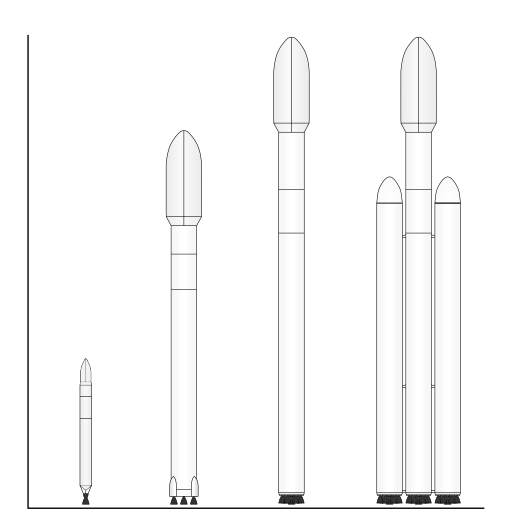
Falcon Heavy (right) with Falcon family
A stretched capsule could launch from a heavy lifting rocket like the Falcon Heavy housed in a fairing.  Upon arrival, it could dock or be captured and berthed to a station.  The hatch on one end of the capsule would minimize space issues while attached to a station.  I don't imagine that it would be used for crew but only for pressurized cargo.  The station's Astronauts (Cosmonauts, or Taikonauts - if you like) would unload it and load it back up with whatever needs to be taken back down to Earth.  That could include experiments and even waste.  I've been considering the environmental impact of expending waste by burning it in the atmosphere.  Dealing with the waste on the ground might be more beneficial.  The capsule would detach from the station and de-orbit on its own merit.  The long heat sheild and the integrity of the cross sectional shape of the capsule would allow for a similar atmospheric re-entry as the Dragon.  Stretching the capsule longways also allows room for extra parachutes.  Dragon stores its parachutes on the side of the craft in a compartment.  The stretched capsule could have two or more compartments for parachutes.  Then comes the propulsive landing which would have a number of thrusters along the sides of the craft.  Several landing legs would also support this operation.

 The stretch capsule could be an intriguing idea for future engineers and space operations.  I think the alternative is to build newer and bigger capsules mostly from scratch.  It's not just the capsule that has to be designed but the manufacturing process as well.  I think a stretched solution would use the existing manufacturing process with some added parts.  In the end, this is just one idea out of many.

Monday, June 3, 2013

Autogyro: Forgotten Tech Still Shows Signs Of Potential

Autogyros seem to be a forgotten tech thanks to the advent of the very versatile helicopter.  In modern times the autogyro has improved from Cierva's original design.  Two man crafts now feature initial powered rotation of the rotors, aft facing propeller that provides partial vector thrusting with the rudder.  Now the technology is being pushed further.  Let's check out a couple of 'sporty' autogyros on the market that would make James Bond green with envy, and let's look at two future developments in the making.

The autogyro is going the way of the sports car.  Calidus and Arrow Copter are currently on the market and show off their sexy bodies like no other rotary wing craft.  They both are tandem two seaters and feature enclosed cockpit with a bubble canopy.  Calidus has nice rounded curves and sleek lines while Arrow Copter sprawls out its elevator and rear landing gear almost like a bird of prey extends its wings, tail, and talons.  They are quite cool.  The beauty of a sleek and sexy autogyros lie in where they likes to fly.  They like to fly just above the tree tops, and they do very well there.  While planes can fly in that region, they can't maneuver as quickly in tight spaces as autogyros can.  Following the terrain is quite dangerous for planes.  Military planes require sophisticated radar mapping equipment to fly near the ground.  Autogyros can swivel in tight turns, can fly slow, and cost less in maintenance than a helicopter.  They can take off in around 500 ft of runway space though they don't need a runway.  A flat field will do.  They land in a fraction of that distance.  Both of these models have a max. speed of just over 100 mph.  They should do great in hilly or lake ridden landscapes.  I gathered this information by watching many videos of gyroplanes and reading specs on them.  Though it is said that autogyros are safer than helicopters, all aircraft can and do crash.  All safety precautions should be taken.


There are now 2 significant developments.  There is a flying car with the Pal-V, and there is a plane hybrid with Carter Aviation Technologies.  The Pal-V is a roadable autogyro.  That is it is street legal and flies like an autogyro.  It seems to drive more like an enclosed motorcycle than a car since it leans into turns on its 3 wheels.  The conversion from road vehicle to aircraft involves a combination of automatic motions and manual hands-on motions.  You can cross rivers, lakes, mountains (or hills), and valleys by flying over them and then park it at home.  That's pretty neat.

Carter Aviation Technologies have developed and perfected the slowed rotor concept to create a hybrid autogyro and plane.  The result is a craft that can virtually takeoff and land vertically yet have the flight efficiency and range of an airplane.  It's a real vertical takeoff and vertical landing craft (VTVL).  Carter Aviation redesigned the main rotor and added weights on the tips.  This allows for jump vertical takeoffs by pre-rotating the rotors.   The craft converts from autogyro to plane just by tilting the mast.  Then, it flies like a plane and you can get some great mileage or range out of your fuel.  With larger craft, Carter Aviation plans on using twin propellers with variable angle props which would allow the craft to hover like a helicopter.  This is truly a major breakthrough for the autogyro.


Autogyros are developing and have come far since Cierva made his debut flight in 1924.   Some on the market are sporty, sexy, and fun.  New innovations should help the future of this venerable craft.  Perhaps one day we will look at autogyros the way we look at helicopters personal planes.  It can be the safer go anywhere personal craft.  Engineering is awesome.

Wednesday, May 22, 2013

Getting To Mars Depicted (Part 2)

In Part 1, we went through how much a trip to Mars costs in terms of fuel and hardware.  It takes 8 large rocket launches just for one manned mission.  That is about 75% the launches of the Apollo program to the moon.  Back then, the US Congress was willing to spend the money, but today they are holding back wanting to cut NASA's budget.  That's nothing new.  Congress has been cutting NASA's budget for at least the past 20 years.  A manned mission to Mars is quite a huge undertaking.  I know I did not talk about the radiation concerns or other crew health issues.  NASA likes to mention those.  They don't like to mention how much it would cost, and I think that is an issue that Congress and the public need to address.  The more the public knows about this issue the better.  How could we possibly reduce the cost?  Well, I've got 2 ideas.  Both of them are along the lines of mass transportation and reusable assets.  Reusable transportation assets and multiple manifests could provide more effective financing than one mission going alone by any one government space program.

Many Launchers for 1 Mission
Reusable Assets

When talking about reusable assets, a tug to take payloads from Earth orbit to Mars orbit and a reusable Mars lander/launcher come to mind.    For Mars, these assets have to be very sophisticated to include transferring of fuel and other consumables.  They would have to be able to be controlled remotely with some automation and manually by any crew.

I've talked about a reusable tug before.  For Mars, having a large tug that can travel many times between the planets could provide the means to take multiple missions on each trip.  Distributing the cost of the trip among several customers could make the trip financially possible.  I like to imagine such a tug as being based on the concept of the Saturn S-IVB.  It would have to be much larger.  I could have duo-propulsion: traditional chemical booster; electric propulsion such as ion drive or plasma drive.  Space.com has a great article on electric propulsion called How Electric Spacecraft Could Fly NASA To Mars.  A robitic arm such as the Canadarm 2 could provide a means of capturing and docking many different types of space modules.  Also it should be able to carry many modules to include unmanned and manned modules simultaneously.  Our module technology has become quite sophisticated so I don't think that would be a problem.  One of the biggest issues of such a craft would be electric power.  Solar panels are nice, but large ones would be needed to power the electric propulsion.  They also should be able to retract and deploy on command and often.  I expect that aerobraking maneuver would help reduce the amount of fuel needed for each mission.  Solar panels would need to retract for that maneuver lest they are damaged.  These panels would have to last a long time.  Another option, though less popular, would be giving the craft its own nuclear power reactor.  Of course, responsible handling of the nuclear material is a must; including a disposal plan for the depleted nuclear material.

A reusable lander/launcher is necessary. The idea of landing on an atmospheric planet is enticing and yet hard.  If you going to reuse the lander, it has to launch from the planet as well.  We've never created a craft like that before.  It would need a heat shield that can pop off and be replaced easily (by robotic means), a reliable engine, and large tanks for fuel.  After every launch back into orbit, it would need to be serviced and refueled for the next landing.  This craft is important because for one manned mission, NASA would use 3 landers and 1 launcher.  That's 4 vehicles.  Consolidating hardware complexity and weight into one vehicle should save on cost.  Using this vehicle for many missions should be a savings multiplier.

What do we really want to do on Mars?  Do we want to just plant a flag and walk around a go home?  No, many folks want to do many things.  From geology to colonization to terraforming, Mars has inspired many possible missions.  If we go with throw away assets, we won't be able to afford getting there but once in a generation if at all.  Mars should also only be the first step to exploring and exploiting the inner solar system.  Therefore, reusable assets are a must.  We must build an infrastructure.

Multiple Manifests

Mars Plane
 To spread the cost of trips to Mars and back, it would seem a no brainer to get as many different missions and customers to sign on.  It's like filling up the cargo hold and passenger cabins of a larch ocean fairing ship to make trips between continents across a large ocean.

Imagine multiple unmanned mission accompanied by one manned mission packed on the reusable tug that is about to depart Earth orbit.  These mission could be from all types: orbital, landers, rovers and sample returns.  The landers, rovers, and sample return missions can get loaded up on the reusable lander/launcher to get down to the surface along with the assests of the manned mission.  It seems they would all land in one spot.  Well, that could create the opportunity to have some planetary transportation services such as fast rovers and aircraft.  You can quickly imagine a multitude of missions and activity around and on Mars.

Spreading the cost for each trip and back from Mars among many customers seems reasonable.  Using reusable assets such as a reusable transportation tug and a reusable lander/launcher goes hand in hand with multiple manifests.  Such an effort could easily be a commercial venture.  Such an infrastructure could have the effect of researching the red planet in a much faster fashion than what we do now.  If regular trips to Mars every 3 years is sustainable then we would have established a permanent link worthy of colonization.

Thursday, May 9, 2013

Getting To Mars Depicted (Part 1)

There is a lot of talk about going to Mars these days.  It's an old goal, and one that captures people's imaginations.  So much so that many movies and science fiction series episodes depict such a trip.  What are the current plans?  Why haven't we gone yet?

Artist's rendition
NASA's Mars Transfer Vehicle
NASA has a plan to get to Mars.  It involves 7 launches of the Heavy Lift Vehicle rocket, then 1 launch of a crew rocket,  and 3 transfer vehicles, 2 landers, and 1 launcher from the surface of Mars.  Unfortunately, that was for 1 manned mission.  That's an insane amount of hardware and consumables.  That gives you an idea of what a monumental task it is to land on Mars and to come back.

Unfortunately the plan was geared for the now dead Constellation Program. Russia has a plan for a manned Mars mission.  I've heard it's to the Martian moon Phobos.  Elon Musk wants to go to Mars as well as the Mars Society members.  Even Buzz Aldrin is looking forward to a manned Mars mission.  He has a book out now called Mission To Mars: My Vision For Space Exploration.

Mars by Viking 1
There are a couple of non-government proposals to the red planet.  Dennis Tito, who visited ISS in , proposed a sling shot mission around Mars involving two people but no landing.  What I like about this mission is that it's quite concise and understood.  I mean we've done this with unmanned craft. Space.com has an article about it called Dennis Tito's 2018 Human Mars Flyby Mission Explained.

Another proposed mission seems a little crazy to me because it sidelines the problem of returning to Earth by not returning.  Mars One Foundation wants to conquer Mars with a colony and is looking for people willing for this one way ticket mission.  The settlement idea is impressive.  They seem to use their resources wisely.  Yet, once people arrive, then you have to supply them with provisions like food for the long term.  That is at least a launch to Mars every 3 years.  If it's all the same to you, I'd be happier with a way back home to Earth, please.

The Mars Society is a group of people interested in colonizing the red planet.  They also create papers and do research that will aid in manned missions.  They have been conducting some interesting simulated manned mission on the martian surface.  These are being conducted at Mars Desert Research Station (MDRS).  It's a simulated base with all kinds of experiments going on.  They are always looking for volunteers.  I you wondered what would people do on the red planet, check Mars Society out.  You'd be amazed.

Mars - JPL Solar System Simulator
So, why haven't we been to Mars yet?  That's a really good question.  It's a question that is not easily answered.  We wanted to go in the Apollo era.  We've been talking about going for many decades.  We've sent rovers there and that has renewed interest for a manned mission.  I suppose the answer is embarrassing to engineers and scientists.  These guys are 'can do' people.  They take a 'can't don't' challenge and tackle it.  Manned mission to Mars happen to be extremely difficult.  The areas of difficulty are not in technology but finances and logistics.

There are two big problems with such a trip:

1. Mars is so far away its very expensive to land 1 lb on it.
2. Mars is hard to launch from, unlike the moon.

Mars is quite far away and that's understandable. 34.8 million miles is the closest Earth has come to Mars.  The moon is only 0.25 of a million miles from Earth.   Mars is going about 54,493.9 mph.  Earth is going about 66,673.5 mph.  Now, that may seem counter intuitive that Earth is actually traveling faster than Mars, but were dealing with the gravitational field of the Sun and it's not linear, but curved.  So, a spacecraft has to overcome the Earth's gravitational pull to cruise to Mars.  That would require several times the fuel needed to get to the moon per pound or kilogram.

To launch from the surface of Mars, you need to account for the gravity and the atmospheric friction.  Mars has about twice the gravity of the moon and a third that of the Earth.  The martian atmosphere pressure is like that at about 100k ft in Earth's atmosphere.  I figure you could compare it to launching from the Moon with the Apollo lander or launching from Earth with a Mercury launch.  Either way, you end up with a launcher that is several times the mass of the lunar lander.  You need to take all that weight to Mars from Earth, and that at multiple times what it costs to go to the moon.

The distance between Mars and the Earth and the conditions on Mars itself make it extremely expensive in fuel and hardware to do any mission.  That may help answer why we haven't gone yet.  Who is going to afford it?  Is there a better way than throw away hardware?

Click here for Part 2.


Sunday, April 28, 2013

Drones For Future Civilian Uses

We have all heard of drones these days.  They attack and hurt people, and they are robots in the sky.  Unmanned Areal Vehicles (UAV) is what they used to call them.  Back in the 90's that was a new name.  Before that we called them remotely controlled aircraft.  Yes, ladies and gentlemen, the harmless R/C airplane made out of balsa wood had turned into a killing monster out of science fiction.  Yet, I don't believe that drones are done evolving.  History has yet to write the next chapter on these aerial vehicles.  What makes a drone a drone, and where can it go from here?

Black Hornet Nano
A drone is an aircraft without a pilot, correction, without a pilot inside the craft itself.  There is most always a pilot, if not two.  Between the pilot and the craft is a series of communication devices and servos, and robotic relays that's needed to fly the craft.  The range of the craft will depend on two things, fuel and communication with the pilots.  Now, this set up allows for a very wide variety of size, shapes, and speeds.  So much so, that the smallest one that the military uses is only 10 cm (0.328 ft) long.  It's called the Black Hornet Nano.  As you can imagine, it's mission is for surveillance,     On the other end of the design spectrum, we have one of the largest which is the Global Hawk made by Northrup Grumman.  Now, this one has been in operation for a while.  New drones have come out that are more stealthy, but Global Hawk represents high end drones for our purposes.  It has a wingspan of 39.9 m (130.9 ft).  Of course, the main drone used by the military has been the Predator.  A drone has exceeded manned aircraft in an endurance flight.  Read about Zephyr in this article found in flightglobal.com.  There are many and varied drones in the world.  New aircraft designs like that of Carter Copter and HILLS Space Plane are finding some interest by the drone clients.  I think that drones are going to jump from military usage to commercial roles in the near future.  In his article, Joe Schoffstall of CNSNews.com says that near future is quite soon.

NASA's Global Hawk
There are commercial applications for drones that will come out in the future.  Among such applications, I can imagine drones covering the morning traffic commute.  Just think; instead of reporters climbing in a prop aircraft or a helicopter, they go inside where the drone's pilots are, an office that's on the ground.  The reporters look intently at the monitor that shows the images from the drone's cameras.  They are not in danger, and they can go to the bathroom anytime.  They report the traffic news, and the cost of this service drops.  Helicopters are costly to maintain.  Drones are smaller, and a drone the right size has the potential to be cheaper.  From what I can find out, current large drones are quite expensive.  It sounds favorable for the reporters, and potentially financially favorable for the network shelling out the money for this service.  Unfortunately, the helicopter or airplane pilot would be out of a job.  Other applications are ones that piloted planes do now, such as surveillance, law enforcement, etc.  One of the main benefits of drones is that they can stay aloft as long as they have fuel.  Pilots can be changed out in shifts on the ground.  An example of non-military use of drones is NASA's Global Hawk which is used to get telemetry on hurricanes and atmospheric readings related to Earth sciences.

I feel like I have to talk about the fear that people have of drones.  The US Military were the first military to use them and the first to use them as weapons.  The weaponizing of drones have had a bad effect on public relations.  Drone fear is real and heavy.  Farea al-Muslimi spoke to the US Senate on this fear in an article by Spencer Ackman of Wired Magazine.  They are hard to detect in the sky and they can strike when you least expect it.  This fear was not unique in aviation history.  Helicopters caused a similar fear, but that fear was about being monitored not killed.  Could this fear hamper any attempts at commercializing drones?

Drones are here, and they are here to stay.  What we do with them is going to be up to us.  What laws will restrict their uses in the future?  What will we tolerate?  What benefits could they have to our everyday life?  These things are merely tools.  ICBMs are weapons of mass destruction and instilled fear in common man in the Cold War.  Now companies like Orbital Sciences use them to launch satellites into orbit.  Like missiles, Drones can find an acceptable role in society.  You decide.

Sunday, August 19, 2012

Flying Cars

Flying cars have been the fancy of many over the years.  This concept is to make flying vehicles road worthy and thus able to take home an put it in your garage, assuming you just don't store junk in the garage but actually use it for vehicles (yeah right).  Robert Fulton debuted the Airphibian in 1946, and Moulton Taylor improved on Fulton's design with the Aerocar in 1949.  It was just after the war and Americans were getting out on the road traveling, even in campers.  The Aerocar towed its wings, tail and propeller as a trailer behind the car portion.  This idea was reinvigorated for a short time in 1980's with the use of a Honda CRX by Taylor.  This was an attempt at taking a production car and adding a wing and tail kit that was towed and then put together to fly.  I loved this idea.  I was a teen in the 1980's and to compound the fantasy of driving and flying, the movie Back To The Future came out.  Its last scene had the star car lift and fly into the future.  The Airphibian and the Aerocar were aircraft that could be driven on the road.  A car weigh approximately 2000 lbs without wings.  A Cessna 350 weighs similar but with wings.  It would seem a difficult task to merge these two techs whichever way you cut it.  Well, now there is a new flying car effort underway.  Let's look at 3 promising examples that have actually flown in prototype.

Terrafugia is a company that created another roadable aircraft but this one has folding wings and only with a push of a button it transforms from a road vehicle to an air vehicle.  The Aerocar required some manual setup for the same conversion.  Yes, it looks like the love child of a small propeller plane and family size car.  Strange to look at and probably strange to drive too.  It's longer than a common car and taller with the wings folded.  I assume you need to drive it with the care for spaces as you do a truck.  On the Terrafugia website, the expected price is about $279,000.00.  YIKES! Getting a space ticket with Virgin Galactic is cheaper than that.  Don't scratch the paint.  On the plus side it could increase you commute range to work.


Maverick is an off road vehicle in more ways than one.  Sure, it's roadable, but some people want to go where there are no roads and want to cross over a gorge or a river valley with less difficulty.  If your such a person, then this vehicle is for you.  It uses parasail tech and a unique deployment system to chance from road machine to flying machine.  It's not all that fast in flight, just about 40 mph.  It is light and fast on the ground.  It's the only off road flying car I know about.  Maybe in the future there will be more.


PAL-V ONE is a European flying car.  Well, car might be stretching it.  It is enclosed, but it drives like a motorcycle by leaning into the curvy roads.  If you feel like its missing a wheel, don't.  It has 3 wheels, one in the front and two in the back.  It seats two, but in tandem.  It's flying technique is that of an autogyro.  What's an autogyro?  Well, it was the predecessor to the helicopter.  Its a rotary wing aircraft that has a pusher propeller and is a short takeoff and landing (STOL) aircraft.  It seems pretty nice and seems to be pretty cool.  It has some interesting fold up features with the propeller and the mast for the rotors.  Yet, it does require setup time for the change from road warrior to angel flight.  As a STOL craft, it doesn't require a full runway, but a short space to take off.  Modern autogyros have a powered rotation system to start the rotors and can literally jump in the air from a stand still and fly.  I don't see that capability here, yet it must have some powered rotation system otherwise you have to start the rotors by hand.  It's cool and good looking, but did the Dutch get it right?  Not many people are attracted to an autogyro, but I am.  I like the STOL feature, and the enclosed driving and flying experience.  You have to wonder what the maintenance expense would be like.  The autogyro setup is much less expensive to maintain than a helicopter, but that's not really saying much.  As a custom and unique vehicle I expect maintenance to be pricey.


There you have it, 3 very different flying cars to choose from: Terrafugia with a car-plane combo, Mavrick with a off road car-paraglider combo, or PAL-V with a enclosed trike-autogyro combo.  Whatever you choose there's one thing you should take notice of and that thing is power lines.  Yeah, well, you know.  Got to be safe and all that.  Being zapped by upteenthousand volts tens of feet in the air isn't that nice.  Our society just isn't set up for flying cars.  I mean each of these need a road license and a flight license.  Then the driver need a driving license and a pilot's license.  On the positive side the FAA is licensing these as Light Sport Aircraft.  So perhaps there is some wind in their wings after all.