Showing posts with label aviation. Show all posts

Thursday, July 16, 2020

Say Goodbye to the Queen of the Skies

Boeing is ending production of the original Jumbo Jet, Boeing 747, per a Bloomberg article. This plane has helped shape the world economy to what it is today. It is more than that, this is personal. The Boeing 747 has been a part of my life story from early on.

Boeing 747 by EC Holm

It had started its journey in 1970.  I first flew on one on a transatlantic flight from New York to Madrid only four years after its debut. The captain came over and handed me a pair of wings. Those were my first. I was seven years old at the time. Yes, the airline was TWA.

The plane made intercontinental flights economical and thus opened up economies. Business people used them a lot. They were also used to ship products. In later years, shipping companies like FedEx and UPS made use of them. Heck, I got FedExed in one while I was in the Air Force to Okinawa. It was a joke because FedEx was the contractor to carry troops to Kadena AB from the States, but it was a passenger plane, no boxes.

The 747 has seen all kinds of variations to her both military and civilian. Some notable variations of the plane have been a firefighter (Supertanker), telescope (SOFIA), rocket launcher (Virgin Orbit), large cargo carrier (Dreamlifter), a laser testbed (YAL-1 ), an engine testbed (article), and 2 of them reconfigured into the largest plane in the world (Stratolaunch). I loved these things. I thought it was amazing how such a large plane could be a tool to do such amazing work. Of course, there have been many production variants of the plane to suit many needs. I remember reading in 1988 about a 747 SP making a world record for flying around the world in record time. The article said that the plane made use of the jet stream. I had realized from talking to Air Force pilots that you can go Mach 1 ground speed in an airliner if you take advantage of a favorable jet stream. Not that you are actually breaking the sound barrier with the air around you because the air is moving with you.

I do not know what Boeing is doing by discontinuing the 747, queen of the skies. Personally, I think it is a mistake on their part like many mistakes they have been making of late. Sure, they blame it on the market and fuel economy, but customers are still wanting the old girl.

I find it nostalgic and frankly sad to say goodbye to such a beauty. Yet the end it is still not (if I dare conjure up my inner Yoda). Many 747’s are flying and will fly the blue yonder for many years to come.

Monday, June 3, 2013

Autogyro: Forgotten Tech Still Shows Signs Of Potential

Autogyros seem to be a forgotten tech thanks to the advent of the very versatile helicopter.  In modern times the autogyro has improved from Cierva's original design.  Two man crafts now feature initial powered rotation of the rotors, aft facing propeller that provides partial vector thrusting with the rudder.  Now the technology is being pushed further.  Let's check out a couple of 'sporty' autogyros on the market that would make James Bond green with envy, and let's look at two future developments in the making.

The autogyro is going the way of the sports car.  Calidus and Arrow Copter are currently on the market and show off their sexy bodies like no other rotary wing craft.  They both are tandem two seaters and feature enclosed cockpit with a bubble canopy.  Calidus has nice rounded curves and sleek lines while Arrow Copter sprawls out its elevator and rear landing gear almost like a bird of prey extends its wings, tail, and talons.  They are quite cool.  The beauty of a sleek and sexy autogyros lie in where they likes to fly.  They like to fly just above the tree tops, and they do very well there.  While planes can fly in that region, they can't maneuver as quickly in tight spaces as autogyros can.  Following the terrain is quite dangerous for planes.  Military planes require sophisticated radar mapping equipment to fly near the ground.  Autogyros can swivel in tight turns, can fly slow, and cost less in maintenance than a helicopter.  They can take off in around 500 ft of runway space though they don't need a runway.  A flat field will do.  They land in a fraction of that distance.  Both of these models have a max. speed of just over 100 mph.  They should do great in hilly or lake ridden landscapes.  I gathered this information by watching many videos of gyroplanes and reading specs on them.  Though it is said that autogyros are safer than helicopters, all aircraft can and do crash.  All safety precautions should be taken.


There are now 2 significant developments.  There is a flying car with the Pal-V, and there is a plane hybrid with Carter Aviation Technologies.  The Pal-V is a roadable autogyro.  That is it is street legal and flies like an autogyro.  It seems to drive more like an enclosed motorcycle than a car since it leans into turns on its 3 wheels.  The conversion from road vehicle to aircraft involves a combination of automatic motions and manual hands-on motions.  You can cross rivers, lakes, mountains (or hills), and valleys by flying over them and then park it at home.  That's pretty neat.

Carter Aviation Technologies have developed and perfected the slowed rotor concept to create a hybrid autogyro and plane.  The result is a craft that can virtually takeoff and land vertically yet have the flight efficiency and range of an airplane.  It's a real vertical takeoff and vertical landing craft (VTVL).  Carter Aviation redesigned the main rotor and added weights on the tips.  This allows for jump vertical takeoffs by pre-rotating the rotors.   The craft converts from autogyro to plane just by tilting the mast.  Then, it flies like a plane and you can get some great mileage or range out of your fuel.  With larger craft, Carter Aviation plans on using twin propellers with variable angle props which would allow the craft to hover like a helicopter.  This is truly a major breakthrough for the autogyro.


Autogyros are developing and have come far since Cierva made his debut flight in 1924.   Some on the market are sporty, sexy, and fun.  New innovations should help the future of this venerable craft.  Perhaps one day we will look at autogyros the way we look at helicopters personal planes.  It can be the safer go anywhere personal craft.  Engineering is awesome.

Sunday, April 28, 2013

Drones For Future Civilian Uses

We have all heard of drones these days.  They attack and hurt people, and they are robots in the sky.  Unmanned Areal Vehicles (UAV) is what they used to call them.  Back in the 90's that was a new name.  Before that we called them remotely controlled aircraft.  Yes, ladies and gentlemen, the harmless R/C airplane made out of balsa wood had turned into a killing monster out of science fiction.  Yet, I don't believe that drones are done evolving.  History has yet to write the next chapter on these aerial vehicles.  What makes a drone a drone, and where can it go from here?

Black Hornet Nano
A drone is an aircraft without a pilot, correction, without a pilot inside the craft itself.  There is most always a pilot, if not two.  Between the pilot and the craft is a series of communication devices and servos, and robotic relays that's needed to fly the craft.  The range of the craft will depend on two things, fuel and communication with the pilots.  Now, this set up allows for a very wide variety of size, shapes, and speeds.  So much so, that the smallest one that the military uses is only 10 cm (0.328 ft) long.  It's called the Black Hornet Nano.  As you can imagine, it's mission is for surveillance,     On the other end of the design spectrum, we have one of the largest which is the Global Hawk made by Northrup Grumman.  Now, this one has been in operation for a while.  New drones have come out that are more stealthy, but Global Hawk represents high end drones for our purposes.  It has a wingspan of 39.9 m (130.9 ft).  Of course, the main drone used by the military has been the Predator.  A drone has exceeded manned aircraft in an endurance flight.  Read about Zephyr in this article found in flightglobal.com.  There are many and varied drones in the world.  New aircraft designs like that of Carter Copter and HILLS Space Plane are finding some interest by the drone clients.  I think that drones are going to jump from military usage to commercial roles in the near future.  In his article, Joe Schoffstall of CNSNews.com says that near future is quite soon.

NASA's Global Hawk
There are commercial applications for drones that will come out in the future.  Among such applications, I can imagine drones covering the morning traffic commute.  Just think; instead of reporters climbing in a prop aircraft or a helicopter, they go inside where the drone's pilots are, an office that's on the ground.  The reporters look intently at the monitor that shows the images from the drone's cameras.  They are not in danger, and they can go to the bathroom anytime.  They report the traffic news, and the cost of this service drops.  Helicopters are costly to maintain.  Drones are smaller, and a drone the right size has the potential to be cheaper.  From what I can find out, current large drones are quite expensive.  It sounds favorable for the reporters, and potentially financially favorable for the network shelling out the money for this service.  Unfortunately, the helicopter or airplane pilot would be out of a job.  Other applications are ones that piloted planes do now, such as surveillance, law enforcement, etc.  One of the main benefits of drones is that they can stay aloft as long as they have fuel.  Pilots can be changed out in shifts on the ground.  An example of non-military use of drones is NASA's Global Hawk which is used to get telemetry on hurricanes and atmospheric readings related to Earth sciences.

I feel like I have to talk about the fear that people have of drones.  The US Military were the first military to use them and the first to use them as weapons.  The weaponizing of drones have had a bad effect on public relations.  Drone fear is real and heavy.  Farea al-Muslimi spoke to the US Senate on this fear in an article by Spencer Ackman of Wired Magazine.  They are hard to detect in the sky and they can strike when you least expect it.  This fear was not unique in aviation history.  Helicopters caused a similar fear, but that fear was about being monitored not killed.  Could this fear hamper any attempts at commercializing drones?

Drones are here, and they are here to stay.  What we do with them is going to be up to us.  What laws will restrict their uses in the future?  What will we tolerate?  What benefits could they have to our everyday life?  These things are merely tools.  ICBMs are weapons of mass destruction and instilled fear in common man in the Cold War.  Now companies like Orbital Sciences use them to launch satellites into orbit.  Like missiles, Drones can find an acceptable role in society.  You decide.

Friday, April 5, 2013

The Return Of Chesterfield Airshow

TBM Avenger 2007 Airshow
The Chesterfield Air Show is coming back in 2014.  We haven't seen it since 2007, which I attended.  I love airshows.  The flight demonstrations are great but I like the static displays best.  That's where you get a close look at the craft, touch it, and talk to pilots and owners.  It's just a thrill to get next to a hunk of metal that can lift itself in the air.

According to the St Louis Post Dispatch reported in it's article Spirit of St Louis to hold anniversary show article that this will be a one time show.  Of course that could change and it could become an annual event.  At least that is the inference.

C-2 Greyhound 2007 Airshow
The previous air show had a county fair attached to it.  The one next year will not but will be on a STEM (Science Technology Engineering, and Mathematics) bent.  I really think this is a worthy cause.  We need young students interested in these fields to fuel our technology research machine.  Aviation is a wonderful field to demonstrate what you can do with research.  Old engineering techniques, 'war' stories (stories of experience),  new materials, and new gadgets are some of the things you can pick up from air shows.

Kudos to St Louis County for this airshow.  I encourage everyone who can to come out next year and check it out.  For those not in Missouri, keep the look out for your local airshow and support it.  Many airshows die out because of lack of participation and that's a sad thing.  I encourage the STEM effort and airshow partnership.  It seems a good need and solution effort.

(Pictures shown in this post were taken by E C Holm in the 2007 Chesterfield Airshow)

Friday, March 8, 2013

Learjet In Chahokia

This story made the national news.  A Learjet had landing gear trouble and took it's time to figure out how to land at St Louis Downtown Airport in Cahokia, Illinois.   The plane ended up making a safe landing at Lambert Airport at the pilots request for a wider landing strip.  The front gear was the one the pilot was concerned about.  Apparently it could come down and retract, but it was 30 degrees tilted off center.  That was revealed to the pilot after a flyby of the tower at the St Louis Downtown Airport.  The crew and eight passengers were aboard.  I'll comment about the aircraft and the landing.

Learjet 45
Learjet is the maker of business jet aircraft that have better speed than airliners.  The Learjet in the story was a model 45.  It has a cruise speed of 500 mph and a range of 1968 mi.  It was developed in the early 1990's so it's not a new aircraft.  In fact, there was an upgrade to this model called the model 45XR.

With nose gear problems, a pilot might try keeping the nose in the air while landing and slowing the plane to a near stop.  I've seen this maneuver done by F-15 pilots.  Apparently they like to see who can keep the nose up the longest.  I don't think a Learjet could do such a stunt.  The pilot might have preferred to let the nose down as slow as possible.  The Grimli Glider had a nose gear that didn't want to lock as one of its problems.  The gear collapsed on landing and the front part of the fuselage halted the aircraft.  The pilot of the Learjet took a long time to land apparently figuring out the best way to minimize damage to the plane and injury to the passengers.  He tried a couple of times to land but aborted before landing at Lambert.  To his credit, he succeeded without incident.

As to emergency landings, this one ended on a good note.  Too often they don't end well.  I suppose it made the national news because the pilot requested the main airport rather than the smaller one.  The story was covered by Fox 2 News. 


Friday, March 1, 2013

Looking At AugustaWestland

Growing up making model aircraft and learning about all kinds of craft, I bought a book on helicopters.  It documented all the helicopters up to that time, 1980's.  The designs were interesting and varied.  I did notice a brand of helicopter that seemed pretty fancy and yet I hadn't heard of.  It was the Augusta helicopters.  They seem to rival high end VIP helicopters of Bell.  Recently I was saddened to hear that AugustaWestland had some serious allegations against them in their deal with selling some helicopters to India.  Westland was a British aircraft firm.  Augusta and Westland were merged in 2000.  Both companies have a good history in making high quality helicopters.  Let's check out a couple of these beauties.

Westland Lynx
The Lynx was originally developed by Westland for the British military.  Westland shared its production with the french company Aerospatiale, now a part of Eurocopter.  This helicopter has had long history with British, French, and many other countries' military.  Whether with wheels or skids it has had a lot of different configurations for multiple roles.  It's popularity is not surprising, since it set the speed record for helicopters in 1986.  I've seen footage where this very capable craft has even done the unimaginable for rotary wing, barrel roles.  It's a great air platform.  The updated version of the Lynx is called the AugustaWestland AW159 Wildcat.  It made an appearance in the movie Skyfall.  The Wildcat has a max speed of 296 kph (183.9 mph), and a range of 787.3 km (489.2 mi).  It can take 2 crew and 6 passengers.

AW101
The AW101 was originally a joint effort by Westland and Augusta under the name of EH101.  They call it Merlin.  It's a medium lift craft that replaces the S-61's role with many modern features.  Troop carrier, sub hunter, search and rescue, this craft can do it all and in all weather conditions.  Looking at the specs, it can hold 2 crew members and 30 passengers.  It has a range of 1058 km (657.4 mi).  It has a cruising speed of 278 kph (172.7 mph). 

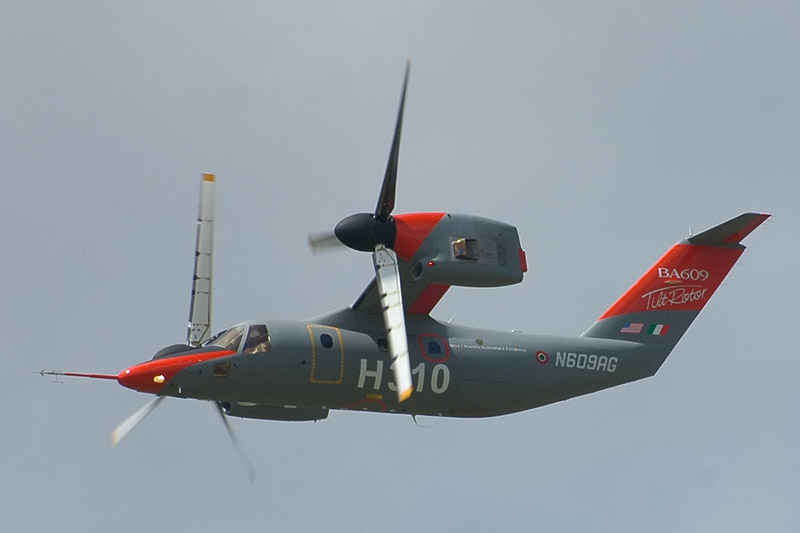
AW 609
The AW609 was developed by Augusta and Bell and it's being produced by AugustaWestland.  The tiltrotor technology was developed by Bell in a project called XV-15.  Out of it came V-22 Osprey.  You can say that the AW609 is the civilian version of the tiltrotor tech.  It has a cruise speed of 465 kph (299 mph).  It has a range of 1390 km (852 mi).  It up to 9 passengers with a crew of 2.  This exceeds the speed and range of the AW101 and the Wildcat.  This is the purpose of the tiltrotor, to have a VTOL aircraft that can fly longer and faster than a helicopter.  Sikorsky's X-2 and Carter Copter's Slowed Rotor techs are competing for similar markets as the tiltrotor tech.

If you haven't heard of AugustaWestland before, now you have.  It happens to be a mainstay company in the rotary wing craft business just like Boeing, Sikorsky, and others.  They have an impressive presence in Europe but do business world-wide.  They are bold enough to try to market the tiltrotor in the commercial markets when no other company will.  I'd keep an eye on these guys see what they will do next.

Friday, February 15, 2013

A Govonor And His Beechcraft

Well, recently the Missouri Governor bought a plane .  Well technically it was Missouri Highway Patrol that bought it.  The Governor is going to use it though.  This caused the legislature to complain because of the cost and the fact they weren't informed of the purchase beforehand.  Could we call this Missouri Force One?  Not likely.  The aircraft is far from an air liner like Air Force One is.  It happens to be a King Air 250 made by Beechcraft.  The plane is also supposed to be used by Highway Patrol for drug interdiction.  Let's check out its specifications and the company that markets it.

King Air 250
It's max speed is about 356 mph.  Its range is about 1362 miles with four passengers.  It can operate up to 35,000 ft.  It can carry up to 10 passengers with one pilot.  That's not at all bad for a prop plane.  I can see the justification of using it for law enforcement.  It could track ground vehicles quite nicely.  It seems to be more economical than a jet.  It only runs $3.06 a mile.  It can cover the State of Missouri handily.  The state is only 240 miles by 300 miles.  Add some surveillance devices on the craft and you have a good platform for law enforcement.  Missouri is located in the middle of the continental United States so we get a lot of through traffic that's legal and illegal.  It should be a nice plane for the Governor as well to travel to other states and such.  Though the public might think of planes as being a cost just for the big wigs, AVweb put out a good article about state planes which explains cost and usage of these aircraft.  There seems to be a valid argument for these planes.  Coupled with another mission of law enforcement, it seems the administration has done its homework.


Beechcraft is a company that markets these small business planes though they are manufactured by different companies.  Its a company that started in 1932 and was bought up by Raytheon in 1980.  Raytheon merged it with Hawker in 1994.  In 2006, Raytheon sold the company to Goldman Sachs and Onex Corporation to make Hawker Beechcraft.  The recession was not good to the company.  They went dove into bankruptcy and pulled out of it in Oct 2012.  It now stand proudly on its own as Beechcraft Corporation.  Hawker, of course, is the legendary company the made the Hawker Hurricane of Battle of Britain fame.  What a history for such an iconic brand.  I hope the best for them.

There you have it. A legislature up in arms, a Governor with a plane, and a company getting back on its feet.  What amazing times we live in. 

Monday, December 24, 2012

Boom By Boom

The P-38 is not like many planes in World War II.  It had twin booms.  Twin boom aircraft are among the most stunning looking and intriguing aircraft.  It seems that reasons for having a twin boom rather than a mono-body are varied and have little to do with aerodynamics.  This configuration allows for rear cargo doors, a push propeller, rear observations or electronics, stable overall frame, central exterior cargo, and other things that I can't think of.  When your designing something and you start to look at the numbers, different characteristics are desired over others based on the desired role of the aircraft.  A twin boom design might just flip the bill.  Let's check out a few of my favorites.

P-38 Lightning
P-61 Black Widow
World War II was an interesting era for aircraft design.  The P-38 and the P-61 had similar twin boom configurations.  Their crews were housed in a central nacelle set between the two booms that housed the twin prop engines.  In the case of the P-38, there was seating only for one and all the guns and cannons were directly in front of the pilot.  No propeller interrupt was needed.  It was designed as a high altitude (20,000 ft.) interceptor.  It featured a large rear elevator, a large wing area, and a twin boom design.  The twin booms were ideal to keep structural integrity and low weight.  It was successful in its missions and had a number of variants and upgrades.  The P-61 was a night fighter that had a crew of 3 and would be in flight for 8 hours.  It was used to hunt bombers, and had a newly developed aircraft radar system.  Such equipment for that era was large and heavy.  On top of that, this plane was armed to the teeth.  It was classified as a fighter.  The rear of the middle nacelle was where the radar guy sat. Jack Northrop made the initial design and gave it its twin booms.  I wish I knew why.

There were some cargo aircraft of this configuration.  Now, they are all but abandoned.  One in particular starred in the 1965 movie Flight of the Phoenix.  The plane was the C-119 Boxcar.  It had a large central nacelle where cargo and crew were.  The rear of that nacelle featured large doors that opened to the sides.  Now cargo planes have a very different design for the rear doors that allows for more traditional craft design.  In the movie, the plane crashes and the survivors make a new plane using one engine boom and attaching the wings to it.  I do recommend the movie.  A remake was made of it in 2004, but I like the original.


WhiteKnightTwo
He 111 z
The strangest of the twin booms are the twin fuselages.  These are used for various reasons.  These differ from the P-38 design in that the elevators are not joined.  One I like a lot is the Heinkel 111 Z.  It was a makeshift of two Heinkel 111s that were joined together by the main wing.  A fifth engine was added in the middle.  The purpose of it was to tow the biggest glider of World War II, the Me 321.  I found some great pictures of this aircraft in a french web site (click here, Google translated here).  Its definitely one of the more unique aircraft.  In modern times, Scaled Composites created a mother ship to launch a rocket spaceplane into suborbital heights.  The plane was the WhiteKnite.  It featured twin booms, a middle nacelle for cockpit and engines.  The main wing raised from the booms to the center in order to give clearance to the main cargo, the space plane.  Burt Rutan designed it and came up with it out of neccesity and speed of manufacturing.  They were in the Ansari X-Prize competition, and ended up winning.  The descendant of this plane was WhiteKnightTwo.  This had twin fuselages and was a more concise design.  Its purpose was also to carry a rocket spaceplane and be able to launch it form altitude.  At the time of its construction, it was the largest all composite aircraft to date.  Another twin body mother ship was the proposed aircraft of Stratolaunch.  Stratolaunch want to launch medium sized space launchers from the air.  The mother ship would be the biggest airplane by wing span.  There's a lot of things to be done before such a vision becomes a reality.

O-2 Skymaster
OV-10 Bronco
In the category of observation aircraft, we have the O-2 Skymaster and the OV-10 Bronco.  The Skymaster was from a civilian aircraft.  It featured two props, a puller and a pusher.  The booms were really skinny and just made to work around the pusher prop.  The US used this in the Vietnam Conflict as an observation platform.  It would track enemy ground troops.  It was featured in the movie Bat-21.  That was a really good flick.  One of the problems with it is that it was shot down by small arms fire.  In later years, the US Air Force acquired the OV-10 as an observation platform.  This craft was rugged.  It could land anywhere, and it could short takeoff as well.  It featured a design like the P-38, but it could carry 2 people and had a small cargo hold.  So it could resupply a small ground troop unit in the bush.  It did have ejector seats, but you'd better be wearing your helmet because your going to crash through the cockpit class.  The glass did not eject.  I bet it hurt.

Wow!  There's a lot of these twin boom aircraft.  From the P-38 to the modern WhiteKnightTwo, it seems these configurations aren't going away.  There are even unmanned aerial vehicles with twin booms.  This types of aircraft have a multitude of uses.  I believe they are a prime example of what makes airplanes so great.


Saturday, August 25, 2012

Wearable Aviation

Ever had a dream where you flew without a craft?  You felt free and liberated.  You could go anywhere.  Well, that's been the dream of humans since history began.  What if you could capture that feeling?  Well, today there are several who are trying with some technology you wear.

 There's an ex-airline pilot by the name of Yves Rossy.  He calls himself  'Jetman' and his technology comprises of a set of wings and mini-turbofan engines.  With that he flies like a bird.  When he puts on the wings and engines, his body become part of the whole flying craft.  Leaning his body up down left right, is part of how he controls the flight.  He is like a bird.


Yves Rossy on TED


Martin Jetpack

Remember the Jetpack?   It's technically called the Rocket Belt.  It's used in various public events such as the Los Angeles Olympics in 1984.  It inspires the mind and causes us to think how wonderful such a flight could be.  You just strap it on and you fly up and around buildings above the tree tops.  WOW!  Unfortunately it only lasts for less than a minute.  It is indeed rocket technology.  Now, there's a company out there taking the idea of the Rocket Belt and redesigning it for longer flights.  It's called the Martin Jetack.  It seems to work like the Rocket Belt, but its bigger and does not use rockets.  Instead, it uses an engine that powers two ducted fans.  The design is impressive.  I particularly like the control fins way down low in the path of the ducked fans' thrust.  It's absolutely amazing.  You should really check out their website here and see their progress.  Especially check out the videos.  I really get inspired and a tingle up my spine when I see this thing fly.  How could you not?  Ok, yes, jetpacking is a dream that many have dreamed for a long, long time.  Watch the Rocketeer and it has reference to the time period people dreamed of this.  It has some really good actors in there, especially Jennifer Connelly.  But I digressed.  Yeah, this flying free is really cool.  Now an off shoot of this is a water jetpack called the Jetlev-Flyer.  It makes jetpacking a water sport.  It's quite an ingenious and fun application of the jetpack tech.  I takes the same configuration as the Rocket Belt.  I've also seen a video of an adaptation of it that takes the configuration similar to that of Iron Man.  It has main thruster on the feet and stabilizing thrusters on the arms.  Really Cool!

ITN News


Now let's go high, really high.  In fact, let's go out of this world high, literally.  The EVA Suit (extra vehicular activity suit) is now commonly used outside of the ISS (international space station).  The NASA EVA suits come with a jetpack just incase astronauts and cosmonauts get unattached to the ISS.  This gives them the ability to cruise around in orbit.  Astronauts have often described EVA suits as your own personal space craft.  You have water, heating, cooling, oxygen, air pressure, and toilet capabilities.  Hey, those guys are in those things for 8 hours at a time you got to put the stuff somewhere. These things are truly amazing.  They allow you to experience space as much as possible without dying.  But when did they first test these things?  If you think it was during Apollo, your wrong.  If you think it was during Gemini, your wrong.  If you think it was during Mercury, your wrong.  Nope, it was before all of them that these things were tested.  One of the most extreme tests was done at the edges of space in Project Excelsior.  No, it was not a transwarp drive test run, like trekkies would like to believe.  Instead it was a test of the EVA suits by means of a balloon to the height of almost 103,000 feet.  The individual had to jump off the balloon at that altitude and parachute down.  GULP!  That's a huge height.  Scardicats need not apply.   The man of the hour was Col. Joe Kittenger.  WOW!  Pilots often say, 'Why jump out of a perfectly good craft?'  For years Kittenger remained the highest parachute jump by a man.  Now, that record is being challenged, and Kittenger is helping with the project.  The Project is called Red Bull Stratos.

Look Out Below
Red Bull Stratos is an ambitious project to not only break records but to test a new EVA suit.  I think it might be a suit for commercial astronauts though I have not read anything to that effect, I just have a hunch.  Just think, you get up in the morning, got to work, put on a suit and a helmet and gloves, climb into this godola that's attached to a balloon that takes you over 100,000 feet from tierra firma.  You get up, unhook and JUMP!  Oh man!  I can feel it, but what kind of crazy person you have to be to do that?  If your such a crazy person, more power to ya.  Ok, so they found someone to do this jump and his name is Felix Baumgartner.  This is an impressive guy in his own right without this feat.  I think the big jump will take him to new heights.  I can only imagine that more people would want to experience such a jump and perhaps a new space tourism market will be born.  This is really mind boggling.  You see Earth far below.  You see the curvature of the planet, above you is the black sky of space, and there is barely any air around you at all.  Your space suit is what is keeping you alive with oxygen.  Good thing it had some facilities built in it, cause you going to use those when you see the view.  Amazing.  Absolutely, amazing.


Well, how to you like that?  From fun to extremely dangerous, we've looked at some of today's or tomorrow's wearable aviation.  What would you give to try one right now?  I would do it in a heartbeat.  The I'll be reminded that I'm scared of heights.  The notion of putting on something that makes you superhuman like a super hero is amazing.  To experience freedom of movement from a extremely personal view is awe inspiring.  To make dreams into reality is what this tech is all about.  You can do it, but you have to know science and math to do it as well as having big dreams.  Cheers.

Sunday, August 19, 2012

Flying Cars

Flying cars have been the fancy of many over the years.  This concept is to make flying vehicles road worthy and thus able to take home an put it in your garage, assuming you just don't store junk in the garage but actually use it for vehicles (yeah right).  Robert Fulton debuted the Airphibian in 1946, and Moulton Taylor improved on Fulton's design with the Aerocar in 1949.  It was just after the war and Americans were getting out on the road traveling, even in campers.  The Aerocar towed its wings, tail and propeller as a trailer behind the car portion.  This idea was reinvigorated for a short time in 1980's with the use of a Honda CRX by Taylor.  This was an attempt at taking a production car and adding a wing and tail kit that was towed and then put together to fly.  I loved this idea.  I was a teen in the 1980's and to compound the fantasy of driving and flying, the movie Back To The Future came out.  Its last scene had the star car lift and fly into the future.  The Airphibian and the Aerocar were aircraft that could be driven on the road.  A car weigh approximately 2000 lbs without wings.  A Cessna 350 weighs similar but with wings.  It would seem a difficult task to merge these two techs whichever way you cut it.  Well, now there is a new flying car effort underway.  Let's look at 3 promising examples that have actually flown in prototype.

Terrafugia is a company that created another roadable aircraft but this one has folding wings and only with a push of a button it transforms from a road vehicle to an air vehicle.  The Aerocar required some manual setup for the same conversion.  Yes, it looks like the love child of a small propeller plane and family size car.  Strange to look at and probably strange to drive too.  It's longer than a common car and taller with the wings folded.  I assume you need to drive it with the care for spaces as you do a truck.  On the Terrafugia website, the expected price is about $279,000.00.  YIKES! Getting a space ticket with Virgin Galactic is cheaper than that.  Don't scratch the paint.  On the plus side it could increase you commute range to work.


Maverick is an off road vehicle in more ways than one.  Sure, it's roadable, but some people want to go where there are no roads and want to cross over a gorge or a river valley with less difficulty.  If your such a person, then this vehicle is for you.  It uses parasail tech and a unique deployment system to chance from road machine to flying machine.  It's not all that fast in flight, just about 40 mph.  It is light and fast on the ground.  It's the only off road flying car I know about.  Maybe in the future there will be more.


PAL-V ONE is a European flying car.  Well, car might be stretching it.  It is enclosed, but it drives like a motorcycle by leaning into the curvy roads.  If you feel like its missing a wheel, don't.  It has 3 wheels, one in the front and two in the back.  It seats two, but in tandem.  It's flying technique is that of an autogyro.  What's an autogyro?  Well, it was the predecessor to the helicopter.  Its a rotary wing aircraft that has a pusher propeller and is a short takeoff and landing (STOL) aircraft.  It seems pretty nice and seems to be pretty cool.  It has some interesting fold up features with the propeller and the mast for the rotors.  Yet, it does require setup time for the change from road warrior to angel flight.  As a STOL craft, it doesn't require a full runway, but a short space to take off.  Modern autogyros have a powered rotation system to start the rotors and can literally jump in the air from a stand still and fly.  I don't see that capability here, yet it must have some powered rotation system otherwise you have to start the rotors by hand.  It's cool and good looking, but did the Dutch get it right?  Not many people are attracted to an autogyro, but I am.  I like the STOL feature, and the enclosed driving and flying experience.  You have to wonder what the maintenance expense would be like.  The autogyro setup is much less expensive to maintain than a helicopter, but that's not really saying much.  As a custom and unique vehicle I expect maintenance to be pricey.


There you have it, 3 very different flying cars to choose from: Terrafugia with a car-plane combo, Mavrick with a off road car-paraglider combo, or PAL-V with a enclosed trike-autogyro combo.  Whatever you choose there's one thing you should take notice of and that thing is power lines.  Yeah, well, you know.  Got to be safe and all that.  Being zapped by upteenthousand volts tens of feet in the air isn't that nice.  Our society just isn't set up for flying cars.  I mean each of these need a road license and a flight license.  Then the driver need a driving license and a pilot's license.  On the positive side the FAA is licensing these as Light Sport Aircraft.  So perhaps there is some wind in their wings after all.


Thursday, August 16, 2012

A New Rotary Wing Class

In 2005 the Bell Boeing Osprey went into service with the United States Marine Corps.  It was the first operational tiltrotor aircraft.  No, it was not the first attempt at taking VTOL beyond the helicopter, but it is enjoying more success than some other concepts.  Now, some new concepts are in research that are made to give tiltrotor competition.  The ideas behind all these concepts are longer range and faster speeds while still allowing for vertical takeoffs and landings.  Let's look at a couple of older concepts and then look at the newer ones.


Tiltwing aircraft was tried in the late 1950's.  It was an interesting concept and it wettened the US, Canada, and Unite Kingdom's militaries on the idea of a VTOL transport that had longer range than helicopters.  The idea was that the main wing tilted from a horizontal position to a vertical position, thus also tilting the engines and propellers.  You could say that it was the predecessor of the tiltrotor.  I always liked this concept and thought that it had potential.  Apparently so did a lot of other folk.

The slowed rotor concept was also an interesting concept.  The idea was that a aircraft with a helicopter like rotors and wings and engines of a plane could take off vertically slow the rotor to reduce drag and increase range and speed for cruising and then land vertically.  Actually the concept employed techniques of the autogyro for going from lift from the rotor to lift from the main wing. Before and after the second world war, aircraft companies ventured in this concept.  The Fairey Rotodyne enjoyed some success, such as creating a world record in speed for the convertiplane (converting form helicoptery type to airplane type) category.  It even had buyers before it was cancelled.  McDonnell XV-1 was also an attempt at this concept.

Since the 80's Boeing has been trying its stopped rotor aircraft concept.  They now call it the Canard Rotor/Wing.  Like the slow rotor concept, the craft has wings, forward propulsion, and a main rotor.  In this case they stop the main rotor and use it as a wing for cruise flight.  The rotor is also used for vertical take offs and landings.  I remember that they had trials in the 80's using a unique aircraft.  The idea is tantalizing   You can imagine a military fighter aircraft taking off vertically and landing vertically but flying with great precision and acrobatics.  This concept promises to be less fuel intensive than the Harrier jump jet.  Right now Boeing is marketing it as an unmanned aerial vehicle, but it was fully intended to have a pilot form the beginning.


Now, let's look at some conventional concepts.

Jay Carter has a small company called Carter Aviation Technologies.  It's a aerospace research company that gives out licenses to production companies.  Remember how the slowed rotor aircraft concept had some issues?  Well it had a barrier.  You can think of it akin to the sound barrier.  This barrier is a little harder to grasp.  You see in theory if you slowed down the main rotor, it produces less drag.  It also produces less lift.  So you have the main wings to provide that lift provided your going fast  enough.  The problem is that in that transition the rotor blades become unstable and can cause the craft to loose control.  Jay Carter broke that barrier, and has a great document on this achievement in his website.  It's called Mu-1.  The result is that Carter Aviation Technologies has a slowed rotor aircraft design that is stable and works well.  This is an important breakthrough in aviation.  To think a small company solved a problem that big companies abandoned decades ago is a mighty feat.  Carter Aviation Technologies has made a prototype aircraft they are calling the PAV that seats 4 people.

Sikorsky developed what we know as the helicopter concept.  In this new effort for range and speed, they don't want to be outdone.  They developed a concept that is very different than tiltrotor or slowed rotor.  They call it Sikorsky X2.  It's interesting because it's a real helicopter.  It has counter rotating main rotor and a pusher propeller.  The idea is that the counter rotating main rotor will provide stability where a normal single rotor would not at high speeds.  They seem to have put in many technologies to create this concept.  I've read where they want to sell it to the Military to provide support for the MV-22 Osprey during operations.  You see conventional attack helicopters can't keep up with the Osprey in flight.  Generals seem to still be learning how to employ the tiltrotor in combat.  I fear that the X2 may use a lot of fuel, after all it's just using muscle to overcome obstacles.

There you have it.  A variation of technologies to make VTOL (vertical take off and landing) aircraft faster and with longer range than the helicopter.  We will see what happens in the future.  Chances are that more than one concept will prevail.  Incidently, if you think that tiltrotor is only for the military, think again.  The Agustawestland AW609 is marketed for the business class aircraft.

Sunday, August 12, 2012

Aviation in St Louis

St Louis is a relatively small metropolis compared to New York, Houston, Chicago, or San Fransisco.  Even so, it has boasted of strong financial institutions in the past and today still has a good foothold in the financial market.  It was financial investors in St Louis who lent her name to a plane that became legendary, the Spirit of St Louis (see Spirit of St Louis at Smithsonian National Air and Space Museum, Washington DC).  Charles Lindburg flew this plane over the Atlantic Ocean non-stop for the first time and thus winning the Orteig Prize and opening up commercial aviation between the United States and Europe.  In fact, St Louis has some things to offer where it comes to aviation.


Aircraft manufacturing is headed by the Boeing Company.  They build F-18s and F15s.  This plant was the McDonnell plant back in the Apollo era and made the Mercury and Gemini capsules.  One of each is at the St Louis Science Center on display.

Lambert Airport provides commercial flights all over the country and surrounding countries.  Spirit of St Louis Airport sports charter plane companies as well as two flight schools (one for planes and one for helicopters).  It also has facilities for private aircraft.

Every year there is a hot air balloon race in Forest Park.  It features a night of 'balloon glow' which is when they inflate and light up the balloons for a 'breath taking view'.  The next day, the balloons take off to the skies and race.

Finally there is also an aeronautical school in the area.  St Louis Aeronautical Institute is part of the St Louis Community College.  It provides courses in manufacturing aircraft that go to an Associates Degree in Skilled Trade Industrial Occupations Technology.

One key note to say, the Ansari X Prize that gave the competition and prize money for the first commercial company to make a space ship that would go to space suborbitaly twice in two weeks and lead to the success of Burt Rutan's SpaceShipOne and thereby Virgin Galactic, was based in the St Louis Science center at the time of the prize award in 2004.


Well, this should give you a good idea what is out there in the aeronautical world in St Louis Metropolitan Area.  Aeronautics is a big world.  If you choose an occupation in it, there's a good chance you will travel to other places.  St Louis has a history in aeronautics and it also has a present.  I wish it had a continued stake in the new commercial space race.