Showing posts with label propulsion. Show all posts

Monday, December 8, 2014

Revenge of the Stick

Ares I 'The Stick'
Could solid fuel be the cure to SpaceX competitors?  ATK seems to think so.  Look what they are touting.

Nasaspaceflight.com article titled 'ATK expand on its domestic alternative to Atlas V’s RD-180' said that ATK is bidding for a solid state first stage for the Atlas V.  Has the much hailed hero rocket by ULA plummeted this far from the heavens?  According to the article, plans to make the politically maligned RD-180 engine in the US fell through.  Now, they are hoping for the BE-4 from Blue Origin to save the rocket.  But wait!  Here comes ATK with an alternative solution, solid fuel first stage for the Atlas V.  What?!

Yes, solid fuel first stages.  Ahhhh!  Those where the days.  Oh the thrust, the power, the long slender look.  Doesn't just give you goosebumps?  I'm referring to the 'Stick.'  No, not some sleazy battery operated toy, but the rocket that was supposed to put astronauts back into space after the Shuttle was decommissioned as part of the ill fated Constellation Program.

Ares I was to be powered by a large solid rocket booster based on the Shuttle SRB.  It was aptly and despisingly nicknamed 'the Stick.'  The only launch, or proto-launch of such a configuration was in 2008 with the Ares 1-X.

Also according to the article, ATK is also petitioning Orbital Sciences and offering a solid rocket booster as a first stage to Antares.  This would make Antares an all solid fuel rocket, perhaps the biggest in operation.  It's not the best of options that could exist for them, but I suspect it would be a quick fix for the troubled rocket.

Now, this is all fine and dandy for ATK.  They are making smart moves for their business.  I don't blame them for offering solid rocket boosters as first stages for troubled Atlas V and Antares.  However, if ULA or Orbital Sciences have any delusions of competing with SpaceX on the basis on solid fuel, they better think again.  SpaceX prices are already so low the launch market members are tossing up their lobster dinners and scrambling for ideas to compete.  SpaceX is still on the move.  They are learning how to catch a flying Falcon 9 in the ocean, and then fly it again.  This is sure to bring their prices down even further, causing more tossing of lobsters.  Hmmm...maybe SpaceX will get an award for saving lobster populations on the planet.


Thursday, July 24, 2014

Warp Theory

We have a warp theory.  We have a warp theory.  I still can't wrap my head around it.  Thanks to Einstein, and some very intelligent Star Trek fans who became scientists, we have a warp theory. Check out the following video put out by Huffpost UK.  If your a Sci-Fi fan, a space enthusiast, a math student, science fan, or even if you have a heart beat watch this video.  Caution, your mind will be blown.


Far out, man!  What this means is that we are tinkering with the math model to find the best engineering model.  It's warp theory in the making.  

You too can tinker with the numbers.  Download Dr White's pdf document entitled Warp Field Mechanics 101.  If you don't understand it all, at least you know where you stand in learning this level of math and physics.

IXS Enterprise - artist envisioned warp ship
Things like this are reasons why we so desperately need students to go into Science Technology Engineering and Math (STEM) fields.  Sure, the economy doesn't look great or even good now.  But were talking the future.  We need to make the future.  The first ingredient to make a great future is always enthusiasm.

As an added bonus for the public, Dr White got together with artist Mark Rademaker to produce a pic of what a warp capable ship could look like according to the math of the warp theory.  They called the ship IXS Enterprise.  How cool is that?


Friday, July 4, 2014

Could Atlas V Days Be Numbered?

Atlas V
The Atlas V was derived from what is called the family of Atlas rockets.  This family started launching in 1957, so Atlas V has a great heritage.  It has also been the main workhorse launcher for NASA and USAF satellites for about 12 years now.  As such, it was a rocket that was built strictly on government money.  It is now under scrutiny because its main engines, RD-180, are from Russia and Putin's administration is threatening to stop providing them.  The response to this is that the US government will put up money to research a new engine.  Wow!  Taxpayers are still paying full price for this rocket system.

With the advent on NASA COTS (commercial orbital transportation services) and CRS (commercial resupply services), the taxpayer has been getting a break.  NASA invested some money for the development of two launch vehicles and spacecraft from two different companies; SpaceX and Orbital Sciences.  These companies paid the rest of the development and own the risk for each launch.  In contrast, United Launch Alliance owns no risk to the Atlas V launches.  NASA deems the COTS and CRS programs successful and successful at reducing launch costs.  Will Atlas V survive in such a stark contrasted means of doing launch business?

Now, the Antares rocket is in a similar predicament with its main engines as Atlas V, though for different reasons.  The Antares main rocket engines are from the old Russian N-1 rocket, and those are of limited supply.  So Orbital Sciences is seeking a new rocket engine as well.  The difference is that they are flipping the bill themselves.  After all, they own the rocket.

 So we can see the inconsistencies for the taxpayer.  On one hand we have the old way of paying for the rockets as in Atlas V's case (the so called Cost Plus contracts).  That is, taxpayers pay for the launcher development, the launch service, and the launch risk.  Doing things the COTS and CRS way (services contracts), taxpayers only partially paid for initial development and for each launch service.  They don't pay for further development nor for the launch risk.

If the USAF got on board with paying only for launch services, they could save a lot of money, have companies competing for launches, and have national security all at the same time.  Sounds like the holy grail for the Department of Defense.  In my opinion, this would require a major change to EELV or even a replacement.  My reasoning is that the word 'expendable' might become a thing of the past since SpaceX is actively developing reusable multistage rockets.

I highly doubt that Atlas V could be converted to take on contracts for launch services only.  The reason is that it was developed under the attitude of limited savings as opposed to the drastic savings now sought after by the US.  No, Atlas V would have to be retired.  Of course engineers are pretty crafty guys.  If, by chance, Atlas V becomes reusable then I will rethink my position.  Otherwise, you really need to design a rocket with cost effectiveness in mind like Falcon 9 and Antares.

Now, SpaceX's Falcon 9 and Orbital Sciences' Antares do not have the lifting capabilities on Atlas V.  So for now, the USAF and NASA needs Atlas V.  Future developments from SpaceX and Orbital Sciences could change all that.  SpaceX is planning to make the Falcon Heavy which will eclipse the Atlas V by a factor of __ in launch capability.  Orbital Sciences is creating the rocket for Startolaunch that will go after the Delta II payload market.  Could there be any more developments in affordable launch vehicles?  I would say yes as long as the market holds up and funds become available.  In such a case, we may see the end of the Atlas family.  Atlas V still needs to get over a couple of hurdles.  One is, as mentioned before, getting new main rocket engines made in the United States.  Another hurdle is the Commercial Crew Development for NASA.  Atlas V is slated to carry one of two crewed vehicles to space: Dream Chaser lifting body by Sierra Nevada, and CST-100 capsule by Boeing.  What would the pricing be to take these to orbit by Atlas V?  Will such pricing be competitive?  Will such pricing be acceptable by NASA?  In other words, can Atlas V compete with Falcon 9 in the market?

Thursday, March 28, 2013

Space Mining Operation Imagined

Deep Space Industries and Planetary Resouces want to mine asteroids and perhaps comets.  For years many people imagined that asteroids and comets were good for extracting minerals.  How would such an operation work in space?  We will look at what these small space bodies are made of, the scouts, the miners, and processors that are needed to extract the goods.

Stardust
To find out the content of comets and asteroids, NASA had some significant missions that provided answers.  Deep Impact spacecraft was successful in giving us analysis of the composition of comet Tempel 1 in 2005.  Stardust was a spacecraft that collected samples of comet Wild 2.  It finished its primary mission in 2006 and then had an add on mission to look at Temple 1 after Deep Impact's mission.   NEAR Shoemaker mission did some spectrography on an asteroid in 1997.  The findings of these missions are posted in the journal Science (membership required - a free one is available).  From what I read in Science articles, comets are full of water, carbon-dioxide, and hydrogen cyanide.  Asteroids seem to have elements to include iron, magnesium, silicon, and calcium, among others.  That's important because that is what is peaking the interest of companies to go and perform mining operations.

To really get a good understanding of what particular asteroids are made of, the companies will have to send out scouts.  Instead of a geologist, they will be remotely operated unmanned spacecraft.  Now, until recent history, unmanned exploration spacecraft either did flybys over specific routes, or went to orbit only one space body.  After their launch, which gave them the velocity they needed to get to their destination, they only had thrusters to steer themselves and no real main propulsion.  DAWN is the first unmanned spacecraft to have its own main propulsion via an ion drive.  Now its on its way to Ceres after orbiting and orbiting Vesta.  That's what you want in a scout.  It needs to orbit several asteroids by jumping from one to another.  Ion drives were first tested on NASA's Deep Space 1 mission with a mission manager that felt like Captain Kirk, Marc Rayman.  He also manages DAWN.


Marc is a pretty neat guy.  After the video interlude, let's get back to our topic.  As for finding the needed materials, and impactor and a spectrograph could be a quick way of determining the composition of asteroids or comets.  A scout could have several impactors.  This would be similar to the Deep Impact mission, but I imagine smaller and simpler impactors would be preferable.  Another way is to simply spectrograph the surfaces of the asteroids or comets.  I also would imagine marking the asteroids and comets by landing a small radio code transmitters.  This would be useful for the miners to come to them and find them.  Then on Earth, an automatic ground based system could track them without the need of an astronomer.

Deep Space 1
After marking the asteroids, miners come to extract the ore.  What would a robotic miner look like?  Now landing on an asteroid would seem tricky because of their irregular potato shape and the fact that they are spinning.  In 2005 Hayabusa landed on an asteroid and collected a sample.  A miner could do the same, but it must collect a lot of soil, do some preliminarily sifting (optional), and send the soil to a processing plant.  The container for the soil would have to be large and have its own service module (like a reusable space tug).  There should be several of these container ships going from the mining site to the processing plant.  They could be refueled at the processing plant and, if necessary, refuel the miner.

The processing plant should not be on Earth.  It should be in a place that is easily accessible from Earth and from deep space.  Earth-Moon, or Sun-Earth  L2 could be ideal places.  The processing plant would be a complex piece of machinery that perhaps would need humans to maintain it when it breaks.  Now such a plant would process the ore and have some material left over.  The waste material could be either sent to the moon or be collected next to the station, effectively making a ever growing pile of rubble that becomes an asteroid itself.

NEAR Schoemaker
After the ore is processed into some usable material, it could be sent to Earth, but why?  Well the simple answer is: that's where the factories are.  Yet, it seems rhetorical to get useful material in space to be only used on Earth where such material already exists.  That would be economically unsound.  An alternative is to take the material and make it usable for 3D printers to create whatever is needed for infrastructure in space and sell these items to other space companies for parts or new space structures.  These structures would use the elements from asteroids like iron, calcium, magnesium, and such.  The other types of product these processing plants could create would be consumables like water, oxygen, and hydrogen.  These consumables would be used by space stations, and even unmanned systems for fuel as well as the obvious.

Now, I've heard an alternate motivation for mining asteroids and that is for precious and rare minerals.  Whether such minerals exist in asteroids, I don't know nor have I read anything to that effect.  In such a case, bringing such material to Earth would be appropriate.  Such minerals could be sold in existing markets.

The use scouts, miners, and processing plants is the heart of my imagined space mining plan.  Now this little thought exercise is nice but is by no means the only way.  I just laid out a way that I thought would work.  It's fun to let you imagination run with a solution.  I even thought of an alternative which would make the miner and processor into one vehicle.  Yet, every plan will have different benefits and liabilities.  I'm sure you can come up with your own space mining operation plan.  It's a fun activity.

Sunday, January 20, 2013

Space Exploration Plans From Boeing

I read in a NASA Spaceflight.com article that Boeing came out with a moon exploration plan.  The plan entails a small space station put at Earth Moon Lagrange Point 2 (EML2).  That's a region of space past the dark side of the moon.  From there you can have a variety of missions ranging from moon missions to asteroid missions to mars missions.  We're told to think of it as a staging area.  It's supposed to be easy to get to and not that much fuel is needed.  They call it Earth Moon Lagrange point Platform (EMLP).  Then Boeing came out with a Mars exploration plan as stated in this NASA Spaceflight.com article.  They use the EML2 as a staging are to launch to Mars with a combination of chemical and ion propulsion system craft.  Are these a good ideas?  I tend to think that it is, but I'm also a little skeptic.

Sure it seems you can do it all with these plans, but at what cost?  SLS doesn't promise to be economical.  It will take several launches of SLS to make the Moon plan work.  It will also take several (at least 2) launches of the same rocket to make the Mars plan work even after the EMLP has been established.  The only reusable part of the SLS are its solid rocket boosters.  At least in the moon plan a reusable moon lander is called for, and the EMLP is designed to be a multi-mission asset.  These plans call for many in-space and landing assets to be built.  This is not cheap.  I am also skeptic about this Mars lander that is supposed to land and launch astronauts on to and from the Martian surface.  How big does that thing need to be?  How much fuel does it need?  Mars is about one third of the gravity of Earth.  Sp they seem to need one third of the energy of a Earth based rocket to get to orbit.  Like a third of a Falcon 9.  I'm just guessing here, the details I'm sure are different due in part Mars' gravitational field's profile (gravity is not linear with altitude).  Yet, it gives you an idea of the problem.  Think of all that hardware and fuel launching from Earth, in parts, and sending off to Mars.  Its huge!  The Mars plan seems to imply that the large transfer vehicle is for only one use, and one mission.  So if we want to make another go at it, we need to spend a lot of money to do so.

Apollo used all throw away assets to do its 7 moon landings.  It was canceled due to cost.  I hold the philosophy that space assets should and ought to be reusable, that is used for more than one mission.  The trans-lunar injection was performed by Saturn V's third stage.    That function can be made by a reusable space tug.  A reusable space tug would be equipped with propulsion (chemical, ion, and/or plasma), communication, and power (solar or nuclear).  They would dock with a manned capsule or cargo capsule/canister and take them to their destination.  I don't see why NASA does not pursue this route rather than majoring on throw away assets.  A reusable space tug can take crew, cargo, and/or modules from Earth orbit to Lunar or Martian orbits and return to Earth orbit.  Then they could be refueled and loaded up with a payload and do the next mission.  The only thing that has not been mastered in this sequence is an unmanned tug returning to Earth orbit.  Yet, space programs do have experience getting into Mar's orbit and using aerobraking to do it.  Similar techniques could be used with the tug.  Of course, when its taking a capsule back to Earth, the capsule would disengage the tug before the tug maneuvers to Earth orbit because it could take weeks for the tug to get to low orbit.  NASA could make its own, or a company can make its own and sell the services to NASA.  I wonder if some company out there is doing just that?  I don't know.  I did think up this reusable tug idea back in 2004 when SpaceShipOne was making its historical flights.  I posted this idea on Space.com forums at the time.  It seems that NASA thought of the Space Tug concept too in 1969.  These tugs could be of variable sizes for a variety of missions for many customers.  They could go to Moon, Mars, Venus, Mercury, the Asteroid Belt, and even the gas giants.  They could form an effective fleet for space exploration and commercial exploitation such as mining.  I imagine that reusable in-space assets, such as the space tug, could bring down the cost of traveling to the Moon and Mars significantly since the commercial launch companies can also leverage their launch capabilities.

Yes, the Boeing plans are cool.  I believe they will be too costly for Congress to flip the bill.  Making good use of the new commercial space approach with reusable assets could make the missions cheaper and help keep them going for a long time.


Saturday, November 10, 2012

Replacing The Rocket Engine?

Have you read Dr. Zubrin's article on VASIMR?  WOW!  Dr. Zubrin knows his stuff.  Many scientists and engineers know their stuff.  There is just a lot of controversy and opinions about how to get to Mars.  Thank goodness that they are not trying to decide on a recipe for pumkin pie.  They'd have to put on my tomb stone, 'Died waiting for pumking pie.'  Yeah, Dr. Zubrin has some misgivings about VASIMR, but what is VASIMR and what are the other propulsion systems he's talking about?

Deep Space 1 - first spacecraft to use Ion Drive
VASIMR (Variable Specific Impulse Magnetoplasma Rocket) is taunted as a plasma propulsion system.  It uses radio waves to turn matter into plasma then uses magnetic fields to accelerate the plasma out of the exhaust.  If the energy is doing two things, you can see that the efficiency of the system is probably not good, just as Dr. Zubrin said.  Sometimes projects need longer time than others to come to a good solution.  If you look at the history of the internal combustion engine, you will see that it has a long list of epochs and people working on one thing or another that eventually became the internal combustion engine we so adore by revving our engines while standing still at a red light looking at one another as if we were a formula 1 race car driver while living things choke on the fumes.  Despite Dr. Zubrin's desire to excuse VASIMR and politician's desire to promote it, it still may be key to a future and better propulsion system than we have today.  Yes, we should've told old Robert Goddard to stop playing with those toy liquid fuel rockets, nothing would come of them.  No, nothing; just taking men to the moon.  That's all.

Ion drive is a propusion system that emits ions.  It uses an inert gas and voltage differentials to accelerate the gas.  The result is that it takes a long time to get to the destination, but its cheaper than large conventional chemical rockets to get up to speed.  Deep Space 1 got to fly around the southern pole of the Sun and Smart-1 got to go from Earth orbit to Lunar orbit on ion thrusters.  Dawn got to Vesta and then to Ceres.  It could only accomplish visiting two space bodies with an on board main thruster such as the ion drive to escape the orbit of one and insert into the orbit of another.  It's like scampering around the asteroid belt.  I hope it finds its cheese.

Thermal nuclear propulsion system is one that emits matter heated by a thermal nuclear reactor.  We're talking a rocket here.  Well, the idea is that energy in the form of heat from a nuclear reactor can heat up a gas and produce really fast speeds for a spacecraft.  That could be a potentially good propulsion system.  OK, let's see.  In the wiki it mentions thermal nuclear reactor and hydrogen in the first sentence.  It also mentions that a core was made in 1955.  I don't know what they were smoking in 1955, but it must have been good stuff.  What do you tell the first guy that's going to fly this thing?

"Here you go buddy, just plant your seat right there and strap in.  Concerns?  Nah, we don't expect anything to go wrong.  It will be a fun ride.  Here, just sign on the dotted line right here.  Small print?  Don't let it concern you, it's just some legal mumbo jumbo and all.  Have a safe trip."

Who in their right mind would fly this?  I don't think the human psyche can dismiss images of a big explosion when talking about nuclear reactor and hydrogen together.  Dr. Zubrin wants NASA to research this.  I hope a working model would be indeed safe.

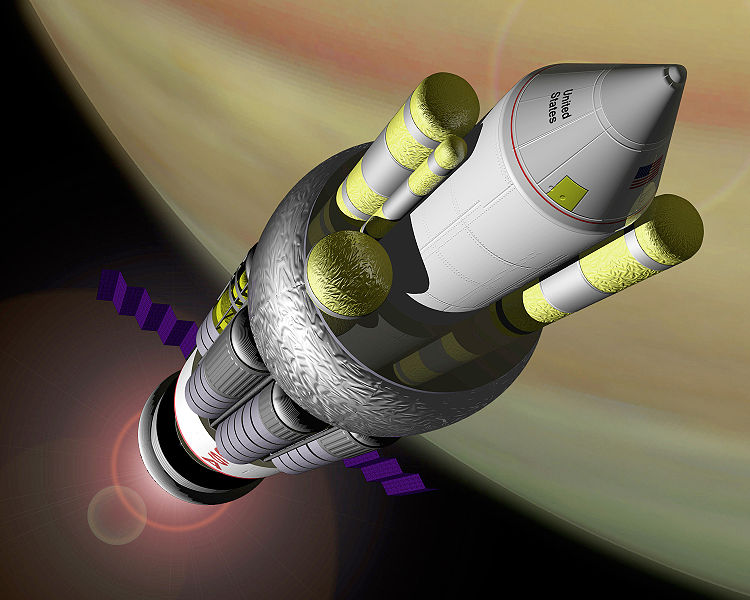
Let's talk about the big one, nuclear pulse propulsion studied under the name of Project Orion.  Essentially, its thermal nuclear explosions detonated just behind a very thick pusher plate.  Do this several times and the craft accelerates in pulse intervals.  It's funny that the scientists were talking about making a farm on a spacecraft that uses this propulsion.  The energy this thing can harness is enormous.  It's the largest energy per weight that we know of.  The scientists involved do agree that there were some issues with the system to be worked out.  The basic idea works, and was tested on small scale with conventional explosives.  Now, it's pulse propulsion.  That means one minute your all fine and dandy and the next your splattered against the back bulkhead until the acceleration stops.  Then it starts all over again.  How uncomfortable does this seem?  Can you imagine a cow handling this?  You'll probably end up with sour milk.  In spite of the challenges of this system, the scientists were optimistic about making a viable system.

Light Pulse propulsion is a modern idea that has some relation with nuclear pulse propulsion.  The idea is that while in atmosphere, a laser can give a reflector with a particular shape power to heat up air and make it expand thus propelling the craft.  The laser is shot form the ground.  This is to propel a craft from the ground to orbit as a first stage.  It's a compelling idea, because you have your power source on the ground and not as dead weight on the craft.  If you use a dedicated nuclear power facility with a very large laser, then you can lift a lot of stuff and many craft to orbit reducing the cost of launch over time.  I like this idea.  I wonder if it can roast some marshmallows in flight.  The in-flight meal should have s'mores in it.


Well, that's what Dr. Zubrin was talking about, and more.  We get weird ideas about how to travel from point A to point B.  Most don't work.  We keep trying until we get it right.  You can get your idea a try if you study Math and Science.  Your going to have to learn to write and argue as well, because your going to get criticized. Are you up for the challenge?

[NOTE FROM THE AUTHOR: The humor in this post is and experiment. In no way was the intention to criticize.  I'm sorry if it comes off that way.  I'm keeping the post as is as a reminder of how poorly chosen humor can hurt.]