Showing posts with label commercial space. Show all posts

Saturday, May 30, 2020

Orbital Commercial Space is Open for Business

SpaceX has accomplished what many have said was impossible. They—a commercial company—have launched two humans successfully to orbit on the Crew Dragon (Dragon 2). Not only to orbit, but they have sent them to the International Space Station on May 30th, 2020. Some have said how important this accomplishment is for the United States to get back launching Americans from American soil. I agree; that's true. Nationalism aside, there is a much much deeper and more important milestone this accomplishment marks that few are saying, and it has to do with our future from here on out. It marks the beginning of commercial human operations. What does that mean? It means we are no longer dependant on government money to get humans to space. SpaceX will open the market to allow citizens and anyone to go to space.


An actor has a contract to go to the ISS on SpaceX Dragon to shoot a movie. Tom Cruise is reportedly going to ride on Crew Dragon to the space station in the near future (Verge article). This was announced almost a month before the launch. This is how Earth-shattering this launch is. It's already sparking space tourism.

A billionaire wants to go to space and take artists around the moon. He has a contract with SpaceX. The Dear Moon project by entrepreneur Yusaku Maezawa hired SpaceX to take him and artists on a journey around the moon on Starship. It's the most ambitious space tourism feat yet. The Crew Dragon launch validates SpaceX's ability to launch humans into space and thus to launch them on the yet to be developed Starship as well.

I heard on the webcast of the launch that SpaceX plans on sending making available twice a year on Crew Dragon a year to the ISS. This article from the Verge states that SpaceX made an agreement with Space Adventures to have four private citizens in the next year or so. 

Now, the future can open up. Commercial Space Stations project entrepreneurs can make real plans because they have a way to get people to their stations. Axiom Space, Bigelow Aerospace, and the Gateway Foundation have been surely watching eagerly the Crew Dragon launch.

Low Earth orbit, the Moon, Mars, the Asteroid Belt, and deep space are all potential destinations for commercial human missions and colonies. The successful launch of Crew Dragon is amazing and is also the key to an open and profitable space future. Ad Astra.


Tuesday, May 26, 2020

Posting Again

I want to start posting here again. I think the time is right. I initially stopped posting in 2017 because a lot of YouTubers came on and started to inform the public on commercial space which was my purpose. So, at that time I didn't see much point continuing. Also, a lot of social media groups came on and fans started to gather. People started to become interested in Space and not only space but in more science, technology, math, and engineering. This was a good thing and I applauded it. I heard of people, both men and women going into science and engineering. That was awesome. I hope the best for them.

Years on, now we have more science detractors. We have a pandemic. We have more commercial space companies. SpaceX is booming. Virgin Group has grown and is still working on its projects. Blue Origin has flown its suborbital craft and is working on its orbital rocket. Statolaunch has been bought out. Xcor went under. Dreamchaser project still holds on to the dream, and its parent company, Sierra Nevada, still gets contracts, very healthy. Bigelow waits. Then Axiom comes up with a commercial space station contract with NASA. It's not called that but it does the job. There is so much to talk about. More YouTubers are on talking about space projects and the field seems endless. I think it's finally happening. Commercial space is making a foothold and is here to stay. So, it can only get bigger. And I can only give my two cents on what all this means and how all this is going down.


Thursday, August 3, 2017

Mad Dash to Plan B

NASA needs a bigger budget from Congress to get to Mars. Check out Dan Vergano’s article, NASA's Mars Program Is As Sad As It’s Ever Been

Elon Musk is considering pulling back on Mars for now. Check out this interview:


He needs to get the astronauts to space and to the ISS. He also needs to make it happen by next year. No  pressure. Except, no more landing legs for Dragon (see minute 35:45). So no power landing for it either, so no Red Dragon, either, and Dragon won’t land on the moon either. Come to think about it, that’s a lot of things. And there goes much of Musk's Mars plans for Mars out the window. And why? Well, real practical practice takes priority over dreams.


Notice that Musk said, “If you want to get people fired up, you make a base on the Moon. And then going beyond that, getting people to Mars.” He said this in minute 24:46.

Robert Bigelow was also at the same conference Musk was at. Check out this video.


Bigelow proposes going back to the moon before Mars because the Chinese are heading to the moon and we need to beat them to it. The prize is resources.

ESA wants to make an international base on the moon. They have been in talks with China about it, (article: http://www.independent.co.uk/news/science/moon-base-outpost-china-europe-chinese-space-agency-collaboration-together-a7702936.html) That’s very interesting. Let’s wait and see how things pan out.

It seems that Russia also has an interest in a mission to the moon (article: https://www.engadget.com/2017/03/15/roscosmos-first-manned-moon-landing/) We also need to wait on this as well. Maybe they will hook up with another country for this.

So what do we make of all this talk in the summer of 2017? To me, I can only conclude that for now Mars is out and the Moon is in on everyone’s agenda, including NASA’s. In my opinion this represents a change of plans that is steered by finances and resources. It’s sad that the dreamers dreams are put on hold for Mars. If you want to see a Mars landing, I suggest you keep healthy and plan to live a long life.

“The best-laid plans of mice and men often go awry,” Robert Burns.

Wednesday, December 30, 2015

Clipped Space Wings

2015 has seen some sad developments in new space companies that tout systems with wings. Virgin Galactic, Stratolaunch, and XCOR have all seen changes in their programs with not much progress.It seems to me that this is the year that space wings have been clipped.

Virgin Galactic was the venerated company that inherited the technology from Scaled Composites’ SpaceShipOne, winner of the Ansari X-Prize. Yet, its SpaceShipTwo suffered a disaster that killed a crew member, injured another, and destroyed the ship. It never made it to space. Due to constant changes to engines and other design features, it probably never will. I realized that this program was in real trouble when I read the article Virging Glactic gets a 747 jet to serve as a flying launch pad for its LauncherOne rocket . It said that VG had changed the mother craft for LauncherOne to launch from from the WhiteKnightTwo to a Boeing 747. That tells me the company sees no end to SpaceShipTwo’s problems. Perhaps we should also see no end either.

Stratolaunch was touted as the largest plane in the world. Then I read the article Stratolaunch Without Final Conception which said that not only has its company changed the rocket it would launch twice, but now the plane itself was in jeopardy. Someone seems to have bitten off more than they can chew; I think.

Then there is XCOR. They were to be a competitor to VG with their space-plane Lynx. Now the main guy Jeff Greason has left his position to a board position according to their news post. They also have not made much progress. What is taking so long? I fear the worse: lack of customers and cash.

All of this comes in a year when two new space rocket companies have made fantastic progress in doing the impossible: landing rockets. I'm talking about, of course, Blue Origin and SpaceX. Both companies have money backing them, one way or another, a strong handle on development, and strong top people to see the projects through. I think, in the end, that makes all the difference.

Shall we say farewell to the dream of space-wings? Perhaps, it’s farewell for now.

Thursday, March 19, 2015

Jupiter Spacecraft - Proposed Reusable Tug

Well, someone has heard.  Someone has come to reason.  In the Tech Times article called Lockheed Martin In Collision Course With SpaceX In Providing Reusable Spaceflight Architecture by Sumit Passary, Lockheed Martin is proposing a reusable space tug to compete in the new cargo resupply contracts bid to the ISS coming up.  I first wrote about a tug that was very similar in January of 2013 in my post Space Exploration Plans From Beoing.  I am happy to see that someone is taking the idea seriously.  This proposal is sophisticated and versatile enough for future infrastructure in space.

Locheed Martin calls it Jupiter spacecraft.  It has solar panels, propulsion (chemical), a robotic arm, and a refueling system.  Once in orbit, it will receive canisters called Exoliners one at a time.  After delivering the initial Exoliner with which Jupiter is launched,  Jupiter will rendezvous and capture the subsequent Exoliners for deliver.  Exoliners can also be deorbited as trash.  This is a very sophisticated if not complicated procedure.  Where is the refueling coming from?  I'm sure the Jupiter spacecraft is getting its fuel from the Exoliners.  Sure, it's not straight forward like Cygnus or Dragon cargo spacecraft, but the benefit is that it is reusable which brings down the launch weight and subsequently the cost.

Now, a craft like this can operate for years.  It may out live the ISS and start servicing other missions like a Bigelow Aerospace commercial space station.  The technology could be expanded into satellite repair/refuel.  It can also be upgraded to service flights to the Moon and back.  Such a technology is quite versatile.  It can not only move cargo pressurized or not, but also space capsules carrying people to higher orbits, different orbits, to asteroids, or the Moon.  It can expand our presence in space.  The idea of automated space tugs is not a new one, but this is the first commercially proposed one.

Jupiter/Exoliner space tug system is sophisticated, versatile, and commercial.  I'm happily surprised that Locheed Martin came up with the proposal.  Now, if they would only replace their venerable and rapidly obselete Atlas V with a reusable rocket that uses more principles from my Space Faring Standards post, they would be set.


Friday, December 26, 2014

Space Faring Standards

IF we want to be a space faring people, we HAVE to adopt new launch vehicle standards.  This has become painfully obvious to me this fall with that failure of the Antares rocket and the political fallout of the RD-180 rocket engine which makes the Atlas V as useless as if it had a catastrophic in-flight failure.  You can say this sentiment has been building since SpaceX arrived on the scene and Elon Musk talked about improving the rocket.  I see it now.  I see how deficient our rockets have been.  The rocket is basically in a state that the automobile was in the pre-Model T period.  They are costly and unreliable.  They are toys for the rich.  Small efforts have been attempted to bring the launch price down.  The only company that is bringing prices significantly down is SpaceX.  Those prices still need to come down MORE.  SpaceX can't do it alone either.  There needs to be more companies in the effort.  Well, I came up with some standards to start with that should get us in the right direction.  Of course this is just my own opinion.  They cover items from payload to the first stage.

1.  The payload needs to be recoverable in all phases of flight.  Capsules with crews have had abort systems which were high speed rockets that separated the payload (capsule and crew) form the failing rocket and allowing the parachutes to activate and bring the payload safely to the ground.  Why don't we have this on unmanned payloads?  Unmanned payloads today just blowup with the rest of the rocket in case of an abort.  Thus making vapors out of hopes and investments.  Then the insurance companies have to pony up cash.  I have no doubt this drives up cost of launch to some degree.  If some degree of recovery of the payload could be guaranteed I bet cost would come down.

2.  The upper stage needs to be able to orbit the Earth and make a reentry and landing back to it launch site to be able to reuse.  This is a plan for SpaceX.  They want to make the second stage of the Falcon 9 rocket reusable.  They want it to land after a launch back to base, preferably.  Today, all second stages are discarded after launch.  This means all that hardware has to be created from scratch and tested for ever launch.  That's a lot of man hours.  That's a lot of material.  That's a lot of money.  It's just a bad way to operate.  We've just been operating like that since the beginning of the space age.  The one exception would be the Space Transportation System which, arguably, had an orbiter that was held the payload and was also the second stage.  It was totally reusable.  It's drawback was that there was a lot of maintenance to it to get ready for the next flight.  Yet, overall reuseability should bring down the price of each launch.  Beneficial reuseability was demonstrated in the suborbital world with SpaceShipOne in 2004.

3.  The first stage needs to be able to lift the upper stage and the payload to a certain altitude guaranteed even in the event of an engine failure.  One rocket today meets this standard.  That rocket is the Falcon 9.  It demonstrated it in Oct 2012 where one Merlin engine shut down.  The rocket kept on flying and thanks to its design got it main payload to the International Space Station.  If that happened to any other rocket, the mission would have been a total failure.  The Falcon 9 can do this feat because it has 9 rockets which allows it to loose one or two engines before mission failure.  This needs to be a standard in all future rockets.  The area from the launchpad to the altitude where the second stage can ignite is a critical one.  The Earth is the most dangerous object to a flying rocket.  The more distance it can get away from the planet the safer it is.  That's why this standard is so important.  It give a high degree of guarantee to get to that second stage at a reasonable cost.

4.  The fist stage needs to be recoverable in one piece and reusable.  No one has ever accomplished this.  Oh, now your thinking about the SRBs in the STS.  Well, those were not reused in one piece. They were broken down and rebuilt.  I'm not talking about breaking down and rebuilding.  I'm talking about launch, land, recover, refuel, and launch again.  SpaceX is trying to learn how to do this.  They are currently trying to land their first stage on a large barge in the ocean.  Nobody else is even trying.  Well, Blue Origin was proported as wanting to accomplish this but they are not releasing where they are at or how far they got.  With them it has been so long that I can only conclude they were unable to finish the project.  First stage reuseablility is essential to bring down prices.  It represents the biggest hardware in the rocket stack.  It is only a suborbital vehicle by itself.

5.  Intensive and comprehensive checks on first stage, and upper stage systems need to be done at the launch time where the computer has the ability to abort at the sign of any failed test.  Most, if not all, mainstream rockets have implemented this standard to some degree or another.  The more successful the rocket, the more comprehensive their computerized checks are.  This stands to reason.  This is why there are delays at launch time.  Though they may be a little frustrating, I take the delays as a sign that the checks and tests are working and working hard.  It is a good thing.  Could Antares have used more comprehensive checks and tests to avoid its catastrophic failure?  Possibly.  Time will tell.  As far as I can tell, these tests and checks have become more and more computerized over the years.  Where many of them were just people staring at numbers on a screen to see if they see any anomalies.  This is thanks to miniaturization of the computer circuits on silicon chips and more sophisticated software.  Progress in this area should continue.  We need to get smarter software and more powerful computers as time goes on.  I have no doubt this trend will continue.  So this standard is the one standard that is being implemented by all successful launchers.  Great!  1 out of 5 ain't bad?!

Elon Musk, in an interview with Walt Mossberg and Kara Swisher, mentioned that reusable rockets were needed to make space more accessible.  So he's working on the reusable rocket.  In my estimation, reusable stages just cover 2 of 5 standards that ought to be implemented by all launchers if we are going to be a people that live and work in space.  I don't mean low Earth orbit.  I mean the Inner Solar System, to include: the Moon, Mars, Venus, Mercury, Asteroid belt, and Near Earth Objects.  It's time we look at the big picture and make plans to inhabit this playground.  To do it we not only need to be scientifically smart but also economically smart in all things.

These standards are mostly from other people through the decades.  Many have realized we needed reusable vehicles to access space to include many science fiction writers.  Computerized tests came out of necessity from real life launch companies and government entities. Von Braun and his team implemented the multi-engine first stage to where if one goes out it could still get to orbit.  Maxime Faget came up with the idea of a rocket as a launch escape system for crews.  I just expanded the possible idea to non-human payloads.

I'd like to see other launch companies make new rockets that take on these standards.  I know a couple of start ups that are targeting the small satellite launch market that design their rockets with multiple engines on the first stage.  One of them is called Firefly.  We need to wait and see what happens.  For now, we have to make due with the clunker rockets as we see Falcon 9 develop and incorporate 4 out of the 5 standards I've stated.  Watch the other companies tremble in fear.

Monday, November 24, 2014

Commercial Launch Market Made Different

"If everyone is thinking alike, then somebody isn't thinking." - George S. Patton.

For years after the Saturn V rocket was retired, rockets in the United States were reduced to a set of parameters.  This reflected a way of thinking in the industry.  If a rocket failed on liftoff, it was to be blown up.  It was an easy solution to minimize collateral damage.  Of course, computers then had a tiny fraction the power of today's computers.  By the way, that smartphone you just dropped? Yeah, it has more computing power than they could dream of back then.  Manufacturing was largely done by hand, or by hand operated mechanical/electrical machines.  Flaws were checked by only human hands and eyes for hours on end.  Now, we have robotic arms equipped with X-rays, infrared, ...etc, sensors.  The flaw checking is done in a fraction of the time it used to.

Saturn V was the so big that it took five of the biggest rocket engines on its first stage.  It was said that it could loose one engine and still complete the mission, or at least it could get its payload to orbit.  That capability went away with the Saturn V.  Elon Musk brought it back with the advent of Falcon 9.

So now, we have a contrast of operations.  One is a legacy operation founded on old technology and a robust track record.  The other is based on new technology capabilities and the need to take launch operations in a whole new direction.  I say 'new' though it's been in operation for four years now, it's still relatively new compared to the many decades of launch history we've had.

On October 7th 2008, Falcon 9 rocket lifted off carrying the Dragon capsule bound for the International Space Station.  There was an engine anomaly and one engine shut down.  The rocket kept on going.  The primary payload got to complete its mission.  The secondary payload did not.  The rocket was not blown up.  If any other rocket had a main engine anomaly and was shut off, the rocket would have to been blown up because there would be no way it could get its payload to any orbit.  Atlas V and Delta IV would have to be blown up if such a thing happened to them.

In contrast, on October 28th 2014, Orbital Sciences rocket, Antares, lifted off and had allegedly a main engine anomaly within seconds.  It was blown up by mission control as soon as they detected the anomaly.  I gathered that from the briefing after the mishap and some articles.  The exact reason and conditions of he anomaly is still being investigated.  Antares was built on the old mindset on how you design a rocket.  Orbital is good at getting parts together and making a rocket.  They leverage the market.

You can see the difference here between the mishaps between Falcon 9 and Antares.  Falcon 9 was purposely designed to succeed with redundancy and Antares was not.  You can say the designers of Antares didn't know or didn't realize.  I say that is total BS.  Everyone knows!  Everyone in rocket design knows the Saturn V.  They know about all the mishaps in the past.  They are just making the same mistake as everyone else is doing by not thinking, or they are rationalizing the problem away.  This problem still exists in Atlas V and Delta IV.  The designers of those rockets did not account for this problem.

I was going to go into other points, but this point is so big and poignant.  It just makes me mad.  It makes me mad that for years big companies have been ripping off NASA and the US taxpayers with high cost for launches on rockets that are sub quality.  In contrast, this entrepreneur is offering high quality rockets at low cost launch service.  How can anyone pass that up?  The reality is they can't.  The Atlas V days are numbered because it's too costly and its engines are politically risky.  So they are trying to give it different engines.  Europe is trying to make a new rocket in an attempt to compete with SpaceX.  Through all of this money is scarce.  Recession is coming back to Europe and things are slowing down in China.  So reducing cost to launch satellites is too tempting.  The old ways have to go.  Elon has the floor.


Wednesday, November 12, 2014

Lack Of Imagination

In the HBO miniseries "From The Earth To The Moon" the episode "Apollo One" depicts the investigation into the deaths of  Gus Grissom, Ed White, and Roger Chaffee and the loss of the Apollo capsule CSM-012.  They perished in a fire during a plugs out test on the launch pad.  In the episode, a Senator asks Astronaut Frank Borman what was the cause of the fire.  His answer was, "failure of imagination."  The idea was that nobody thought that the conditions of that particular test were dangerous.  They were all thinking of getting to the Moon.  NASA lost its innocence because of that incident.

Now we live in the wake of two commercial space disasters,  One commercial astronaut is dead.  One is wounded.  For all those who love space and commercial space, this is a time of pause.  One reusable space plane is destroyed.  One non-reusable rocket and cargo spacecraft with all of its cargo and research is also destroyed.  Accounting and insurance takes care of the rocket and the spacecraft.  The cargo must have had many customers with their hopes going to ISS.  Their projects may be insured but their hopes were dashed.

Many outside of the industry do not understand how these accidents happen.  There is a lot of anger out there on the net.  That's understandable.  There's a lot of fear and uncertainty.  That's also understandable.  Understand that these things affect everybody.  They affect all the CEO's of every space company to every kid who dreams about space and all the people and engineers in between,  We are all rattled even if we don't admit it.

Our innocence is gone.  Now, we will see how the space market reacts to it.  Investigations have to be completed.  They will find stuff that nobody may have suspected before.  Other stuff may be confirmed.  Plans will be made and implemented to avoid the same disasters.  These things must happen and will happen to move forward.  Moving forward is in the hands of the market.

Why are we doing this?  Why are we going to space at all?  Why did the crew of Apollo One and of VSS Enterprise die or get injured?  Why did Orbital Sciences Cygnus' customers loose their hopes?  Why did they even try?

They did it because they believe in a future that was better than this present one.  Space is out there.  We have been dabbling in low earth orbit for several decades trying to figure out how to proceed out in deeper space where higher radiation lives,  Out there where asteroids can be studied and mined and  where a moon can be settled.  Out there where a second planet can possibly hold life again (Mars).  Where we can study a dense atmosphere up close and figure out how to keep climate in check (Venus).

One of the biggest reasons is that life as we know it is a single point failure.  That means we know that if a big enough asteroid hits the planet it will wipe out all of life,  We know the size of the asteroid it would take to do it.  We know there are many asteroids much larger than such a size.  So in a real sense we are trying to save no just the human race of all of life from certain extinction.  It's not a matter of if but a matter of when.

My condolences to the family of the Virgin Galactic astronaut who died.  I hope the injured astronaut makes a full recovery.  I sincerely hope Virgin Galactic and Orbital Sciences are able to carry on with their programs.

Space programs should continue.  We must renew our hope in space.  We owe it to those who have perished and to our children and their children.  We must imagine again.

Remember the fallen:  Apollo 1, Challenger OV-099 STS-51-L, Columbia OV-102 STS-107, VSS Enterprise 4th rocket powered test flight.

PS I call the pilots astronauts as a way to honor them.

Wednesday, October 15, 2014

Boeing CST-100

Credit NASA
Boeing and SpaceX have won NASA's Commercial Crew Transportation Capability competition in the last month.  Good job to both teams.  Now, I've written a lot about SpaceX because there has been a lot to write about.  Here, I'm gong to change my focus on the Boeing team.  It may come to a surprise to some of my readers that, in fact, I like Boeing as a company.  I've been a customer, both for pleasure and business, for many years of their jetliners and never had a complaint.  Boeing is mostly a mainstay company.  They have their jets for many decades.  Sure, they change them to meet market demands, but for the most part, they keep them up and running for as long as possible to keep costs down both for themselves and for their customers.  On the rocket side, they have the Delta family.  It has been operating well for many years.  There has been a couple of mishaps, but overall everything is OK.  They do make the currently largest rocket in the world, the Delta IV Heavy.  Then they have business with the military and NASA in miscellaneous projects - at least for this post.  CST-100 is a different project for Boeing.  For a company that is a safe company as Boeing, CST-100 is really out there.

The first thing about CST-100 is that it is not business as usual.  It is not a 'cost plus' contract.  It is a contract where risk is taken on by Boeing.  That, I sense, is a big deal to the company.  Sure, they do take on that sort of risk when they sell a jetliner to an airline company, or do they?  Well there is no airliner to go between the end user and the company.  So far, the contract will be just between NASA and Boeing.  In the unforeseen event Boeing decides to put in a third party, like ULA, then the dynamic would change a little.  Let's assume that it won't.  Boeing will take responsibility for the craft and all the technicalities.  That means that they retain ownership.  For a disposable craft, ownership is a short lived thing.  Risk is the important item here.  Any technical malfunction leading to human injury or fatality could lead to money lost by the company.  Amount will vary on a case by case basis.  Of course, since this is rocket industry, the sky is the limit.  (These are generalized statements. I have no clue what agreements NASA and Boeing will have including anything pertaining to risk.)

Credit EC Holm
Now, in face of the higher risk, I can see why the CST-100 was designed the way it was; it has little innovation.  About the only two major innovations it does have are that it can land on land using airbags and has autonomous docking.  Otherwise, it is shaped like the old Apollo capsule, most of its supporting systems are in the service module like in Apollo, thrusters are in the service module like Apollo.  So the craft has a strong design basis in legacy systems.  I believe this was to reduce risk.

There seems to be a belief out there on the net that this craft's electrical system is only powered by batteries alone.  If that is the case, it is unprecedented and could possibly be a significant innovation.  Batteries are traditionally heavy and don't last long.  They are usually replenished with power form solar cells or fuel cells as is for all modern maned or cargo carrying craft.

The CST-100 team was in a tough situation.  On one side, they had a company that was adverse to a lot of risk, and on the other side, they had a project that demanded to take on a lot of risk.  So the design reflected lower risk.  I applaud the team for their excellent work in such a tough situation.  Is CST-100 really what we need to advance commercial space?  Maybe.  Time will tell.  It is not the best.  It was design for five people but can fit seven.  On the other hand SapceX Dragon 2 was designed for seven people.  Dragon 2 is a riskier program to build.  CST-100 has a better chance at success.  I think both will make it.  I can't stress enough how extraordinary it was for Boeing to take on this project in the first place.  There was never a manned capsule made in Boeing's name.  Instead Boeing bought McDonnell Douglas who had made both the Mercury and the Gemini capsules (late 1950's to early 1960;s).  These are on display at the St Louis Science Center.  I took pictures of them - seen above.  They are strikingly small.  So small that they look like some mesh between modern art and engineering built around humans.  This is a really risky project for Boeing.  I applaud them in taking this leap.

Tuesday, September 30, 2014

Future of the Dream Chaser

Credit Ken Ulbrich/NASA
NASA has made its choices.  SpaceX and Boeing are in and Sierra Nevada Corporation (SNC) is out.  In their comments, NASA said that it was a hard choice.  I believe them.  The Dream Chaser was based on the HL-20, a NASA project.  This gives Dream Chaser good credibility.  So, what possible future could there be for a spaceship that needs someone to fly it?

It's an unprecedented situation in the world where a company has an almost ready made space ship but needs someone to fly it.  SNC has vowed to keep on with the project with possibly using it to compete for NASA's next round of cargo hauling to the ISS (see Denver Business Journal article).  In a Denver Post article, SNC said it will offer flight to anyone or even sell a space ship to anyone.  You can see they are trying their best to keep the project afloat.

Now, bear with me in some speculation.  I can think of two customer/buyers that would be in their interest to buy services or a craft.

European Space Agency (ESA) has for a very long time toyed with the idea of having their own manned access to space without relying on Russia or the United States.  They considered making a space plane they called Hermes a long time ago.  They are considering leveraging the ATV technology and making a capsule to launch on an Ariane 5 launcher.  They are currently about to launch a technology tester to test reentry systems known as IXV.  Why not just forgo development and buy a Dream Chaser?  They could take their astronauts to ISS and bring home experiments landing on a european runway.  Sounds like an opportunity Europe would be crazy to pass up.

Virgin Galactic (VG) is about to fly people to space.  Six people at a time get to fly to suborbital space in the new SpaceShipTwo space plane.  They get to experience weightlessness for 5 minutes and then come home.  A chance of a lifetime, nay, a chance never before offered,  What would be the next step?  Why orbit of course.  With a Dream Chaser, Virgin Galactic could take passengers to orbital space for a day or a week and then come home.  Up to six passengers can fit on board.  Then they can land on a runway just like SpaceShipTwo,  Heck, it can be the same runway.  Dream Chaser shares some technologies with SpaceShipTwo.  They have the same non-caustic hybrid engines, and they have the similar type of landing gear configuration.  They are both made out of carbon fibers and resin.

So here we are.  In an unprecedented situation in the history of commerce, a orbital space ship is offered to the world.  Isn't it exciting?  Will ESA and VG make an offer?  We have to wait and see how the market responds.  Is it too early for a commercial orbital space craft?  Does anyone really have the money to purchase?  It the answers are 'no' then SNC will probably store Dream Chaser for a future venture, hopefully.

Thursday, September 11, 2014

Future Growth of Pressurized Cargo Deliveries Imagined

Ares V
NASA wants to build a rocket bigger than Saturn V, the Space Launch System 130 metric ton launcher.  This is to get the hardware they need to go to Moon, Astroids, and Mars.  It's basically a cargo hauler.  Now the Ares V, from the cancelled Constellation Program, was going to be a 188 metric ton rocket.  I had done some of my own calculations to realize that it could potentially haul the equivalent of 4 shipping containers to low Earth orbit.  Now, Saturn V was a 118 metric ton rocket.  Take a moment and thing about these numbers.  Think, also, about how much stuff people use every day.  Most of the stuff we use come in shipping containers.  Now consider a city in space.  The content of the many shipping containers that come by train and sea ships has to be launch off the Earth.  Has it dawned on you how much stuff such a city will need?  Has it dawned on you how big the rockets need to be to launch such stuff?  I came to realize that we are just at the very beginning of space colonization.  We have cargo carriers that supply the International Space Station (ISS) now that are both from government and commercial entities.  How much will the rocket launchers of the future have to grow to meet the demand?

ESA ATV
I looked at data shipped to the ISS in 2012.  I then reduced the number to tons per person per year.  I got 3.8 tons.  This is a pretty rough number.  I then did the same with the United States in 2012 and got 6.2 tons per person per year.  It would seem that the astronauts and cosmonauts are living on a shoelace compared the people on the ground.

If that is the case, our current launchers are, for all practical purposes, the smallest they can be to support 6 people permanently in orbit.  Falcon 9 (13.2 metric tons), Antares (6.1 metric tons), Ariane 5 (16 metric tons), Soyuz (6.5 metric tons), and H-II (10.1 metric tons) are the launchers for cargo to ISS.  This is our baseline.  On average, our launchers are 10.4 metric tons to low earth orbit.

If the astronauts lived like we do on earth, by how much will our launchers grow?  I calculate that our launchers would have to be 19 metric tons on average for 6 people with 6 launches per year.  You can see how that number already dwarfs our current launchers.

Now what if we had more than one space station or one big one, in orbit and a total of 100 people living in space full time?  If they live like astronauts do now, they would need 380 tons launched from the ground annually.  They will need launchers of 1,040 metric tons to launch 6 times a year.

Now if those 100 people lived like we do on Earth, then they would need 620 metric tons in a year.  The launchers would need to be 1,900 metric tons for 6 launches.

Can you imagine a 2000 metric ton rocket launcher?  That's about 17 times the size of a Saturn V.  That is huge.

You might say what if we increase the number of launches a year?  Won't that decrease the size on the average launcher?  Sure it will.  Let's see....  I calculate that for 100 people that need 620 metric tons a year and 20 launches, they would need average launcher size of 510 metric tons.  That's still about 4 times the size of a Saturn V.  Now 20 launches a year is quite a hefty schedule.  I suppose  if they spread out the load over 4 companies and/or countries it's not so bad.  Though a 510 metric ton rocket is quite large, I believe it is within the realm of possibility to accomplish.

You can see how the number expand with the increase of people.

This is only to LEO.  What about the Moon and Mars?  Well the numbers get exponentially larger.  So the rockets get exponentially larger.  The ones we have now are puny by comparison. That is why people have suggested learning to 'live off the land' and reduce the need for new cargo from Earth.  Even in deep space living off of asteroids and comets will be necessary.  It's just too much for us to lift that much stuff out of the Earth's gravity well.  The other thing we can learn to do is recycle, and recycle everything.  Air, water, waste (yes No 1 and No 2), soil, plant matter, and parts are things we need to learn to recycle if we are to live in space, or on the Moon, or on Mars.  New technologies are bound to be needed to this end.  Are we up for the challenge?

Sunday, August 10, 2014

Commercial 130+ Metric Tonne Rocket Competition Imagined

COTS; Courtesy of NASA
The current Space Launch System (SLS) rocket that is in development is a 70 metric tonne vehicle.  By comparison, SpaceX's Falcon Heavy is a 53 metric tonne rocket.  The Falcon Heavy is slated to make its maiden flight towards the end of 2014.  SLS is slated for a 2017 maiden flight, but that time seems to be slipping.  These dates often slip, even for commercial companies like SpaceX.  The SLS program is also slated to create a 130 metric tonne rocket to explore the solar system.  Consider that commercial space services have already been successful and saved NASA money.  Consider also that a new space services market has been created and is growing.  I do not think that SLS will survive long in a commercial space services dominant environment.  I think a competition for a 130 metric tonne rocket is in order for NASA.

In 2006 NASA's Commercial Cargo & Crew Program Office (C3PO) created the Commercial Orbital Transportation Services (COTS) which was a competition for companies to create rockets and spacecraft to provide the International Space Station (ISS) with cargo.  COTS also lead to Commercial Resupply Services (CRS) which was the operational missions to supply the cargo.  While there were many entrants into COTS, including Boeing and Lockheed Martin, SpaceX and Orbital Sciences won, and are supplying cargo today.  The CRS contracts were fixed price versus the traditional Cost Plus contracts which is how SLS is being developed.  Under CRS the companies retain ownership of their rockets and spacecraft, and also the risk associated with development and operation.  Risk is one of the potentially most costly aspect of any project or program.  By giving companies the risk, NASA has also given the companies freedom for innovation.  Essentially NASA has helped create new competition in the space launch world and has saved money at the same time.  SpaceX's Dragon first berthed with ISS in 2012.  Orbital Sciences' Cygnus first berthed with ISS in 2013.  The success of COTS is historic for the planet.  For the first time, orbital commercial services became a reality.

Think of the future where commercial space companies dominate launch and operation services. What place does a costly SLS have in this environment?  Already Falcon Heavy encroaches on the lifting capability of the 70 metric tonne SLS.  SpaceX has plans to launch cargo and people to Mars.  They will make a very large rocket that competes with 130 metric tonne SLS.  What future does SLS have?  Even is SLS functions perfectly, its cost will make it obsolete.  With a constraint budget, NASA would be tempted to launch the Orion Multipurpose Crew Vehicle (MPCV) on a commercial launch service.  They might even be tempted to use a commercial capsule for missions like a new version of SpaceX's Dragon.  To me, the mighty dollar is going to doom SLS the scrap heap.

In the aerospace industry, competitions is what spur innovation and development.  Charles Lindbergh won the Ortieg prize in 1927 by crossing the Atlantic Ocean in a non-stop flight with his plane the Spirit Of St Louis.  This resulted in our current transatlantic flight market.  This also resulted in round the world air commercial air travel.  Burt Rutan's Scaled Composites won the X-Prize in 2004 by flying their space craft SpaceShipOne to suborbital space twice in a two week period.  This has spurred the new commercial space market.  Now Virgin Galactic, Xcor, and others are competing for customers for their first suborbital passenger space flights.  These competitions work.  Let us go a step further and make a competition that will result in more than one commercial launch system of 130 metric tonnes or greater.

Why would we need such monster rockets you may ask.  Commercially, the bigger the rocket, the less money per kilogram is needed to launch anything.  Who would use these?  Besides NASA, there are current companies and organizations with big plans and ideas.  Bigelow Aerospace makes inflatable habitat modules for future commercial space stations/space ships/moon bases.  The Mars Society members long to get to Mars.  Google Lunar Xprize participants have big plans for the Moon. B612 is an organization with a mission to help protect Earth from asteroids. Our current rocket only can start these big ideas.  These represent many people from many countries.  They want to go to space.  They need very large rockets to get to their endgame.

As wonderful an idea SLS is, it is just not cut out for the future that is just around the corner.  If NASA is not relieved of the burden of a 130 metric tonne SLS, the agency will be bypassed by commercial companies in the field of exploration.  NASA should take the lead in exploration, not lag behind.  They should not make any more rockets.  They should hold a competition to develop 130+ metric tonne rockets.  Then they could use those commercial rockets and services to get their spacecraft out in the solar system.  Then they can make more of the wonderful discoveries they have been doing since the 1970s.  These discoveries have helped people on Earth through the decades.  New discoveries can only help those on Earth and those out in the solar system.

Friday, June 20, 2014

SpaceX and ULA

SpaceX and ULA are fighting.  It started when Elon Musk went before the Senate Appropriations Committee to testify how unethical it was for the Air Force to grant ULA a large contract for EELV missions while SpaceX is in the middle of the registering with the EELV program.

In the process, Musk not only made clear the successes of SpaceX but the fact that all Falcon rockets parts are made in the US while the Atlas engines are made in Russia and are subject to Putin.  Then they hyperbole started.  ULA claimed sixty some odd successful launches in a row.  Well, as a company, ULA is not that old.  In fact ULA (6 years old) is younger than SpaceX (12 years old).  But it's the two companies behind ULA that have the successful launches, Boeing and Lockheed Martin.  In my mind, ULA is just a front man.  ULA is really a ploy to compete with the new space companies.  I question that ULA should even be in the EELV program.  Instead it should be Boeing and Lockheed Martin competing still.  The government should have never allowed a sole company to compete for EELV launches.  That's a monopoly.

Now the fight is still ongoing.  It's becoming a 'he said' and 'she said' thing.  It's really pathetic and sad.  What it should boil down to are the price tag.  SpaceX claims it can launch satellites at at fraction of what ULA charges.  In the end that is what matters.  The government has to save money.  It has to keep national security assets and at the same time lower the cost.  That's for all our sakes.

On commercial principles, Congress has a dilemma.  Clearly the Air Force has disregarded competition and fair trade principles in favor of keeping assets flying to orbit.  Should Congress punish the Air Force?  Or, should the EELV program be overhauled?  Some might say that the word 'evolved' could be taken out if all they are going to launch are old Atlas Vs and old Delta IVs.  Maybe the 'expendable' word could be taken out since SpaceX is about to make the rocket reusable.  In any case the program seems broken and/or mismanaged.

In the meantime, let's sit back and watch the drama unfold.  Maybe the fireworks will come before the 4th.  Perhaps some popcorn and a lounge chair is in order.  At any rate, in the end SpaceX seems to be holding all the cards.  It's just a matter of time.  Really, I guess time is what this feud is all about.  After all, time is money.

Sunday, August 25, 2013

Interview With A Commercial Astronaut

The following is a work of fiction. The characters are fictional.  Any resemblance of characters to real people is a mere coincidence and unintentional.

"Test, test.  Is this thing on?" said Tom checking his microphone.  He tried to look past the blinding lights to see his audio guy.  All he could see was the camera men.

"It's working, Tom," came a voice in his earphone.  He adjusted his suit and got ready for the mission at hand.  Then he looked straight into the nearest camera.

"2030 is the year of more commercial space progress.  The Dragonfly project is going to take off tomorrow around 6 am in the morning.  The project will test an in-line air boost to orbit concept in the hopes of competing with the reusable rocket family from SpaceX.  This is Tom Townsend live from Cape Canaveral.  Here with me is the pilot of the mission, Dan Darger.  Dan, what got you interested in space?" Tom looked starlight at his guest in a silver pressure suit that had several logos of sponsors on it.

"Well, Tom.  That's a good question," Dan said trying to calm himself to say the right thing. "I think it started when I was pretty young.  You see, my Dad got me and himself tickets to ride a Virgin Galactic spaceplane.  I guess it was love at first launch."  Dan felt really good about that answer.

"Was that the SpaceShipTwo class or later classes?  I think were up to SpaceShipFive if I'm not mistaken."

"Uhh. Yeah.  It was a small ship that seated six passengers and took us up to about 100 clicks."  Dan paused a moment with his finger ponting to Tom with a up an down motion. "The thing that struck me was the view of the Earth.  I always thought the rocket ride up would be the coolest, but the Earth....Man!  That was something." Dan's mind went back to that moment, that emotion.

"I heard it's a magnificent site."

"You haven't been up? Oh man! You gotta go, you just gotta.  You don't know what your missing until you go." Dan smiled at Tom feeling a little superior.

"Well, I guess I just might.  But let's talk about your mission tomorrow.  What is the significance of it?" Tom attempted to gain control back after feeling a little put down.

"Well, Tom.  It's a winged craft with scram jets and a orbiter attached to its nose.  I will be riding in the orbiter.  The two crafts will take off from the space runway here at the Cape with the first stage rocket.  Then that will be jettisoned.  It will scream up into the atmosphere gaining acceleration as it goes using the scram jets.  At about 100,000 ft, the orbiter will detach with a small rocket and go into space.  Once in initial orbit, that small rocket is jettisoned, and the orbit is stabilized by the orbiter's main engines."  Dan could feel himself relaxing and getting the hang of this interview.

"OK.  What will happen to the mothership?"

"Oh, right! It will fly back down to the runway."

"I know the project is about the mothership, but tell us a little about the orbiter."  Tom put on the best interested tone he could muster.

"Well, the orbiter has been to space before.  In fact, it's been in orbit more than a hundred times and was retired about 5 years ago.  It was built by SNC and it was the original Dreamchaser.  It's a lifting body style craft that flies well in space and the atmosphere.  It was refurbished and retrofitted for this mission." Dan went through the data in his mind to see if that was enough for the answer.

"So, why are you not piloting the mothership rather than the orbiter?" Tom smiled smugly at the camera then at Dan.

"Well...uh....isn't it obvious?" Dan looked quizzically.

"Not everyone is a rocket scientist, Dan.  The folks out there want to hear your expert viewpoint.  So tell us why your in the orbiter."

"Oh...right!  Well the project is about getting to space cheaply.  So the mothership was designed to fly without a pilot on board.  The actual pilots will be on the ground.  It is also smart so it can fly independently if need be.  I'm in the orbiter to do orbits.  Yeah, for the system to be proven, I have to get the orbiter to orbit and then land back safely on the runway."

"Good.  That sums the mission up pretty good." Tom felt back in control and Dan was all smiles patting himself on the back. "So, Dan, what are you wearing?"

"This is my pressurized flight suit.  It keeps me alive in case of a loss of pressurization."  Dan looked down at his silver suit. "As you can see it has logos of my sponsors."

"Yes, it's very colorful.  And loss of pressurization means when the orbiter looses air Dan won't die because of the suit."  Tom felt a little ticked that Dan didn't elaborate on that detail.

"Yeah, that's it!  On top of this I will be wearing a parachute."

"A parachute?"

"Uh....yeah! In case something bad happens." Dan felt that was enough said.

"Something bad?  Like you blow up?"

"Ah...well....yes, but not exactly.  If the orbiter blows up I blow up with it and the chute is no good.  But if the mothership has a bad failure I can just detach the orbiter and fly it down to safety.  Now if the mothership is badly damaged and the orbiter is damaged as well but in one piece but can't get back to land, then I have the chute to bail out and fly another day."  Dan felt that that was a blunder of an explanation and it was uncomfortable to say.

"Oh I see.  You just want to live no matter what."  Tom stated the obvious but he felt it needed to be said.

"Ah, yeah! Don't you?" Quizzical look again showed up on Dan's face.

"Sure I do.  And we all do." Tom laughed his way through embarrassment.

"Well, good luck on your flight tomorrow.  I hope the Dragonfly project is a success," said Tom concluding the interview.

"Thanks Tom," said Dan with a big smile.

Tom gave a cut sign to the camera men.  The cameras lenses dropped like horses stopping to graze.

"Feel nervous about tomorrow?" asked Tom.

Dan slumped back in his seat with a sigh. "Not as much as I do about this interview."

Tom looked at him quizzically.


Tuesday, June 18, 2013

Mass Logistics To Space Idea

ISS partners keep a flow of small pressurized cargo craft coming to the station for just 6 crew and experiments. Progress, ATV, HTV, Dragon, and soon Cynus make up such a fleet. The ATV is the biggest carrying a max of 16,900 lbs or 7,667 kg. On land, we stack huge metal boxes carrying all kinds of cargo on ships, trains, and trucks.  These are shipped around the land supplying communities with effectively whatever they need. Commonly these are 40ft long cargo containers and can carry a max of 68,008 lbs or 30,848 kg. Imagine if commercial space takes off, and many space stations orbit around Earth, the moon, and deep space are made and manned. Having around 24 people in each station who need food, clothes, equipment sent to them and waste taken from them. How would you supply that amount of cargo? SpaceX's Falcon Heavy can lift to orbit almost the gross weight/mass of two 40 ft cargo boxes. So, I figure it could carry the cargo of one of these cargo boxes in a purpose made reusable stretch cargo capsule.  It would be a vehicle of mass logistics transportation.   What would such a craft look like and what would its operation be like?

Stretch Capsule concept made from Apollo CM pic
Why stretch anything?  The airline industry have stretched the bodies of its planes for many years to expand their payload capacity.  I remember first learning about stretched aircraft  with the DC-9.  It would seem reasonable to assume that commercial space companies sought out a solution for an increased capacity without reinventing the wheel all the way.  SpaceX's Dragon is touted as a reusable capsule.  They also want to make it to be capable of propulsive landings on the ground from orbit.  Thinking about those capabilities, you could stretch the capsule lengthwise (see pic above) to increase cargo capacity per trip.

Falcon Heavy (right) with Falcon family
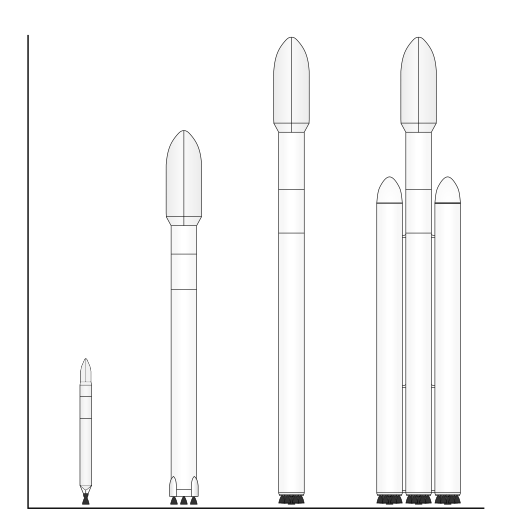
A stretched capsule could launch from a heavy lifting rocket like the Falcon Heavy housed in a fairing.  Upon arrival, it could dock or be captured and berthed to a station.  The hatch on one end of the capsule would minimize space issues while attached to a station.  I don't imagine that it would be used for crew but only for pressurized cargo.  The station's Astronauts (Cosmonauts, or Taikonauts - if you like) would unload it and load it back up with whatever needs to be taken back down to Earth.  That could include experiments and even waste.  I've been considering the environmental impact of expending waste by burning it in the atmosphere.  Dealing with the waste on the ground might be more beneficial.  The capsule would detach from the station and de-orbit on its own merit.  The long heat sheild and the integrity of the cross sectional shape of the capsule would allow for a similar atmospheric re-entry as the Dragon.  Stretching the capsule longways also allows room for extra parachutes.  Dragon stores its parachutes on the side of the craft in a compartment.  The stretched capsule could have two or more compartments for parachutes.  Then comes the propulsive landing which would have a number of thrusters along the sides of the craft.  Several landing legs would also support this operation.

 The stretch capsule could be an intriguing idea for future engineers and space operations.  I think the alternative is to build newer and bigger capsules mostly from scratch.  It's not just the capsule that has to be designed but the manufacturing process as well.  I think a stretched solution would use the existing manufacturing process with some added parts.  In the end, this is just one idea out of many.

Wednesday, May 22, 2013

Getting To Mars Depicted (Part 2)

In Part 1, we went through how much a trip to Mars costs in terms of fuel and hardware.  It takes 8 large rocket launches just for one manned mission.  That is about 75% the launches of the Apollo program to the moon.  Back then, the US Congress was willing to spend the money, but today they are holding back wanting to cut NASA's budget.  That's nothing new.  Congress has been cutting NASA's budget for at least the past 20 years.  A manned mission to Mars is quite a huge undertaking.  I know I did not talk about the radiation concerns or other crew health issues.  NASA likes to mention those.  They don't like to mention how much it would cost, and I think that is an issue that Congress and the public need to address.  The more the public knows about this issue the better.  How could we possibly reduce the cost?  Well, I've got 2 ideas.  Both of them are along the lines of mass transportation and reusable assets.  Reusable transportation assets and multiple manifests could provide more effective financing than one mission going alone by any one government space program.

Many Launchers for 1 Mission
Reusable Assets

When talking about reusable assets, a tug to take payloads from Earth orbit to Mars orbit and a reusable Mars lander/launcher come to mind.    For Mars, these assets have to be very sophisticated to include transferring of fuel and other consumables.  They would have to be able to be controlled remotely with some automation and manually by any crew.

I've talked about a reusable tug before.  For Mars, having a large tug that can travel many times between the planets could provide the means to take multiple missions on each trip.  Distributing the cost of the trip among several customers could make the trip financially possible.  I like to imagine such a tug as being based on the concept of the Saturn S-IVB.  It would have to be much larger.  I could have duo-propulsion: traditional chemical booster; electric propulsion such as ion drive or plasma drive.  Space.com has a great article on electric propulsion called How Electric Spacecraft Could Fly NASA To Mars.  A robitic arm such as the Canadarm 2 could provide a means of capturing and docking many different types of space modules.  Also it should be able to carry many modules to include unmanned and manned modules simultaneously.  Our module technology has become quite sophisticated so I don't think that would be a problem.  One of the biggest issues of such a craft would be electric power.  Solar panels are nice, but large ones would be needed to power the electric propulsion.  They also should be able to retract and deploy on command and often.  I expect that aerobraking maneuver would help reduce the amount of fuel needed for each mission.  Solar panels would need to retract for that maneuver lest they are damaged.  These panels would have to last a long time.  Another option, though less popular, would be giving the craft its own nuclear power reactor.  Of course, responsible handling of the nuclear material is a must; including a disposal plan for the depleted nuclear material.

A reusable lander/launcher is necessary. The idea of landing on an atmospheric planet is enticing and yet hard.  If you going to reuse the lander, it has to launch from the planet as well.  We've never created a craft like that before.  It would need a heat shield that can pop off and be replaced easily (by robotic means), a reliable engine, and large tanks for fuel.  After every launch back into orbit, it would need to be serviced and refueled for the next landing.  This craft is important because for one manned mission, NASA would use 3 landers and 1 launcher.  That's 4 vehicles.  Consolidating hardware complexity and weight into one vehicle should save on cost.  Using this vehicle for many missions should be a savings multiplier.

What do we really want to do on Mars?  Do we want to just plant a flag and walk around a go home?  No, many folks want to do many things.  From geology to colonization to terraforming, Mars has inspired many possible missions.  If we go with throw away assets, we won't be able to afford getting there but once in a generation if at all.  Mars should also only be the first step to exploring and exploiting the inner solar system.  Therefore, reusable assets are a must.  We must build an infrastructure.

Multiple Manifests

Mars Plane
 To spread the cost of trips to Mars and back, it would seem a no brainer to get as many different missions and customers to sign on.  It's like filling up the cargo hold and passenger cabins of a larch ocean fairing ship to make trips between continents across a large ocean.

Imagine multiple unmanned mission accompanied by one manned mission packed on the reusable tug that is about to depart Earth orbit.  These mission could be from all types: orbital, landers, rovers and sample returns.  The landers, rovers, and sample return missions can get loaded up on the reusable lander/launcher to get down to the surface along with the assests of the manned mission.  It seems they would all land in one spot.  Well, that could create the opportunity to have some planetary transportation services such as fast rovers and aircraft.  You can quickly imagine a multitude of missions and activity around and on Mars.

Spreading the cost for each trip and back from Mars among many customers seems reasonable.  Using reusable assets such as a reusable transportation tug and a reusable lander/launcher goes hand in hand with multiple manifests.  Such an effort could easily be a commercial venture.  Such an infrastructure could have the effect of researching the red planet in a much faster fashion than what we do now.  If regular trips to Mars every 3 years is sustainable then we would have established a permanent link worthy of colonization.

Monday, April 15, 2013

Commercial Moon Missions Imagined

Apollo took men to the Moon. Many unmanned craft of Russia and US and now other countries have made it to the moon. Soon to follow are commercial companies. Now, China wants to send Taikonauts to the moon. I don't blame them since a progressive space program can produce lots of research that helps their economy.  How would commercial companies go to the moon?  What vehicles would they need?  How should they differ from past manned missions?  Learning from Apollo, it's obvious that certain modules are needed to make any mission to the moon work.  You need a capsule to return the crew to Earth, you need an in space booster, or two, to get the crew and equipment from earth to the moon and back, and you need a lander.  Now, if your not going to the surface, you will need a space station made up of at least one module. It goes without saying that you need to supply all the fuel and other consumables for those vehicles.  Let's look at how these modules might be for a cool commercial effort that comprises of many missions to our natural satellite.

NASA's Orion MPCV
Why a capsule?  Well, let's put it this way, two superpowers chose the capsule to return crew from the moon. Even though Soviet Russia did not do a manned mission to the moon, they did plan for one. Capsules are concise and able space vehicles. I've heard space professionals say that wings are not needed in space. A space plane would have extra weight, and weight is the Achilles' heal of flight. When your traveling a half a million miles round trip in space, wings seem like a luxury.  So capsules it is.  What's great right now is that SpaceX is pushing the development of the capsules to have them set down on land with a propulsive landing and be able to be reused for more missions.  That is a far cry form Apollo days which relied extensively on a service module for crew survivability over the length of the mission.  SpaceX Dragon only has solar panels that are not incorporated into the capsule itself.  Everything else is.  Now, a capsule needs a beefier heat shield for lunar missions than just Earth orbit.  The temperature difference is about 2000 degrees Fahrenheit (1093 degrees Celsius) between reentering Earth's atmosphere from low orbit and from the Moon.  Currently, it is only feasible to have the capsule reenter the Earth atmosphere coming from the moon rather than trying to enter an Earth orbit.  We have not figured out how to go from Moon orbit to Earth orbit with a manned mission yet.  Though, in the future that could be a preferred way of doing business.

ESA'a Smart-1 ion drive to Moon
Trans Lunar Injection (TLI) was the maneuver used to take Apollo from Earth orbit to lunar orbit.  They used the upper stage of the Saturn V rocket to perform it and then jettisoned the booster.  Yes, I did not mention the Command Module docking with the Lunar Module because it's not relevant right now.  That may have worked for NASA but commercial efforts would require re-usability for many missions over time.  So to take care of the TLI function a reusable tug is in order.  Now this tug has to accommodate both manned an unmanned missions.  So, two forms of propulsion that exist should be used.  One is the traditional chemical booster and the other is the newer ion drive.  ESA's Smart-1 used an ion drive to power its way from Earth orbit to lunar orbit so its a viable technology.  The ion drive can be used for multiple reasons.  It has the power to navigate unmanned craft or failed manned craft (in the case of a dead crew) back to Earth so the loss of assets are minimized.  It can navigate the tug by itself to meet another ship for rescue operations.  It can speed up a manned mission to the moon, or other space bodies, by activating en-route all the way.  So it makes sense to have a dual propulsion system for our reusable space tug.  Of course, it will need a power supply and solar panels should do nicely.  A nuclear power system would be nicer since it could enhance performance and endurance of the craft, but radiating the crew or your cargo or ship is an issue.  Though, the nuclear system could power an artificial magnetic field that provides shielding.  The tug can be used to do all the burns to get from Earth orbit to lunar orbit, and it can get the capsule on its way back to Earth.  After detaching from the capsule, it can change course and get into an elliptical orbit and use aerobraking to slow down the craft to an orbit that is useful for refuel and the next mission thus saving fuel.

Apollo 12 - Intrepid Lunar Module

LEM was the acronym for the lunar lander in the Apollo program.  It meant Lunar Excursion Module.  Later, they just named it Lunar Module but somehow LEM stuck.  A reusable lunar lander would be more appropriate for multiple missions than the one time use LEM.  It could be refueled by the space tug in preparation of a landing and launching back from the surface.  It could be kept in lunar orbit in between missions.  One chemical engine should suffice.  The Apollo LEM was made up of two vehicles: a landing vehicle and a launching vehicle.  For our reusable one, it should be one vehicle.  Perhaps, two lunar landers could provide some redundancy and security for missions.

A single inflatable station module is good to have in orbit around the moon.  Such modules are being developed by Bigelow Aerospace.  It can serve as bigger space and more accommodations for crews, a port for the reusable lander, and a staging place for crew equipment and supplies.  One mission can bring it into orbit with or without a lander to begin with.  More station modules can be added to it as needed.  Boeing had previously suggested EML2 as a place for a lunar station instead of just simple lunar orbit.  I mentioned this plan in my post "Space Exploration Plans From Boeing".  I like the simple lunar orbit exclusively for moon missions over EML2 simply because its closer to the surface and it should take less time and fuel to get to.  Even if that is marginally true, its still viable over the course of many missions or even a campaign.

With capsules, space tugs, landers, and a space station; a commercial effort can carry out many moon missions for various customers.  Thinking about it now, I feel that having a space station around the Moon and a lander would be a good combination for several missions.  Humans have gone to the moon, and many more want to go for various reasons.  Finding way on how to thrive and not just survive on the moon is important for humanity.  We need to spread out beyond Earth.  The moon provides a first step towards that goal.

Thursday, March 28, 2013

Space Mining Operation Imagined

Deep Space Industries and Planetary Resouces want to mine asteroids and perhaps comets.  For years many people imagined that asteroids and comets were good for extracting minerals.  How would such an operation work in space?  We will look at what these small space bodies are made of, the scouts, the miners, and processors that are needed to extract the goods.

Stardust
To find out the content of comets and asteroids, NASA had some significant missions that provided answers.  Deep Impact spacecraft was successful in giving us analysis of the composition of comet Tempel 1 in 2005.  Stardust was a spacecraft that collected samples of comet Wild 2.  It finished its primary mission in 2006 and then had an add on mission to look at Temple 1 after Deep Impact's mission.   NEAR Shoemaker mission did some spectrography on an asteroid in 1997.  The findings of these missions are posted in the journal Science (membership required - a free one is available).  From what I read in Science articles, comets are full of water, carbon-dioxide, and hydrogen cyanide.  Asteroids seem to have elements to include iron, magnesium, silicon, and calcium, among others.  That's important because that is what is peaking the interest of companies to go and perform mining operations.

To really get a good understanding of what particular asteroids are made of, the companies will have to send out scouts.  Instead of a geologist, they will be remotely operated unmanned spacecraft.  Now, until recent history, unmanned exploration spacecraft either did flybys over specific routes, or went to orbit only one space body.  After their launch, which gave them the velocity they needed to get to their destination, they only had thrusters to steer themselves and no real main propulsion.  DAWN is the first unmanned spacecraft to have its own main propulsion via an ion drive.  Now its on its way to Ceres after orbiting and orbiting Vesta.  That's what you want in a scout.  It needs to orbit several asteroids by jumping from one to another.  Ion drives were first tested on NASA's Deep Space 1 mission with a mission manager that felt like Captain Kirk, Marc Rayman.  He also manages DAWN.


Marc is a pretty neat guy.  After the video interlude, let's get back to our topic.  As for finding the needed materials, and impactor and a spectrograph could be a quick way of determining the composition of asteroids or comets.  A scout could have several impactors.  This would be similar to the Deep Impact mission, but I imagine smaller and simpler impactors would be preferable.  Another way is to simply spectrograph the surfaces of the asteroids or comets.  I also would imagine marking the asteroids and comets by landing a small radio code transmitters.  This would be useful for the miners to come to them and find them.  Then on Earth, an automatic ground based system could track them without the need of an astronomer.

Deep Space 1
After marking the asteroids, miners come to extract the ore.  What would a robotic miner look like?  Now landing on an asteroid would seem tricky because of their irregular potato shape and the fact that they are spinning.  In 2005 Hayabusa landed on an asteroid and collected a sample.  A miner could do the same, but it must collect a lot of soil, do some preliminarily sifting (optional), and send the soil to a processing plant.  The container for the soil would have to be large and have its own service module (like a reusable space tug).  There should be several of these container ships going from the mining site to the processing plant.  They could be refueled at the processing plant and, if necessary, refuel the miner.

The processing plant should not be on Earth.  It should be in a place that is easily accessible from Earth and from deep space.  Earth-Moon, or Sun-Earth  L2 could be ideal places.  The processing plant would be a complex piece of machinery that perhaps would need humans to maintain it when it breaks.  Now such a plant would process the ore and have some material left over.  The waste material could be either sent to the moon or be collected next to the station, effectively making a ever growing pile of rubble that becomes an asteroid itself.

NEAR Schoemaker
After the ore is processed into some usable material, it could be sent to Earth, but why?  Well the simple answer is: that's where the factories are.  Yet, it seems rhetorical to get useful material in space to be only used on Earth where such material already exists.  That would be economically unsound.  An alternative is to take the material and make it usable for 3D printers to create whatever is needed for infrastructure in space and sell these items to other space companies for parts or new space structures.  These structures would use the elements from asteroids like iron, calcium, magnesium, and such.  The other types of product these processing plants could create would be consumables like water, oxygen, and hydrogen.  These consumables would be used by space stations, and even unmanned systems for fuel as well as the obvious.

Now, I've heard an alternate motivation for mining asteroids and that is for precious and rare minerals.  Whether such minerals exist in asteroids, I don't know nor have I read anything to that effect.  In such a case, bringing such material to Earth would be appropriate.  Such minerals could be sold in existing markets.

The use scouts, miners, and processing plants is the heart of my imagined space mining plan.  Now this little thought exercise is nice but is by no means the only way.  I just laid out a way that I thought would work.  It's fun to let you imagination run with a solution.  I even thought of an alternative which would make the miner and processor into one vehicle.  Yet, every plan will have different benefits and liabilities.  I'm sure you can come up with your own space mining operation plan.  It's a fun activity.