Showing posts with label history. Show all posts

Wednesday, October 15, 2014

Boeing CST-100

Credit NASA
Boeing and SpaceX have won NASA's Commercial Crew Transportation Capability competition in the last month.  Good job to both teams.  Now, I've written a lot about SpaceX because there has been a lot to write about.  Here, I'm gong to change my focus on the Boeing team.  It may come to a surprise to some of my readers that, in fact, I like Boeing as a company.  I've been a customer, both for pleasure and business, for many years of their jetliners and never had a complaint.  Boeing is mostly a mainstay company.  They have their jets for many decades.  Sure, they change them to meet market demands, but for the most part, they keep them up and running for as long as possible to keep costs down both for themselves and for their customers.  On the rocket side, they have the Delta family.  It has been operating well for many years.  There has been a couple of mishaps, but overall everything is OK.  They do make the currently largest rocket in the world, the Delta IV Heavy.  Then they have business with the military and NASA in miscellaneous projects - at least for this post.  CST-100 is a different project for Boeing.  For a company that is a safe company as Boeing, CST-100 is really out there.

The first thing about CST-100 is that it is not business as usual.  It is not a 'cost plus' contract.  It is a contract where risk is taken on by Boeing.  That, I sense, is a big deal to the company.  Sure, they do take on that sort of risk when they sell a jetliner to an airline company, or do they?  Well there is no airliner to go between the end user and the company.  So far, the contract will be just between NASA and Boeing.  In the unforeseen event Boeing decides to put in a third party, like ULA, then the dynamic would change a little.  Let's assume that it won't.  Boeing will take responsibility for the craft and all the technicalities.  That means that they retain ownership.  For a disposable craft, ownership is a short lived thing.  Risk is the important item here.  Any technical malfunction leading to human injury or fatality could lead to money lost by the company.  Amount will vary on a case by case basis.  Of course, since this is rocket industry, the sky is the limit.  (These are generalized statements. I have no clue what agreements NASA and Boeing will have including anything pertaining to risk.)

Credit EC Holm
Now, in face of the higher risk, I can see why the CST-100 was designed the way it was; it has little innovation.  About the only two major innovations it does have are that it can land on land using airbags and has autonomous docking.  Otherwise, it is shaped like the old Apollo capsule, most of its supporting systems are in the service module like in Apollo, thrusters are in the service module like Apollo.  So the craft has a strong design basis in legacy systems.  I believe this was to reduce risk.

There seems to be a belief out there on the net that this craft's electrical system is only powered by batteries alone.  If that is the case, it is unprecedented and could possibly be a significant innovation.  Batteries are traditionally heavy and don't last long.  They are usually replenished with power form solar cells or fuel cells as is for all modern maned or cargo carrying craft.

The CST-100 team was in a tough situation.  On one side, they had a company that was adverse to a lot of risk, and on the other side, they had a project that demanded to take on a lot of risk.  So the design reflected lower risk.  I applaud the team for their excellent work in such a tough situation.  Is CST-100 really what we need to advance commercial space?  Maybe.  Time will tell.  It is not the best.  It was design for five people but can fit seven.  On the other hand SapceX Dragon 2 was designed for seven people.  Dragon 2 is a riskier program to build.  CST-100 has a better chance at success.  I think both will make it.  I can't stress enough how extraordinary it was for Boeing to take on this project in the first place.  There was never a manned capsule made in Boeing's name.  Instead Boeing bought McDonnell Douglas who had made both the Mercury and the Gemini capsules (late 1950's to early 1960;s).  These are on display at the St Louis Science Center.  I took pictures of them - seen above.  They are strikingly small.  So small that they look like some mesh between modern art and engineering built around humans.  This is a really risky project for Boeing.  I applaud them in taking this leap.

Friday, February 15, 2013

A Govonor And His Beechcraft

Well, recently the Missouri Governor bought a plane .  Well technically it was Missouri Highway Patrol that bought it.  The Governor is going to use it though.  This caused the legislature to complain because of the cost and the fact they weren't informed of the purchase beforehand.  Could we call this Missouri Force One?  Not likely.  The aircraft is far from an air liner like Air Force One is.  It happens to be a King Air 250 made by Beechcraft.  The plane is also supposed to be used by Highway Patrol for drug interdiction.  Let's check out its specifications and the company that markets it.

King Air 250
It's max speed is about 356 mph.  Its range is about 1362 miles with four passengers.  It can operate up to 35,000 ft.  It can carry up to 10 passengers with one pilot.  That's not at all bad for a prop plane.  I can see the justification of using it for law enforcement.  It could track ground vehicles quite nicely.  It seems to be more economical than a jet.  It only runs $3.06 a mile.  It can cover the State of Missouri handily.  The state is only 240 miles by 300 miles.  Add some surveillance devices on the craft and you have a good platform for law enforcement.  Missouri is located in the middle of the continental United States so we get a lot of through traffic that's legal and illegal.  It should be a nice plane for the Governor as well to travel to other states and such.  Though the public might think of planes as being a cost just for the big wigs, AVweb put out a good article about state planes which explains cost and usage of these aircraft.  There seems to be a valid argument for these planes.  Coupled with another mission of law enforcement, it seems the administration has done its homework.


Beechcraft is a company that markets these small business planes though they are manufactured by different companies.  Its a company that started in 1932 and was bought up by Raytheon in 1980.  Raytheon merged it with Hawker in 1994.  In 2006, Raytheon sold the company to Goldman Sachs and Onex Corporation to make Hawker Beechcraft.  The recession was not good to the company.  They went dove into bankruptcy and pulled out of it in Oct 2012.  It now stand proudly on its own as Beechcraft Corporation.  Hawker, of course, is the legendary company the made the Hawker Hurricane of Battle of Britain fame.  What a history for such an iconic brand.  I hope the best for them.

There you have it. A legislature up in arms, a Governor with a plane, and a company getting back on its feet.  What amazing times we live in. 

Monday, February 4, 2013

A Short History Of New Commercial Space

While I don't claim to have the whole story behind the new commercial space effort, I did start to follow it in spring 2004.  I think some of the 'old guard' of spaceflight are trying to discredit the new companies.  Some of the attacks leverage peoples' ignorance on how these companies got their start.  So, here's a layout of the history of new commercial space.

Mike Melvill and SpaceShipOne
Now its 'new' commercial space because NASA and the US Military have contracted with commercial companies to launch satellites into orbit since the beginning of the space race.  Those were cost plus contacts.  Boeing, Lockheed, and McDonnell Douglas were among these companies, and they made up the establishment.   In 1996 the X Prize put set up a competition for the first company to send 3 humans to suborbital heights twice in two weeks with the same craft.  I have to say that back then the X-Prize foundation set up shop at the St Louis Science Center.  Such a feat was not done by anyone including NASA and Roscosmos.  That may sound strange, but orbital flight and flights to the moon were more important than suborbital flight in the 1960's space race.  We're talking manned missions here.  This would be a coup for reusable spacecraft.  In 2004 Scaled Composites won.  Its SpaceShipOne did 3 space flights that year.  Mike Melvill was one of the pilots and was the first commercial astronaut pilot.  The first was a test flight while the other two were for the prize.  Instead of sending up 3 people, they had the pilot and the equivalent weight of two other bodies.  SpaceShipOne and its mother ship WhiteKnight became the first totally reusable launch system since the X-15 and its B52 mother ship.  After the win, Richard Branson contracted with Scaled Composites to make SpaceShipTwo and WhiteKnightTwo thus forming Virgin Galactic.

Armadillo's Pixel
In that competition there were several teams and some have gotten some momentum and contracts.  Armadillo Aerospace went on to win in the Northup Grumman Lunar Lander Challenge level 1 after the X-Prize.  They also have paired up with Space Adventures to provide a suborbital experience to tourists.

Of course, Space Adventures was the company that started the space tourism with Dennis Tito the International Space Station in 2001.

Masten Space Systems competed with Armadillo Aerospace in the Lunar Lander Challenge.  They managed to win the level 2 prize.  Now they are pursuing reusable suborbital launch rockets demonstrating VTVL technology.  NASA has long used sounding rockets for research since the V-2 rocket.  Those were single use rockets.  NASA has been experimenting with these reusable rockets from both Armadillo and Masten in the last couple of years to present.  The benefits of such vehicles are obvious.  They supply multiple missions.  I think of Masten and Armadillo as a type of rocket company that is contracted by other rocket and/or space companies rather than catering to the public.  These guys seem small, but they are not to be underestimated.  Once they mature the technology, space will never be the same.

SpaceX Dragon
Other companies sprung up with the X-Prize momentum.  Space Exploration Technologies started in 2004 and had a preliminary design of their Dragon capsule and a family of rockets known as Falcon.  They were going after the cost plus launch companies and a cheaper way to launch to orbit.  At this time they received no government moneys.  It wasn't until the X-Prize was won that NASA seriously looked at the new companies. XCOR came up with a space plane called Xerus around 2002.  Now, they are touting a smaller suborbital space plane called Lynx.  If and when the Lynx flies, it will be the first fully reusable commercial suborbital space plane in a single stage.  Now XCOR has plans to use the old Space Shuttle landing strip in Cape Canaveral for the Lynx.

Of all these space companies, one really is in a league of their own.  Bigelow Aerospace makes inflatable space stations.  They started in 1999.  Their design was based on some inflatable space modules ideas from NASA.  In 2006 and 2007, they launched two test modules that were successful, Genesis 1 and Genesis 2.  Now NASA has bought a small inflatable module to attach to the ISS and taken up there by SpaceX's Dragon spacecraft.


What's next for space competition?  There a current competition, the Google Lunar X-Prize.  This started in 2007.  Watch these competitors.  The idea is to put a rover or probe on the surface of the moon.  Yes, commercial space is looking at the moon even if NASA is not.  If all goes according to pattern, one or two teams will spearhead through and land taking the prize.  Then contracts will emerge from NASA and other space companies.

NASA Administrator Bolden congratulating Musk after COTS demo
When NASA got interested in this New Commercial Space, they started with a program that was designed to check out then new companies capabilities.  This program was called Commercial Orbiting Transportation Services (COTS).  It started in 2006 with SpaceX and Rocketplane Kistler.  SpaceX proved their worthiness but Rocketplane Kistler was another story.  It failed and put a black mark on commercial space.  In its place, NASA elected Orbital Sciences.  This company started in 1982 with the advent of the Pegasus air launched rocket.  It seemed to be a bold attempt at making access to space cheaper at the time.  Orbital still operates and sells launches with Pegasus and with other more traditional rockets.  Orbital has had some setbacks.  Now its fixing to launch its new Cygnus spacecraft and Antares rocket to satisfy COTS.  Now NASA has Commercial Resupply Services (CRS) contracts with SpaceX and Orbital.  They also are hosting a competition for development of hardware for commercial companies to transport Astronauts to orbit in their Commercial Crew Development (CCDev) program.  COTS, CRS, and CCDev are the programs that give money to the competing companies so far.

Now for two humble space companies.  In 1998, UP Aerospace was founded.  Their launch vehicle is a small suborbital rocket.  They have scored some NASA and DOD contracts.  They have been launching from Spaceport America in New Mexico since 2006.  In 1977 the concept of an all volunteer lighter than air company was imagined.  Out of that meeting came JP Aerospace.  It may be the oldest commercial space company that was not part of the establishment.  They have launched many balloon missions to the edge of space.  They have even launched some rockets from their balloons.  Their ultimate goal is to create a ground to orbit system using airships and a lither than air station.  It sounds wacky, but to me it seems more plausible than the space elevator concept.  To their credit, JP Aerospace made and flew the highest dirigible ever to fly called the Tandem in 2011.

Well, that's the start of the New Commercial Space.  It started with just dreams and private money and now NASA is helping out here and there.  New companies are still being made and the market is likely to grow.  Deep Space Industries wants to mine asteroids;  Golden Spike wants to sell you a ticket to the moon; and Stratolaunch wants to air launch medium sized rockets.  These were formed in 2011 and 2012.  This is history in the making.  This is rocket science and rocket business.  I don't know which is more daunting.

Monday, December 24, 2012

Boom By Boom

The P-38 is not like many planes in World War II.  It had twin booms.  Twin boom aircraft are among the most stunning looking and intriguing aircraft.  It seems that reasons for having a twin boom rather than a mono-body are varied and have little to do with aerodynamics.  This configuration allows for rear cargo doors, a push propeller, rear observations or electronics, stable overall frame, central exterior cargo, and other things that I can't think of.  When your designing something and you start to look at the numbers, different characteristics are desired over others based on the desired role of the aircraft.  A twin boom design might just flip the bill.  Let's check out a few of my favorites.

P-38 Lightning
P-61 Black Widow
World War II was an interesting era for aircraft design.  The P-38 and the P-61 had similar twin boom configurations.  Their crews were housed in a central nacelle set between the two booms that housed the twin prop engines.  In the case of the P-38, there was seating only for one and all the guns and cannons were directly in front of the pilot.  No propeller interrupt was needed.  It was designed as a high altitude (20,000 ft.) interceptor.  It featured a large rear elevator, a large wing area, and a twin boom design.  The twin booms were ideal to keep structural integrity and low weight.  It was successful in its missions and had a number of variants and upgrades.  The P-61 was a night fighter that had a crew of 3 and would be in flight for 8 hours.  It was used to hunt bombers, and had a newly developed aircraft radar system.  Such equipment for that era was large and heavy.  On top of that, this plane was armed to the teeth.  It was classified as a fighter.  The rear of the middle nacelle was where the radar guy sat. Jack Northrop made the initial design and gave it its twin booms.  I wish I knew why.

There were some cargo aircraft of this configuration.  Now, they are all but abandoned.  One in particular starred in the 1965 movie Flight of the Phoenix.  The plane was the C-119 Boxcar.  It had a large central nacelle where cargo and crew were.  The rear of that nacelle featured large doors that opened to the sides.  Now cargo planes have a very different design for the rear doors that allows for more traditional craft design.  In the movie, the plane crashes and the survivors make a new plane using one engine boom and attaching the wings to it.  I do recommend the movie.  A remake was made of it in 2004, but I like the original.


WhiteKnightTwo
He 111 z
The strangest of the twin booms are the twin fuselages.  These are used for various reasons.  These differ from the P-38 design in that the elevators are not joined.  One I like a lot is the Heinkel 111 Z.  It was a makeshift of two Heinkel 111s that were joined together by the main wing.  A fifth engine was added in the middle.  The purpose of it was to tow the biggest glider of World War II, the Me 321.  I found some great pictures of this aircraft in a french web site (click here, Google translated here).  Its definitely one of the more unique aircraft.  In modern times, Scaled Composites created a mother ship to launch a rocket spaceplane into suborbital heights.  The plane was the WhiteKnite.  It featured twin booms, a middle nacelle for cockpit and engines.  The main wing raised from the booms to the center in order to give clearance to the main cargo, the space plane.  Burt Rutan designed it and came up with it out of neccesity and speed of manufacturing.  They were in the Ansari X-Prize competition, and ended up winning.  The descendant of this plane was WhiteKnightTwo.  This had twin fuselages and was a more concise design.  Its purpose was also to carry a rocket spaceplane and be able to launch it form altitude.  At the time of its construction, it was the largest all composite aircraft to date.  Another twin body mother ship was the proposed aircraft of Stratolaunch.  Stratolaunch want to launch medium sized space launchers from the air.  The mother ship would be the biggest airplane by wing span.  There's a lot of things to be done before such a vision becomes a reality.

O-2 Skymaster
OV-10 Bronco
In the category of observation aircraft, we have the O-2 Skymaster and the OV-10 Bronco.  The Skymaster was from a civilian aircraft.  It featured two props, a puller and a pusher.  The booms were really skinny and just made to work around the pusher prop.  The US used this in the Vietnam Conflict as an observation platform.  It would track enemy ground troops.  It was featured in the movie Bat-21.  That was a really good flick.  One of the problems with it is that it was shot down by small arms fire.  In later years, the US Air Force acquired the OV-10 as an observation platform.  This craft was rugged.  It could land anywhere, and it could short takeoff as well.  It featured a design like the P-38, but it could carry 2 people and had a small cargo hold.  So it could resupply a small ground troop unit in the bush.  It did have ejector seats, but you'd better be wearing your helmet because your going to crash through the cockpit class.  The glass did not eject.  I bet it hurt.

Wow!  There's a lot of these twin boom aircraft.  From the P-38 to the modern WhiteKnightTwo, it seems these configurations aren't going away.  There are even unmanned aerial vehicles with twin booms.  This types of aircraft have a multitude of uses.  I believe they are a prime example of what makes airplanes so great.


Sunday, December 2, 2012

Cat's and Do's

Today there are not many flying boats left in the military.  The era of the flying boats was between the world wars.  The helicopter took much of the duties of the flying boats.   Flying boats were very utilitarian in their time and gave a means of transportation of cargo and passengers faster than any sea vessel.  Airplanes needed flat fields or runways, but flying boats could land anywhere there was water.  'Landing anywhere' concept is what made these aircraft so special and needed.  There were many flying boats but I like to look at a couple of my favorites, the PBY Catalina and the DO-24.


The PBY Catalina (Cat) was manufactured by Consolidated Aircraft.  It was developed in the 1930's and became famous during World War II by taking on a long list of roles.  It was a cargo plane and a sea rescue plane.  It was a bomber and it was a medical plane.  You name it; it probably did it.  I fell in love with this plane when I had a model of it.  It had exquisite lines, retracting floats and landing gear, and rear bulbous windows that served both as side guns and in water exit and entrance to the craft.  It just seemed unstoppable.  It only had a maximum speed of 196 miles, and an altitude of about 15,800 ft.  During the war, it was mass produced.  After the war many were sold and one was bought by Jacques Cousteau.  Unfortunately that plane crashed on the Tagus River (rio Tajo) near Lisbon, Portugal, while making a landing.  The crash claimed the life of Phillipe Cousteu, Jacques younger son.

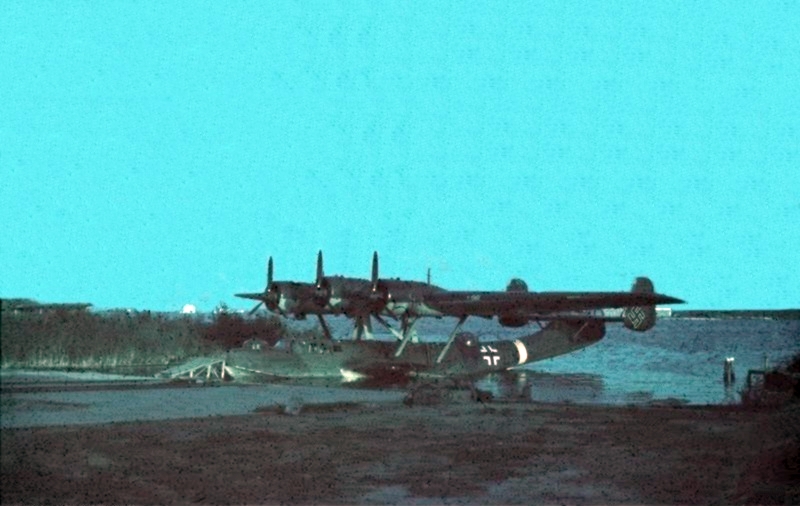
As a child, my grandfather told me of a german flying boat, the DO-24.  It was made by Dornier.  Just like the Catalina, it was developed in the 1930's.  It also had some nice lines.  It also had 3 engines, which was fairly rare.  It also had twin tail and its floats where 'water wings' adjacent to the body/hull.  I don't find it surprising that the DO-24 and the Cat had similar configuration.  Long thin body that also served as a hull and a high wing that held the engines.  The 'water wings' served as a way to get in and out of the craft while in water.  Unlike the Cat, the DO-24 did not have a landing gear for runway landings.  It was strictly a water lander.  My grandfather told me he served on one in the war as a flight engineer.  He said that the 'water wings' also served as secondary fuel tanks, and that they prefer to use up the fuel in those before making a landing.  I asked him if he ever saw combat.  He said that his plane never fired a shot, but instead would rescue downed pilots.  They even rescued British pilots and took them back to their lines.  I found that hard to believe, but I had no reason to think he was lying about it.  He also told me that before serving on the DO-24 he served on a DO-X and went on a mission to listen to radio signals just about 30 miles off the coast of New York.  I assumed that refueling was done by ship.  It certainly was a different world back then.  There was a restored DO-24 called DO-24 ATT.  It featured modern engines and added landing gear.  It flies for demonstration and education.  The DO-24 had a maximum speed of about 212 miles per hour and a max altitude of almost 20,000 ft.  It was faster and flew higher than the Cat, and took more cargo.  The german machines tended to be more powerful than the allied ones.


The PBY Catalina and the DO-24 were great aircrafts for their times.  Today we have developed impressive airstrip technology where we can send a engineering crew to make one in hours from a jungle.  We also have large aircraft carriers and helicopters.  Land everywhere cargo task is mostly done by cargo planes like the C-130.  So, all the tasks that these flying boats did are divided among several aircraft and some techniques.  Even so, we can marvel at what these planes and others like them accomplished from the 1930's to the 1950's.